
Waterproofing Under Tiles in Warsaw — Leak Protection
15.03.2026Waterproofing Under Tiles in Warsaw — Leak Protection
Tiles by themselves are not waterproofing. Water penetrates through grout joints, cracks in the grout, and wall junctions. Without proper waterproofing beneath tiles in a bathroom or shower, a leak is only a matter of time. This is especially critical in Warsaw apartment blocks, where flooding a downstairs neighbour means not just repairs but compensation. Mapei Mapelastic, Weber.tec 822, Ceresit CR 166, Sika — proven systems we use daily across Warsaw, from Praga Poludnie to Bemowo.
How much does it cost and what affects the price
The cost depends on the area, room type (shower, full bathroom, kitchen), number of layers and chosen product. Liquid membrane is the standard for bathrooms. Joints and corners are reinforced with tape — a separate item. Materials are charged separately. Current prices in the table below.
| Service | min | max |
|---|---|---|
| Waterproofing under tiles | 30 zł/m² | 60 zł/m² |
| Substrate preparation for tiles | 40 zł/m² | 80 zł/m² |
| Old tile removal | 40 zł/m² | 100 zł/m² |
| Standard tile up to 60 cm | 120 zł/m² | 160 zł/m² |
| Epoxy grouting | 40 zł/m² | 70 zł/m² |
How the work is done on site
- Substrate inspection. We check the screed for cracks and irregularities. Waterproofing is applied only to a prepared surface — flat, clean and dry.
- Priming. One or two coats of deep-penetrating primer to improve adhesion.
- Joint reinforcement. Elastic tape (Mapei Mapeband, Ceresit CL 152) is laid at wall-floor and wall-wall junctions and around pipe penetrations.
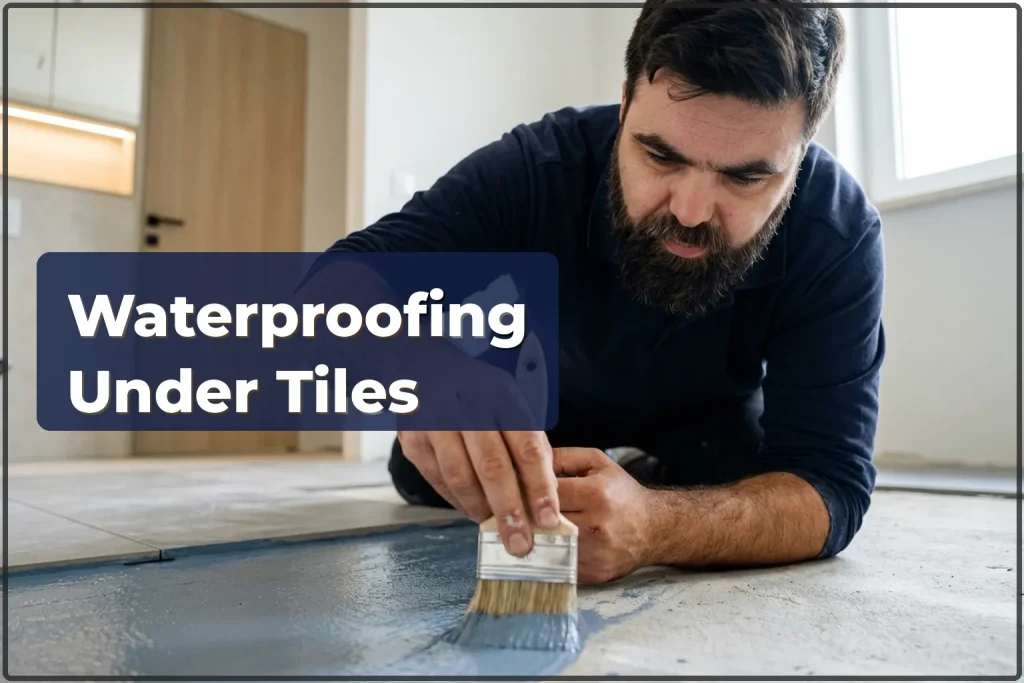
- First membrane coat. Liquid membrane (Mapei Aquadefense, Weber.tec 822, Ceresit CR 166) applied by roller or brush. Walls — at least 20 cm high; in the shower zone — to the ceiling or at least 20 cm above the shower head.
- Intermediate drying. 4-12 hours between coats depending on product and temperature.
- Second coat. Applied perpendicular to the first for even coverage. Two coats is the standard.
- Inspection. After full curing (24-48 hours) we check for gaps and damage. Only then does tiling begin.
Common waterproofing mistakes
- Single coat — insufficient thickness and missed spots. Two coats minimum.
- No tape at corners — corners and junctions are where the membrane fails first.
- Applying to a damp substrate — the membrane does not bond and peels off.
- Waterproofing the floor only — shower walls left unprotected. Water enters through wall grout joints.
- Damaging the membrane during tiling — stepping on it, scratching with tools.
- Skipping pipe penetrations — the most vulnerable points, requiring separate treatment with collars.
- Cheap uncertified products — false economy that leads to a leak within a year.
What to prepare before the technician arrives
- Screed cured and dry (minimum 28 days for cement). Cracks repaired.
- Surface clean: no dust, debris or adhesive residue.
- Pipes installed — waterproofing comes after plumbing, before tiling.
- Waterproofing purchased: Mapei Aquadefense, Weber.tec 822 or Ceresit CR 166.
- Elastic tape for corners.
- Deep-penetrating primer.
- Pipe collars if needed.
- Room temperature at least +10 C.
- Ventilation for drying.
- Room clear of furniture and fixtures blocking wall access.
A real case from Warsaw
A new-build on Praga Poludnie, bathroom 7 m². The client was renovating from scratch: screed, pipe runs, and waterproofing needed before tiling. The screed had micro-cracks — we patched them with repair compound and let it dry. Primed floors and walls. Corners and pipe passes reinforced with Mapei Mapeband. First coat of Mapei Aquadefense — roller on the floor, brush on the walls (shower zone to ceiling, other walls 30 cm up). Dried for eight hours. Second coat perpendicular. After 24 hours — inspection: membrane continuous, even, blue (Aquadefense changes colour when cured). The tiler came the next day. Six months on — not a single leak, neighbours satisfied.
Frequently asked questions
Is waterproofing mandatory in a bathroom?
Yes. Tiles and grout are not waterproofing. Water penetrates through joints. Without a membrane a leak to the flat below is just a matter of time.
Is one coat enough?
No. A single coat may have gaps and insufficient thickness. Two coats is the minimum.
Which product is best?
Mapei Aquadefense, Weber.tec 822, Ceresit CR 166, Sika — all are proven. The choice depends on the substrate.
Is waterproofing needed on walls?
In the shower zone — mandatory, at least to shower head height. Behind the bath — minimum 30 cm from the floor.
How long does waterproofing take to dry?
Between coats — 4-12 hours. Full cure before tiling — 24-48 hours.
Can it be applied to plasterboard?
Yes, to moisture-resistant board (green type). Standard plasterboard is not suitable for wet areas.
What happens without waterproofing?
Water seeps through joints, damages the screed and reaches the flat below. The repair costs far more than waterproofing.
Is corner tape necessary?
Yes. Corners are the weakest point. Without reinforcement the membrane tears at junctions first.
Are materials included in the price?
No. Waterproofing, tape and primer are purchased by the client.
How long does bathroom waterproofing take?
1-2 days: priming, reinforcement, two coats with intermediate drying. Plus a day for full cure before tiling.
Who does the work
Waterproofing beneath tiles is carried out by technicians who understand membrane systems and manufacturer requirements. It is not just painting a wall — the layer sequence, drying times and correct reinforcement all matter. We work with Mapei, Weber, Ceresit and Sika. We cover all of Warsaw. Call or message to discuss your project.