

Composite Countertop Installation in Warsaw — Quartz, Acrylic, Silestone, Corian
22.02.2026A composite countertop is neither chipboard nor natural stone. It is an engineered material: quartz agglomerate (Silestone, Caesarstone) or acrylic stone (Corian, Staron). These slabs are seriously heavy — quartz weighs around 50 kg per square metre, acrylic is lighter but still substantial. Attempting installation without experience almost guarantees damaging an expensive material. We work across all of Warsaw, from Mokotow to Ursynow, arriving with tools and a helper for carrying.
How much does it cost and what affects the price
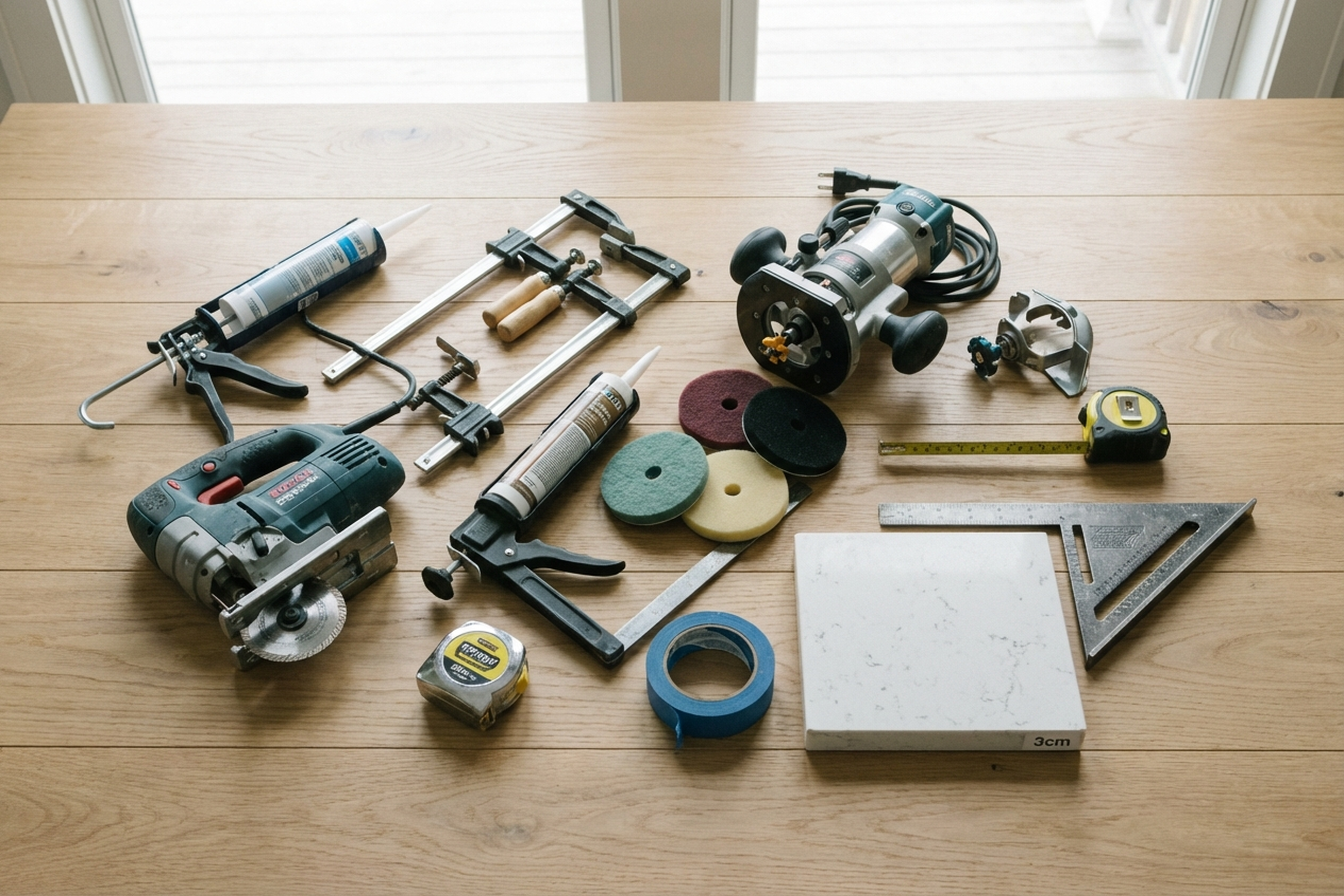
Installation cost depends on the countertop length, number of cutouts (sink, hob), whether a wall upstand is needed, and the complexity of fitting to walls. Exact prices for all kitchen services are in the table below. Fixings are included in the labour cost. The countertop itself, colour-matched adhesive sealant, and material delivery are charged separately. Carrying heavy slabs upstairs is also a separate item — a 3-metre quartz countertop weighs about 150 kg.
| Service | min | max |
|---|---|---|
| Kitchen furniture installation (complete set) | 20% od ceny | 25% od ceny |
| Kitchen base cabinet installation | 250 zł | 400 zł |
| Wall cabinet installation | 250 zł | 400 zł |
| Kitchen cabinet door adjustment | 80 zł | 150 zł |
| Hinge replacement | 60 zł/szt | 120 zł/szt |
| Kitchen countertop installation | 200 zł/mb | 350 zł/mb |
| Laminate countertop installation | 150 zł/mb | 250 zł/mb |
| Composite countertop installation | 250 zł/mb | 400 zł/mb |
| Countertop joining | 190 zł/szt | 300 zł/szt |
| Countertop cutout (sink / hob) | 120 zł/szt | 200 zł/szt |
How the on-site installation works
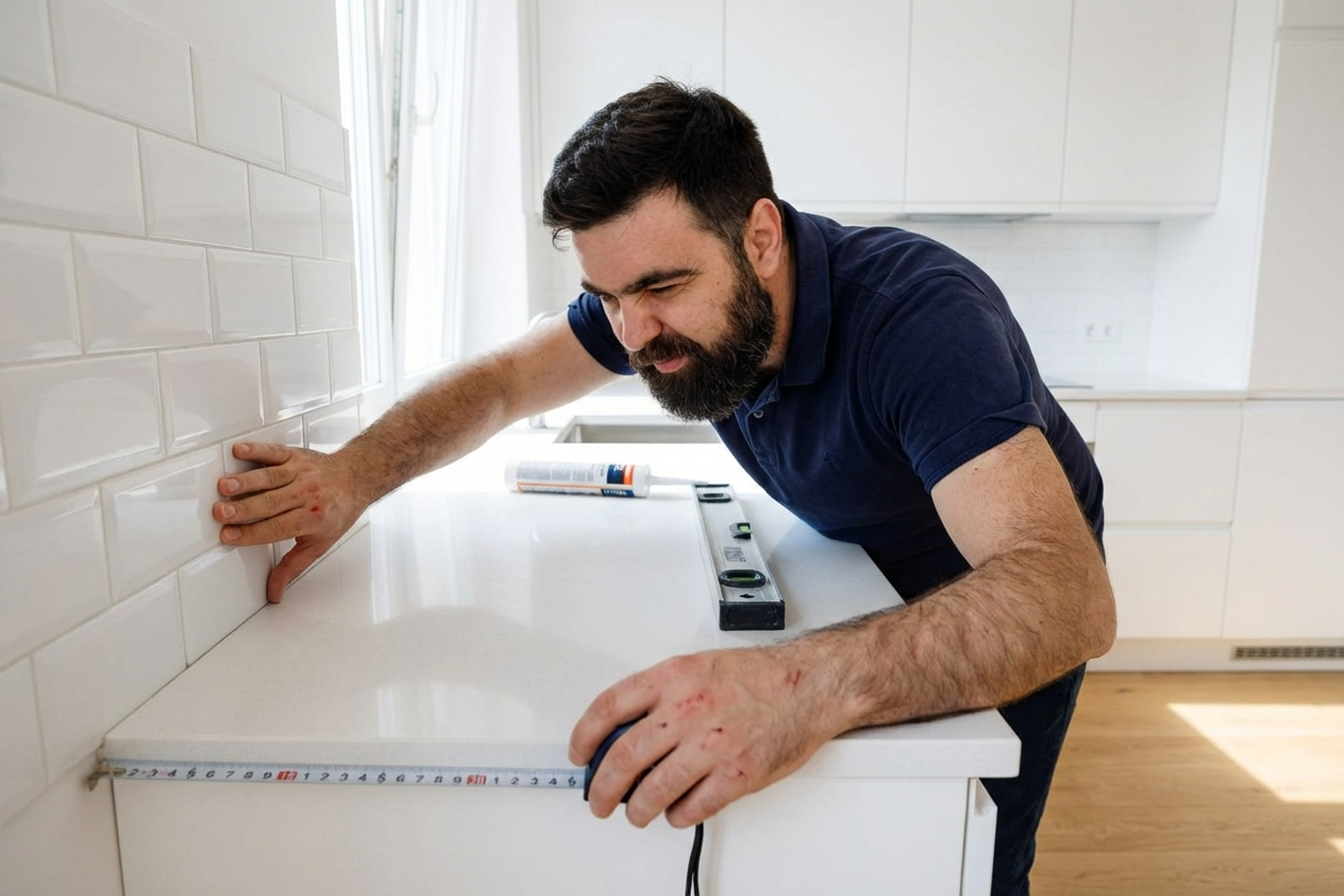
- You send photos of the kitchen and measurements — the technician assesses the scope and gives an approximate price.
- We agree on a date. We usually arrive as a pair — two people are needed to carry the slab.
- We check the cabinet level. If the frames are uneven, we level them first — otherwise the countertop will crack under load.
- We carry the slab in and place it on the cabinets. Sink and hob cutouts are usually made at the factory, but if on-site adjustment is needed, we use diamond tools.
- The countertop is secured with silicone adhesive sealant and mechanical fixings from below.
- Joints between sections (if the countertop is in multiple pieces) are bonded with a colour-matched two-component adhesive. With acrylic, the seam can be made virtually invisible; with quartz, a minimal joint line remains.
- We install the wall upstand and seal the junction with the wall.
- We check the level, stability, and cleanliness of all joints. We clean up after ourselves.
Common mistakes when installing composite countertops
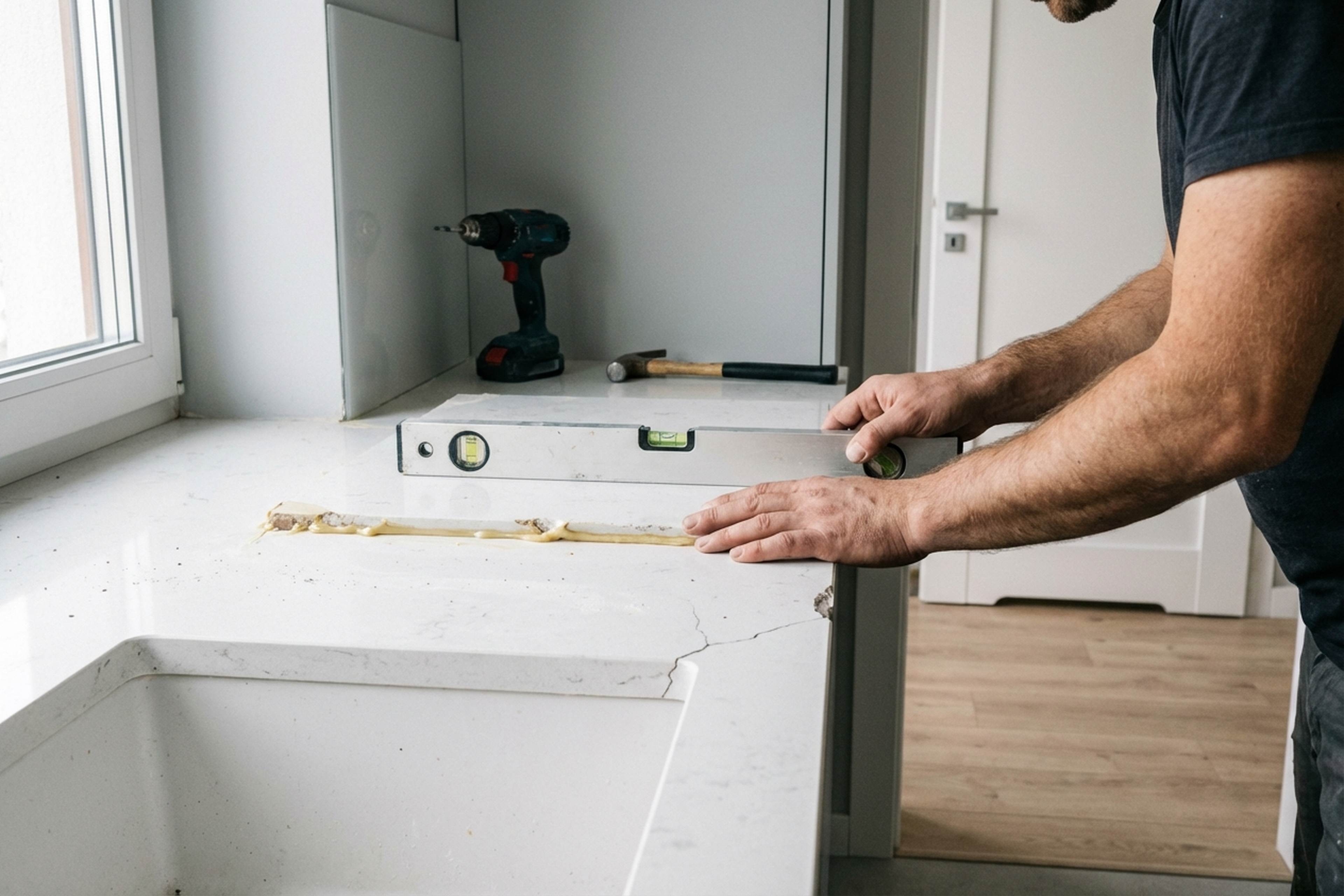
- Cabinets are uneven but the countertop is laid “as is” — six months later a crack appears near the sink because the slab is under bending stress.
- Skipping supports — leaving a span of 60+ cm between cabinets with no support. Quartz is heavy and needs support at least every 50 cm.
- Using ordinary silicone instead of specialist stone adhesive — the bond yellows and peels away.
- Over-tightening mechanical fixings — acrylic can crack at the fixing point.
- No expansion gap at the walls — temperature changes cause the countertop to expand and push against them, leading to chips.
- Cutting the sink opening with an angle grinder without a guide — uneven edges and micro-cracks.
- Forgetting to treat the cutout edge with a hydrophobic sealant (for quartz) — moisture penetrates the structure.
What to prepare before the technician arrives
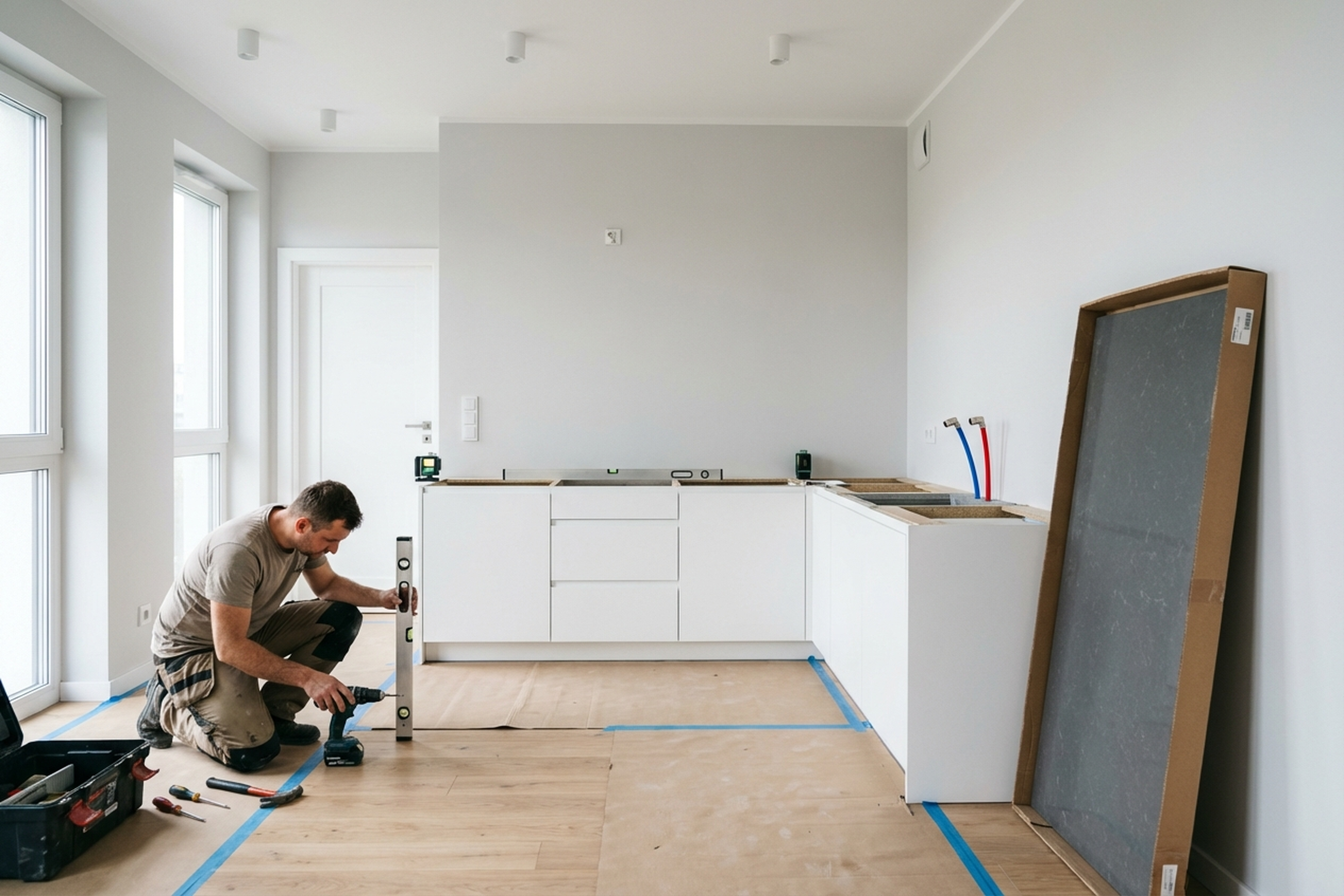
- Kitchen cabinets must be assembled and in position. The countertop goes on a finished frame.
- Make sure the countertop has been delivered and is in the apartment or near the entrance. If it needs carrying upstairs, let us know in advance.
- Check completeness: countertop, wall upstand, end strips, colour-matched adhesive (if supplied by the manufacturer).
- Clear the kitchen of boxes and unnecessary items — space is needed to manoeuvre a long slab.
- If you have a kitchen drawing from the manufacturer, send it to the technician beforehand.
- Make sure water and drainage connections for the sink are ready.
- Check that electrics for the hob are already in place (if a cutout is needed).
- Provide building access: intercom code, lift, unloading area.
- If the apartment has a fresh renovation, let us know so we can protect floors and furniture.
A real case from Warsaw
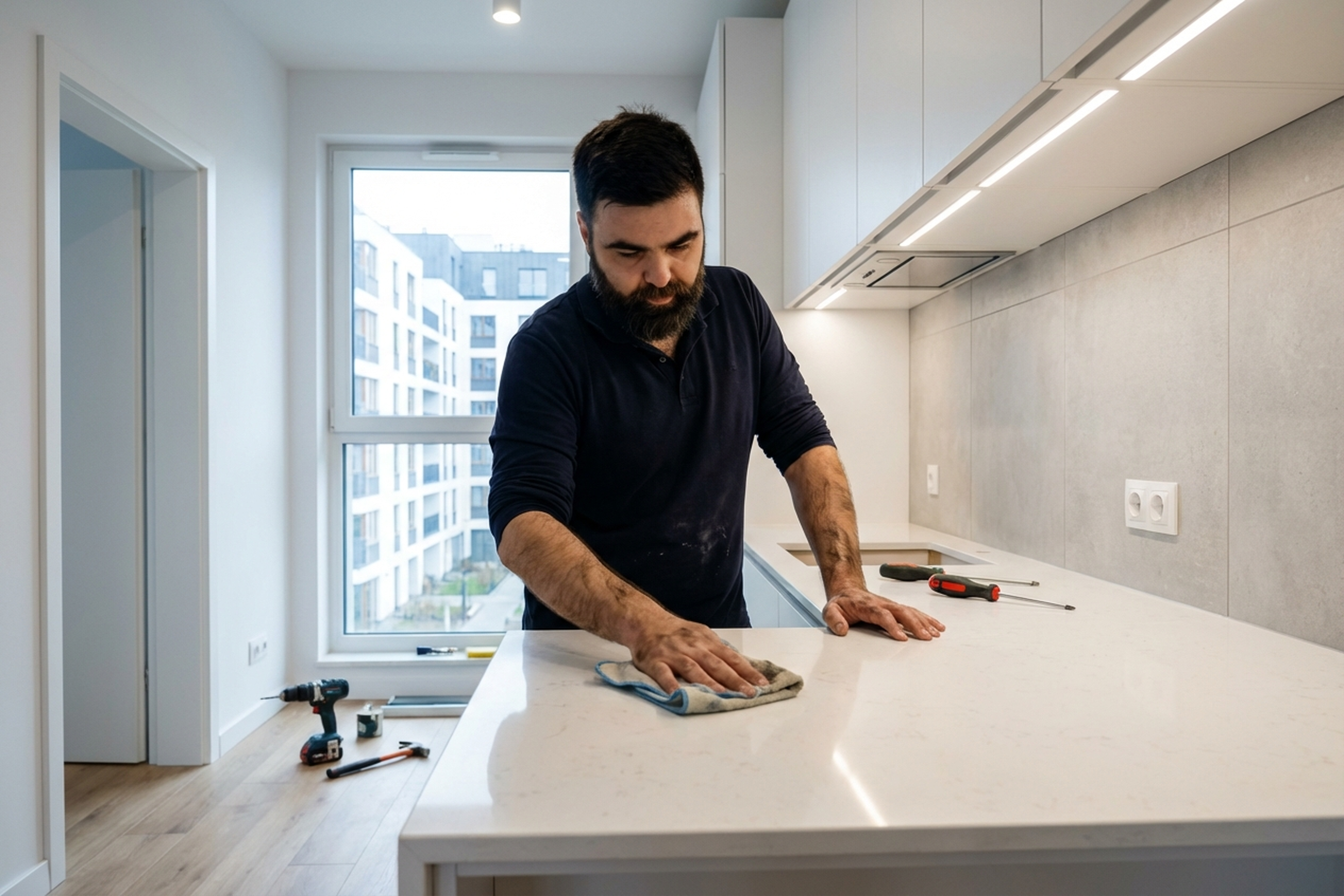
A client in the Wilanow district ordered a kitchen with a 3.2-metre Silestone quartz countertop. The slab arrived in two pieces, with the joint falling in the sink area. During measurement we found that one base cabinet was 5 mm out of level — a standard situation after self-assembled frames. We levelled the cabinet with adjustable feet and checked across the full length. We carried the slabs in together, placed them on the frame, and bonded the joint with two-component adhesive in “Calacatta Gold” colour. After curing, the seam was barely detectable by touch. We fitted the under-sink cutout with edge treatment and installed the wall upstand. The whole job took about 3 hours. The client noted that without a helper it would have been physically impossible to get the countertop up to the second floor. Takeaway: always check cabinet level before laying — correcting a tilt after the countertop is mounted is no longer possible.
Frequently asked questions
Can a composite countertop be installed on old cabinets?
Yes, if the frame can handle the weight. Quartz weighs about 50 kg/m2 — for a standard 3 m kitchen that is 150 kg. Cabinets made of 16 mm chipboard may not cope; an inspection is needed.
What is the difference between quartz and acrylic countertops?
Quartz is harder, more resistant to scratches and heat, but heavier and the seam is always visible. Acrylic is lighter, seams can be made invisible, but it is softer and sensitive to hot pans.
Do you make the sink cutout or does the factory?
It is better to order the cutout from the factory — more precise and dust-free. But if on-site adjustment is needed, we use diamond tools with a vacuum.
How long does installation take?
A straight countertop without complex cutouts takes 2–3 hours. An L-shaped kitchen with a joint and two cutouts takes 3–5 hours.
What is included in the price and what is not?
Labour, fixings, and travel within Warsaw. The countertop, adhesive, delivery, and carrying the material are separate.
Do you offer a warranty on installation?
Yes, on the workmanship. The countertop itself carries the manufacturer’s warranty.
Can the countertop be installed without a wall upstand?
Yes, but then the junction with the wall must be thoroughly sealed. Without an upstand, water will seep behind the countertop.
Who does the work

Composite countertop installation is carried out by technicians experienced with quartz agglomerate and acrylic stone. We arrive as a team of two for safe handling of heavy slabs. We cover all of Warsaw and surrounding areas. To book, call or message us — we reply within an hour and will advise what to prepare for the visit.