
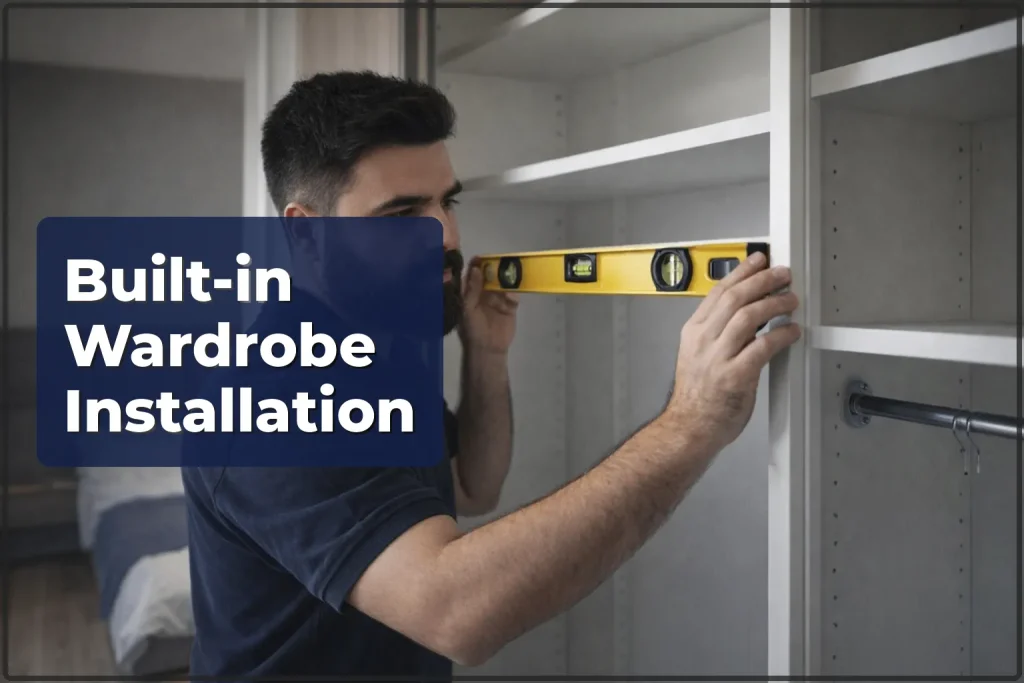
Built-in Wardrobe Installation in Warsaw — Precise Measurements, Solid Mounting, Perfect Finish
21.02.2026A built-in wardrobe is not just furniture — it is a structure that becomes part of the wall. The alcove it fits into is almost never perfectly straight: corners are not 90 degrees, walls have deviations, ceilings slope. If you ignore these details, you end up with gaps along the sides, crooked doors, and shelves that will not close properly. We install built-in wardrobes across all of Warsaw: from IKEA PAX to custom-made units, with sliding and hinged doors. We bring our own tools, take precise measurements, and fit everything to the actual room geometry. If you want a wardrobe that looks like it belongs in the apartment rather than a box shoved into a corner, give us a call.
How much does built-in wardrobe installation cost and what affects the price

The price depends on the size of the structure, the door system type, and the complexity of the interior layout. A simple frame with shelves and a rail is one thing. A full-wall unit with sliding doors, pull-out drawers, lighting, and baskets is something else entirely. Cost factors include: whether panels need trimming to match uneven walls, the wall type for mounting (concrete, brick, plasterboard), and the number of sections and mechanisms. Mounting hardware is included in the price. Additional materials (panels, filler strips, seals) are charged separately. See current prices in the table below.
| Service | min | max |
|---|---|---|
| Built-in wardrobe installation | 400 zł | 800 zł |
| Freestanding wardrobe assembly | 250 zł | 450 zł |
| Hinge adjustment | 60 zł/pc | 120 zł/pc |
| Hinge replacement | 60 zł/pc | 120 zł/pc |
| Furniture fitting to alcove | 250 zł | 600 zł |
| Shelf installation | 80 zł | 150 zł |
How the installation process works

- You send photos of the alcove or room, dimensions, and the wardrobe model — the technician estimates the scope and gives you an approximate timeframe.
- The technician visits for measurements. He checks the alcove geometry: wall plumb, floor and ceiling level, corner angles. All deviations are recorded — they are almost always present.
- If adjustments are needed, we plan which panels to trim, and where to use compensating strips or seals.
- We assemble the frame: side uprights, top and bottom panels. The frame is anchored to the wall — this is mandatory for a built-in wardrobe, otherwise the structure is unstable.
- We install the interior fittings: shelves, rails, pull-out drawers, baskets. Each element is levelled individually.
- We mount the door system. For sliding doors — upper and lower tracks are installed, doors are hung, and the slide is adjusted. For hinged doors — they go onto hinges with three-plane adjustment.
- Final check: doors glide smoothly, drawers close without jamming, shelves hold the load. We clean up debris and packaging.
Common mistakes when installing a built-in wardrobe

- Not measuring the alcove geometry — only taking width and height. Walls can diverge by 2-3 cm from floor to ceiling. Result: gaps at the top, wardrobe too tight at the bottom.
- Not anchoring the frame to the wall — a built-in wardrobe without wall and ceiling fixings wobbles and deforms over time.
- Placing IKEA PAX into an alcove without adjustment — standard modules are not designed for uneven walls; filler strips and compensators are needed.
- Installing sliding doors on an uneven floor — the bottom track must be perfectly horizontal, otherwise doors drift to one side.
- Using weak fixings in plasterboard — standard plugs cannot hold the weight of loaded shelves; you need butterfly plugs, molly bolts, or fixings into the metal stud.
- No ventilation gap — clothes in a sealed wardrobe start smelling of damp.
- Overloading shelves — a 16 mm chipboard shelf longer than 80 cm without a centre support sags under the weight of clothing.
- Installing lighting after assembly — routing LED strip wiring through a finished structure is far harder than laying it during frame assembly.
What to prepare before the technician arrives

- Clear the alcove completely — remove everything inside and nearby. The technician needs unrestricted access to all walls.
- Make sure all wardrobe parts are inside the apartment (carrying them upstairs is a separate service).
- Check completeness against the receipt or manual. If you ordered a custom wardrobe, verify that all panels are cut correctly.
- Decide on the interior layout: where shelves go, where the rail goes, where drawers go. The technician can advise, but having a basic plan speeds things up.
- Find out the wall types around the alcove (concrete, brick, plasterboard on studs) — this determines the fixings.
- Ensure access to a power socket — tools need charging. If you are planning interior lighting, think ahead about where the power will come from.
- Remove rugs and fragile items from the work area — panels are heavy, and drilling dust travels far.
- Provide the intercom code and parking information.
- For wardrobes wider than 2.5 metres, let us know in advance so the technician can bring a helper.
A real case from Warsaw

A client in the Ursynow district ordered installation of an IKEA PAX built-in wardrobe in a bedroom alcove. The alcove was 260 cm wide and 250 cm tall. The first issue appeared during measurement: the left wall was 18 mm off plumb — the alcove was wider at the top than at the bottom. The right wall leaned the other way, with a 12 mm deviation. The ceiling sloped 8 mm across the full width. The standard 236 cm PAX frames had to be extended with a filler panel on top, and the side gaps were closed with compensating strips. We used metal angle brackets for wall mounting — the wall turned out to be calcium silicate brick, where standard plastic plugs are unreliable. The sliding doors were installed on levelled tracks — the bottom track shimmed with wedges, the top one set with a spirit level. Final adjustment took about an hour: three doors needed to run parallel, without overlap and with even gaps. Inside — a double-height rail, shelves, and four pull-out drawers. The entire job took around 7 hours. The client later admitted he had tried doing it himself but stopped at the third frame — he realised that without experience fitting to uneven walls, the result would be poor.
Frequently asked questions
What built-in wardrobes do you install?
IKEA PAX, custom-made units from furniture manufacturers, wardrobes from Allegro and other stores. We work with both sliding and hinged door systems.
How is a built-in wardrobe different from a freestanding one?
A built-in wardrobe is mounted inside an alcove or wall-to-wall. It is anchored to the walls, floor, and ceiling. A freestanding wardrobe is a separate unit that can be moved.
What is included in the price?
The technician’s labour, tools, and wall-mounting hardware. Additional filler strips, compensators, carrying boxes upstairs, and waste removal are charged separately.
How long does installation take?
A small built-in wardrobe (up to 180 cm) — 3 to 4 hours. A full-wall unit with sliding doors — 5 to 8 hours. Complex builds with lighting and multiple drawers may require two visits.
Can IKEA PAX be fitted into an alcove with uneven walls?
Yes, this is one of our most common jobs. PAX is a modular system, but standard dimensions do not account for wall irregularities. We adjust the build using fillers and compensators.
Do the walls need to be levelled before installation?
In most cases, no. Minor unevenness is compensated during installation. If deviations exceed 3-4 cm, partial plastering may be needed.
Who does the work and how we operate

Installation is carried out by technicians experienced in built-in furniture. No trainees — professionals who know how to compensate for wall curvature, set tracks correctly, and achieve even gaps on sliding doors. We cover all of Warsaw and surrounding areas: Mokotow, Ursynow, Wilanow, Wola, Praga, Bemowo — we arrive at the time that suits you. To book an installation, call or message us and we will reply within an hour.