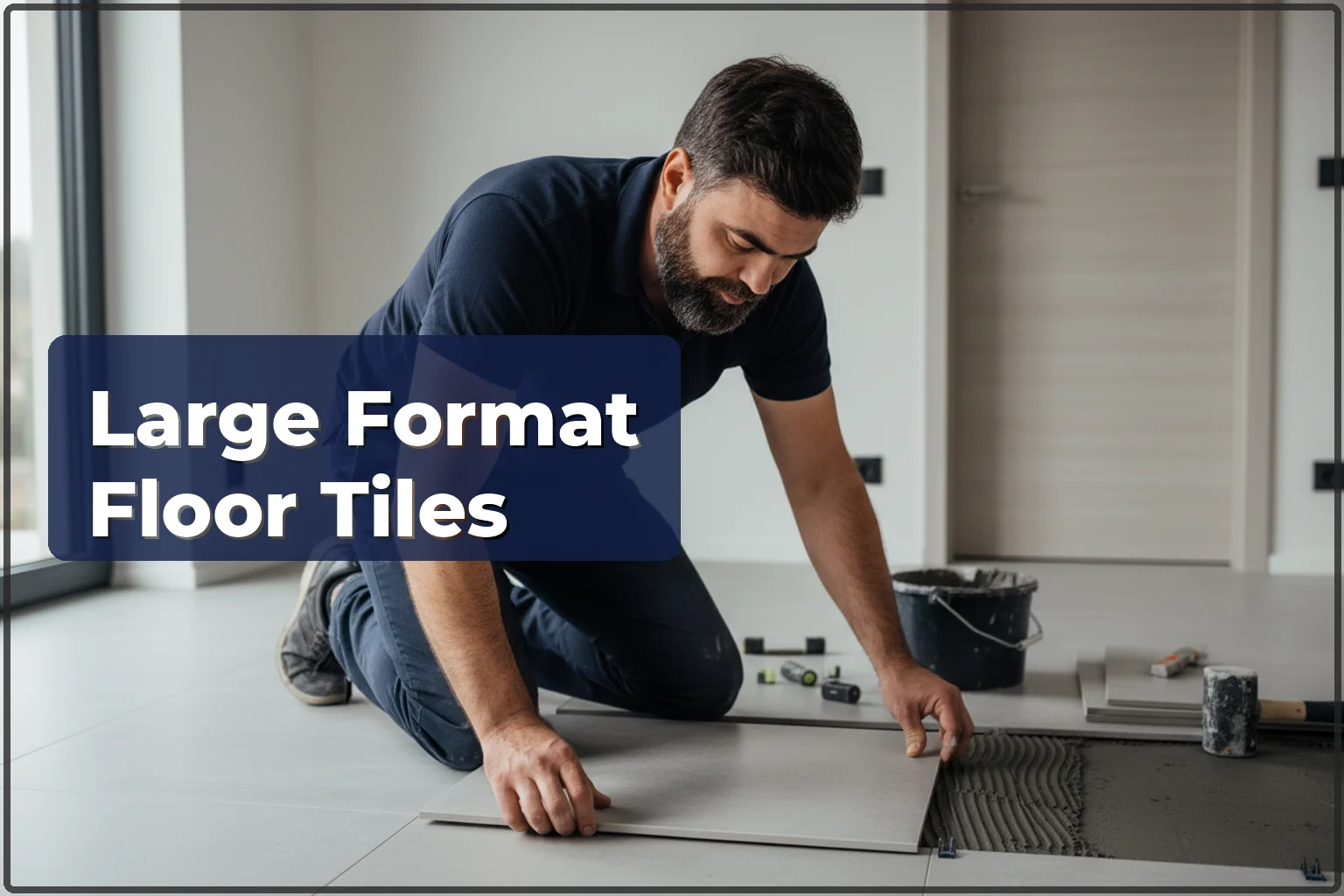

How much does large format floor tile installation cost in Warsaw?
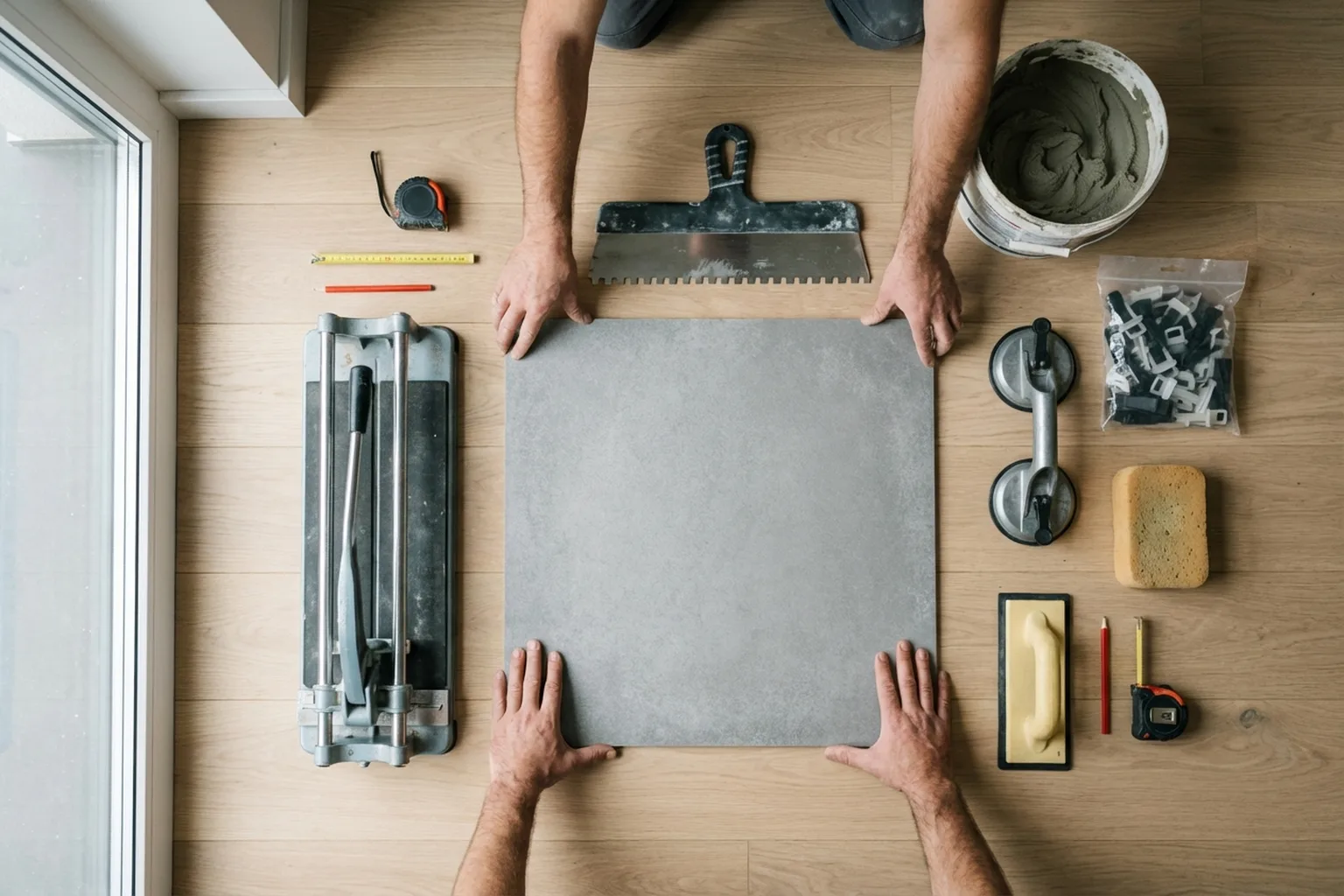
The cost of large format floor tile fitting depends on the tile dimensions, the tile material, and the state of the base. Porcelain stoneware 60×120 is the starting point for large format: easier to handle. Slabs in 80×160 or 120×120 are more demanding: they weigh more, need two people to move, and chip more easily when being cut. If the screed is uneven, it has to be levelled, and that is a separate line item. Removal of old flooring, base preparation, waterproofing (for bathrooms and kitchens): all charged separately. Materials are billed separately; labour includes consumables. Current prices are in the table.
| Service | Price |
|---|---|
| Large format: floor | 280–420 zł/m² |
| Laying large-format tiles | 180–400 zł/m² |
| Large format: wall | 250–650 zł/m² |
| Substrate preparation for tiles | 40–80 zł/m² |
| Removing old tiles | 50–80 zł/m² |
| Epoxy grouting large format | 60–90 zł/m² |
| Waterproofing substrate before tiling | 35–80 zł/m² |
Indicative prices. Ranges for a typical scope. Fixings included, materials separate. Minimum order 300 zł.
Price ranges and offers from tradespeople: large format tiling in Warsaw.
How large format floor tile installation is done

- Measuring and checking the substrate. Tradespeople put a two-metre straightedge on the screed, anything above 2 mm per 2 metres is not acceptable for large format. If the screed is not ready, they recommend levelling it with self-levelling compound.
- Removing the old flooring if required. Old tiles are broken off with a rotary hammer, and adhesive residue is cleaned away. The floor has to be clean and even.
- Two coats of primer on the substrate. Primer closes the pores in the screed and gives the adhesive proper grip. In wet zones: waterproofing membrane goes over the primer.
- Dry layout. Tradespeople decide the laying direction, pattern, and where the cuts will land. Cuts are moved under furniture or towards less exposed walls. For 60×120 format the standard layout is a one-third staggered offset.
- Adhesive is spread with a 10-12 mm notched trowel on both the floor and the back of the tile (back-buttering). Tradespeople use flexible C2 S1 adhesive: Mapei Keraflex Maxi, Ceresit CM 17, or Litokol K80.
- Laying with a tile levelling system (LLS). Clips and wedges keep the tiles from moving while the adhesive sets. With large format, a levelling system is not optional.
- After 24 hours: grouting. For floors they advise epoxy grout (Mapei Kerapoxy, Litokol Starlike): it does not take in dirt, does not crack, and is easy to clean. Perimeter expansion joints are finished with colour-matched silicone.
Common mistakes when laying large format floor tiles
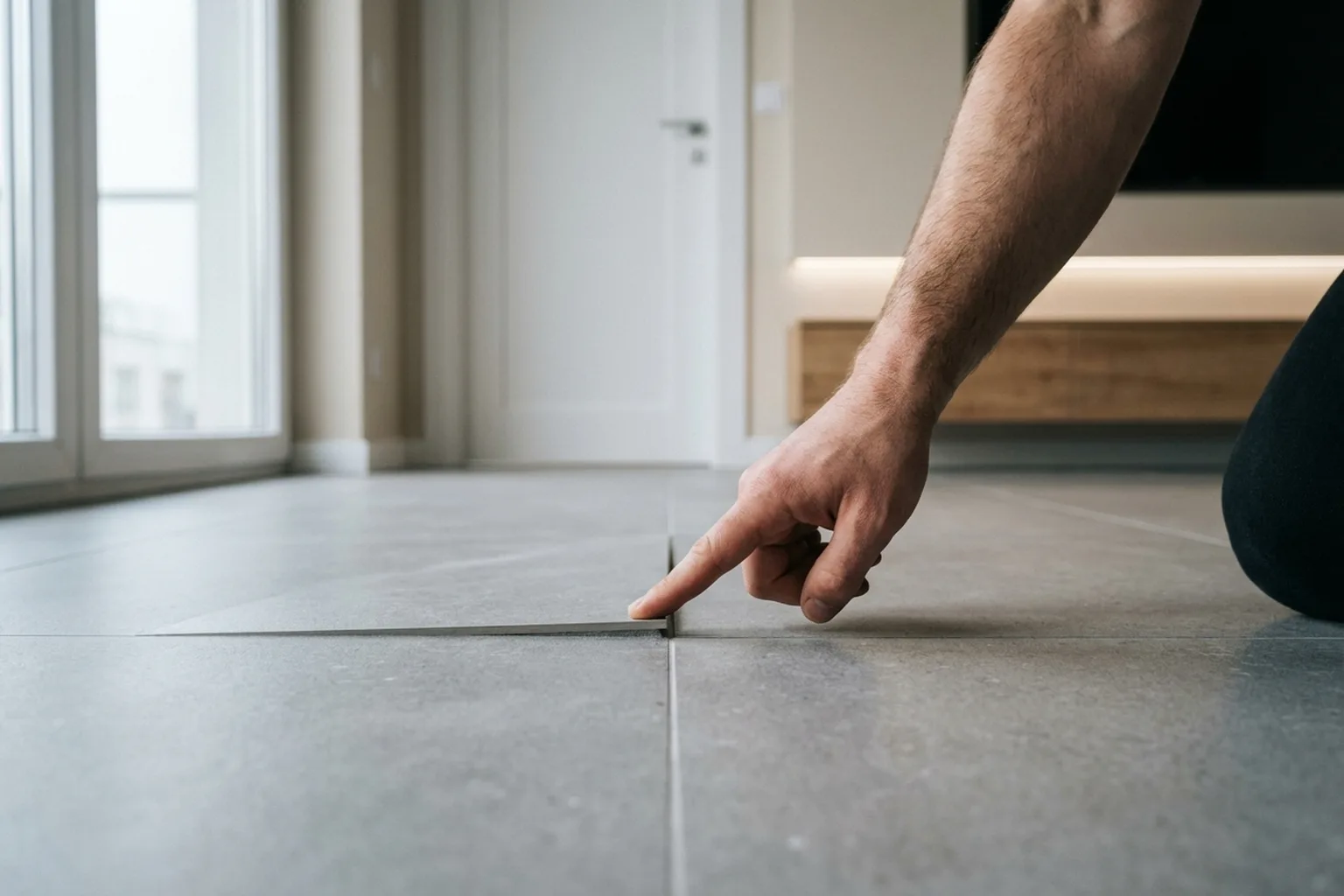
- Laying on an uneven screed — large format does not forgive mistakes in the base. Tiles wobble, corners stand proud, and the levelling system cannot handle gaps over 3 mm.
- Using standard C1 adhesive: within six months the tiles begin to lose bond and sound hollow. Tiles from 60 cm need at least C2 S1.
- Putting adhesive only on the floor: empty spots stay under the tile. Under load (furniture, foot traffic) the tile cracks. Back-buttering is the standard with large format.
- Cutting with an angle grinder without a guide: chips, crooked cuts, wasted tiles. Large format should be cut only on an electric wet tile cutter.
- No perimeter expansion joints: underfloor heating makes the tiles expand, they press into the wall and crack.
- Laying at 50% offset: the middle of one tile sits over the edge of another. On a slightly uneven screed the edges rise, making a ridge. The right offset is 20-33%.
- Walking on tiles before the adhesive has set: the tiles move, and adhesive gets pushed into the joints. Keep off for at least 24 hours.
What to prepare before the technician arrives
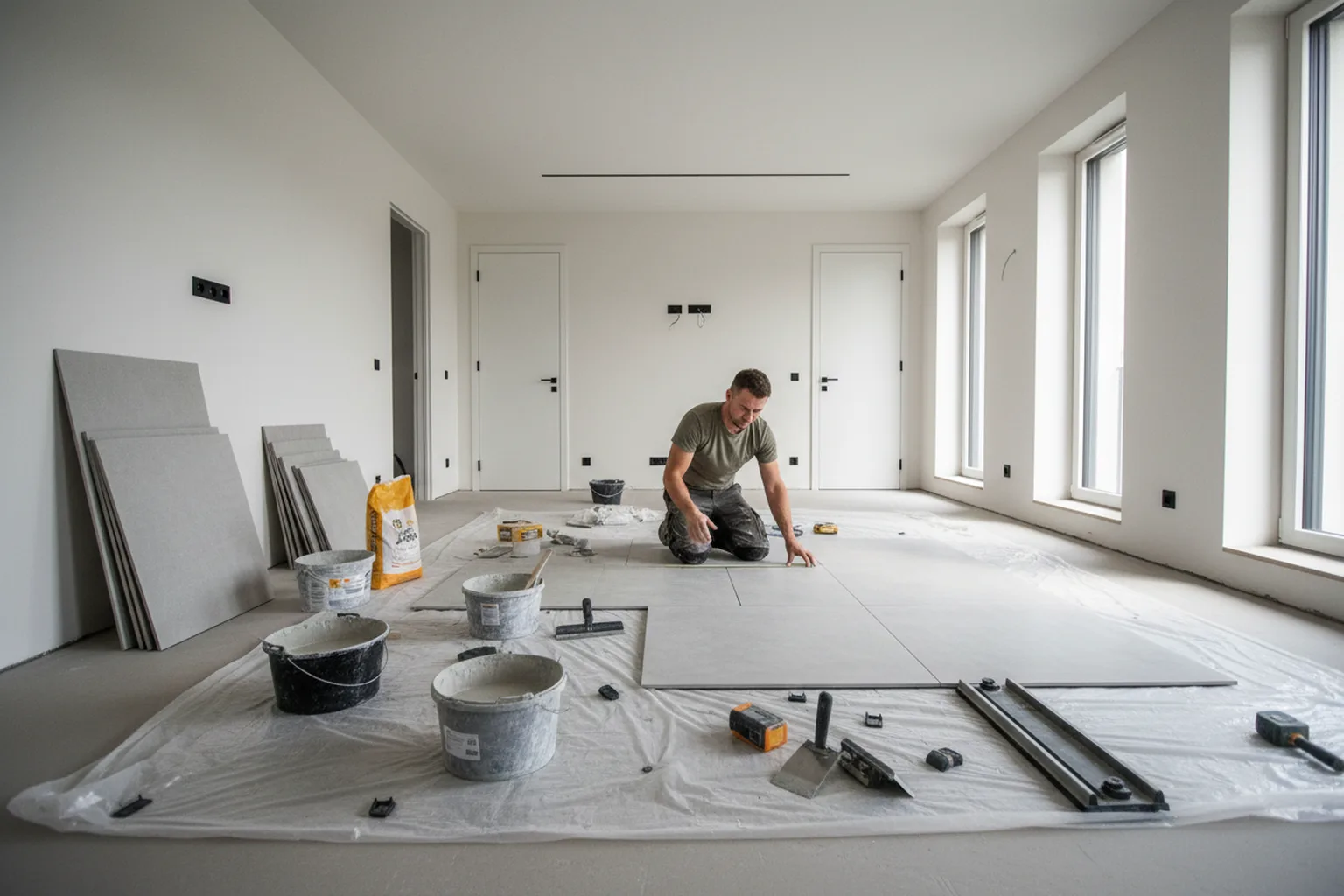
- The screed must be finished and fully cured: cement-based, at least 28 days, anhydrite, according to the manufacturer’s guidelines.
- If there is underfloor heating — it must be tested and turned off 48 hours before tiling. Do not switch it back on for at least 14 days.
- Remove all furniture from the room: the technician needs full access to the whole floor.
- Buy tiles with a 10-15% extra allowance. Large format creates more waste during cutting.
- Check that all tiles are from the same batch and calibre. Even a 0.5 mm difference between batches will show.
- Large format adhesive (C2 S1): Mapei Keraflex Maxi, Ceresit CM 17, Litokol K80. Consumption: around 5-7 kg/m² with back-buttering.
- Epoxy grout: agree the colour beforehand.
- Colour-matched silicone sealant: for perimeter expansion joints.
- Make sure power and water are available: you need a tile cutter and wet cutting.
- Let the neighbours know: there will be noise.
- Send access details: intercom, floor, goods lift for bringing tiles up.
A real case from Warsaw: large format floor tile installation
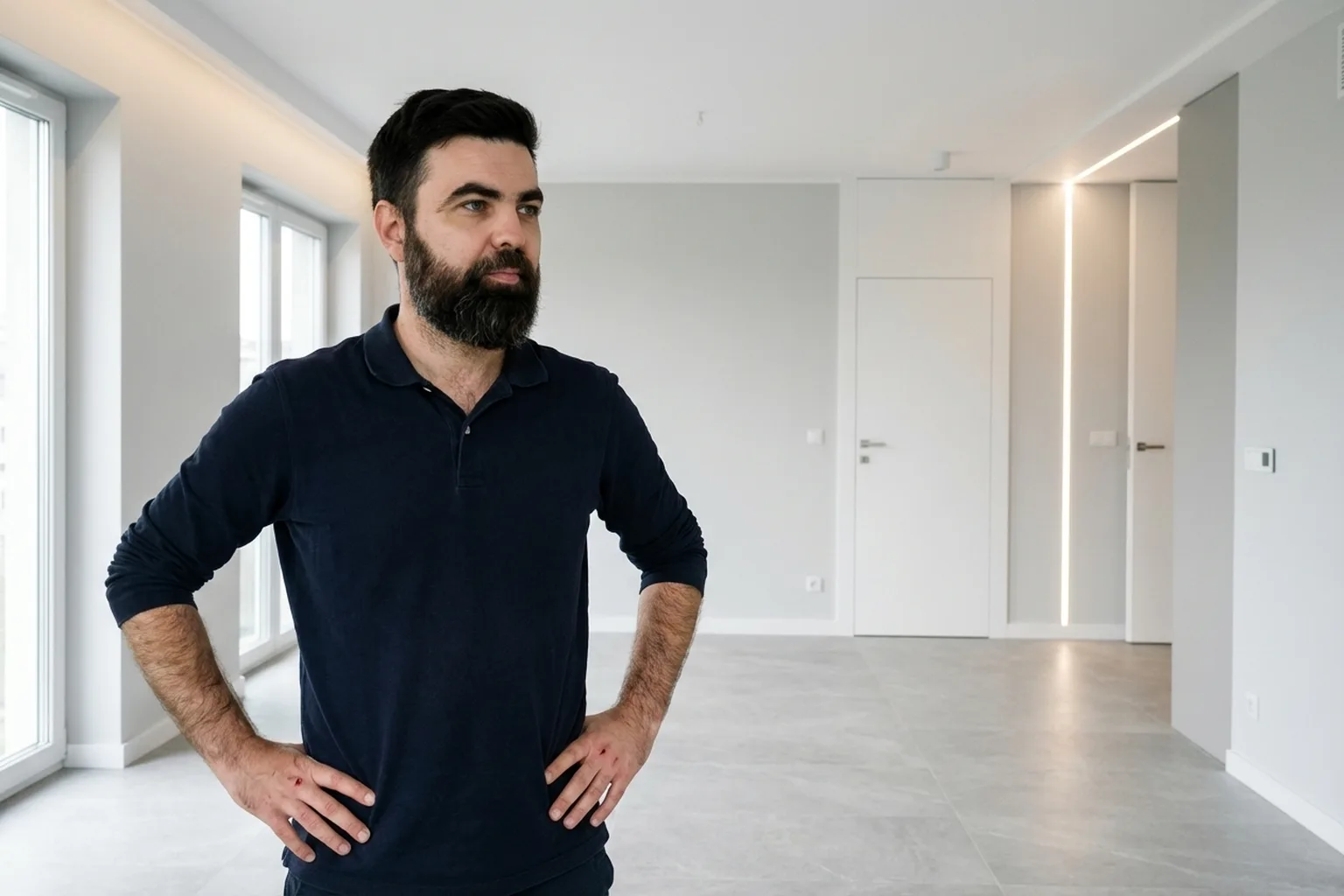
A flat in Mokotow, 65 m²: the client wanted one porcelain floor in Tubądzin 80×80 marble-effect across the whole flat: hallway, open-plan kitchen-living room, and corridor. The old laminate came out in a day. The screed turned out to be off by 5 mm over two metres: too much for large format. Tradespeople poured Ceresit CN 68 self-levelling compound and left it to cure for two days. Priming, dry layout — they planned the cuts so they finished under the kitchen units and the built-in wardrobe in the hallway. Adhesive: Mapei Keraflex Maxi, back-buttered with a 12 mm trowel. Levelling system: Litolevel clips on every joint. The installation took four days with two technicians. Grout: Litokol Starlike in manhattan. A week later the client moved the furniture back in. The floor reads like one marble slab: the grout joints are barely visible.
Frequently asked questions
What is the minimum size considered large format?
In practice, large format starts at 60 cm on one side. So 60×60, 60×120 and anything bigger all need a specialist installation approach.
Can large format tiles be laid over underfloor heating?
Yes, but the adhesive has to be flexible (C2 S1 or S2) and perimeter expansion joints are required. Turn the heating off 48 hours before and do not switch it back on for 14 days.
How flat does the screed need to be?
For large format the limit is no more than 2 mm over 2 metres. Anything beyond that needs levelling with self-levelling compound.
Why not lay at 50% offset?
At 50% offset the middle of one tile sits on the edge of another. On a slightly uneven screed the edges lift and form a ridge. The correct offset is 20-33%.
Is a levelling system mandatory?
For large format: yes. Without it, even a tiny lip between tile edges makes a step that shows in side light and can be felt underfoot.
What grout is best for floors?
Epoxy. It does not absorb water or dirt, does not crack, and does not change colour. Cement grout on floors gets dirty quickly and starts breaking down in high-traffic areas.
Can large format tiles be laid on top of old tiles?
Technically yes, if the old tiles are firmly fixed and the surface is flat. But the floor level will go up by 15-20 mm: check that doors and thresholds still have clearance.
How long does installation take?
A 20 m² room with no cuts: one day. A 60 m² flat with cuts and transitions: 3-5 days. Plus one day for grouting.
Are materials included in the labour price?
No. Tiles, adhesive, grout, primer, waterproofing — all purchased by the client. Labour includes consumables: levelling clips, cutting discs, spacers.
Is waterproofing needed under floor tiles?
In bathrooms and kitchens: mandatory. In living rooms: unnecessary unless you have a water-based underfloor heating system.
Who does the work
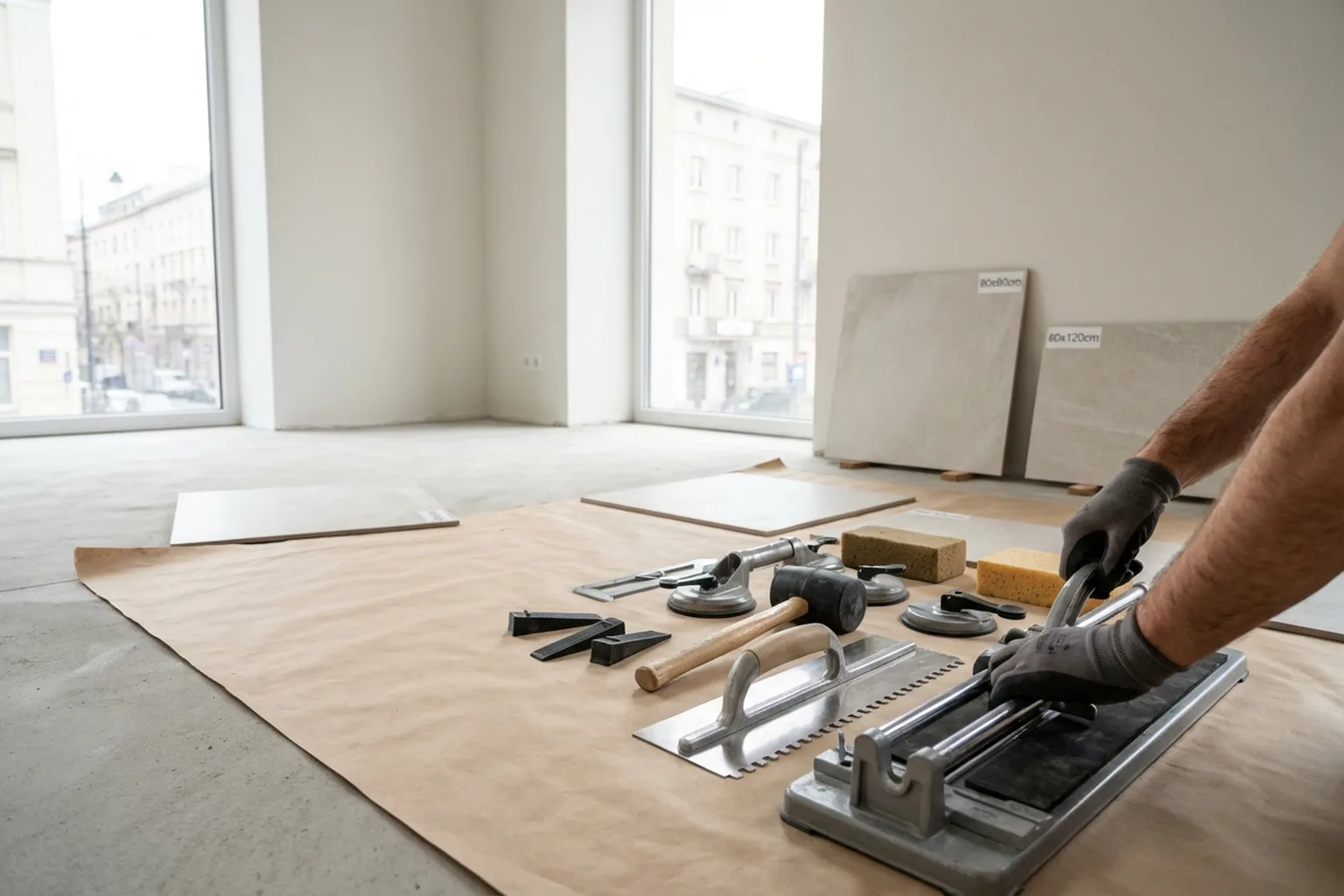
Large format floor tiles are fitted by technicians who work specifically with big formats: this is a separate trade skill. Tradespeople come with an electric wet tile cutter (cut length up to 120 cm), a full levelling system kit, 10-12 mm trowels, and a laser level. On big formats they work in pairs: one person cannot carry and place an 80×160 cm tile without it moving out of line. Tradespeople check every joint and confirm flatness with a straightedge.
Order in the app
Describe the job, add photos and the address. Tradespeople send their own prices and dates, and you pick one of the offers.
Open the app

