
How much does large format wall tile installation cost in Warsaw?
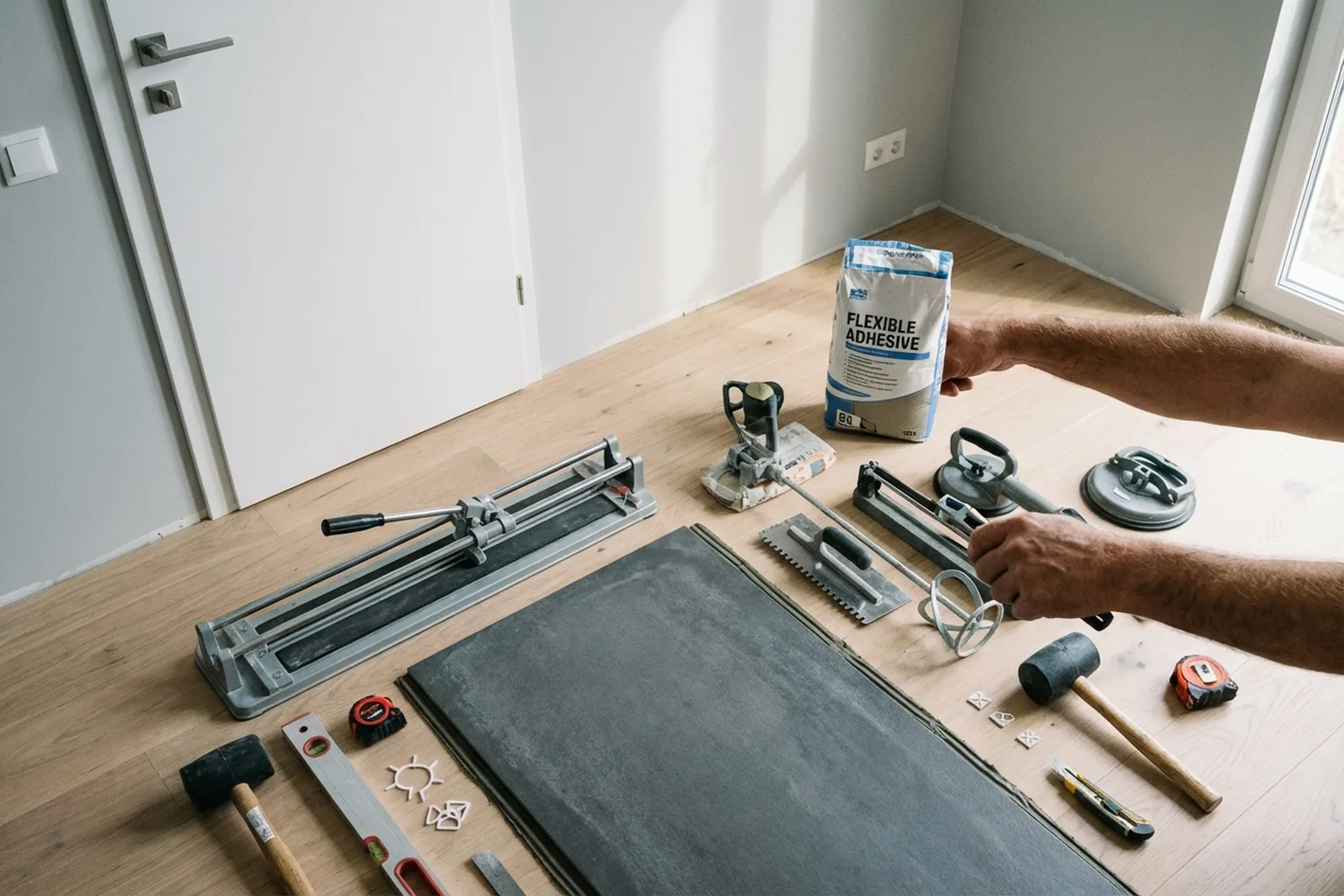
Large format tiling in Warsaw costs 220 to 500 zł per m², the rate depends on the format and where it goes: wall, floor or shower area. The current rates are in the table below. The price of large format wall tiling depends on the tile dimensions, the condition of the wall, and how complicated the cuts are. The 60×120 size is the starting point — easier to work with. Slabs in 120×260 or 120×120 are already serious work: each piece weighs 15-30 kg, the adhesive must have stronger initial grab, and two installers are a must. If the walls are uneven, they need plastering or levelling with plasterboard, that is billed separately. Materials are paid for separately; consumables are included in the labour cost. You can see current prices in the table below.
| Service | Price |
|---|---|
| Large format: wall | 250–650 zł/m² |
| Laying large-format tiles | 180–400 zł/m² |
| Large format: floor | 280–420 zł/m² |
| Large format: shower walls | 350–650 zł/m² |
| Tile grinding at 45° | 60–90 zł/mb |
| Epoxy grouting large format | 60–90 zł/m² |
Indicative prices. Ranges for a typical scope. Fixings included, materials separate. Minimum order 300 zł.
Price ranges and offers from tradespeople: large format tiling in Warsaw.
How the work is done on site
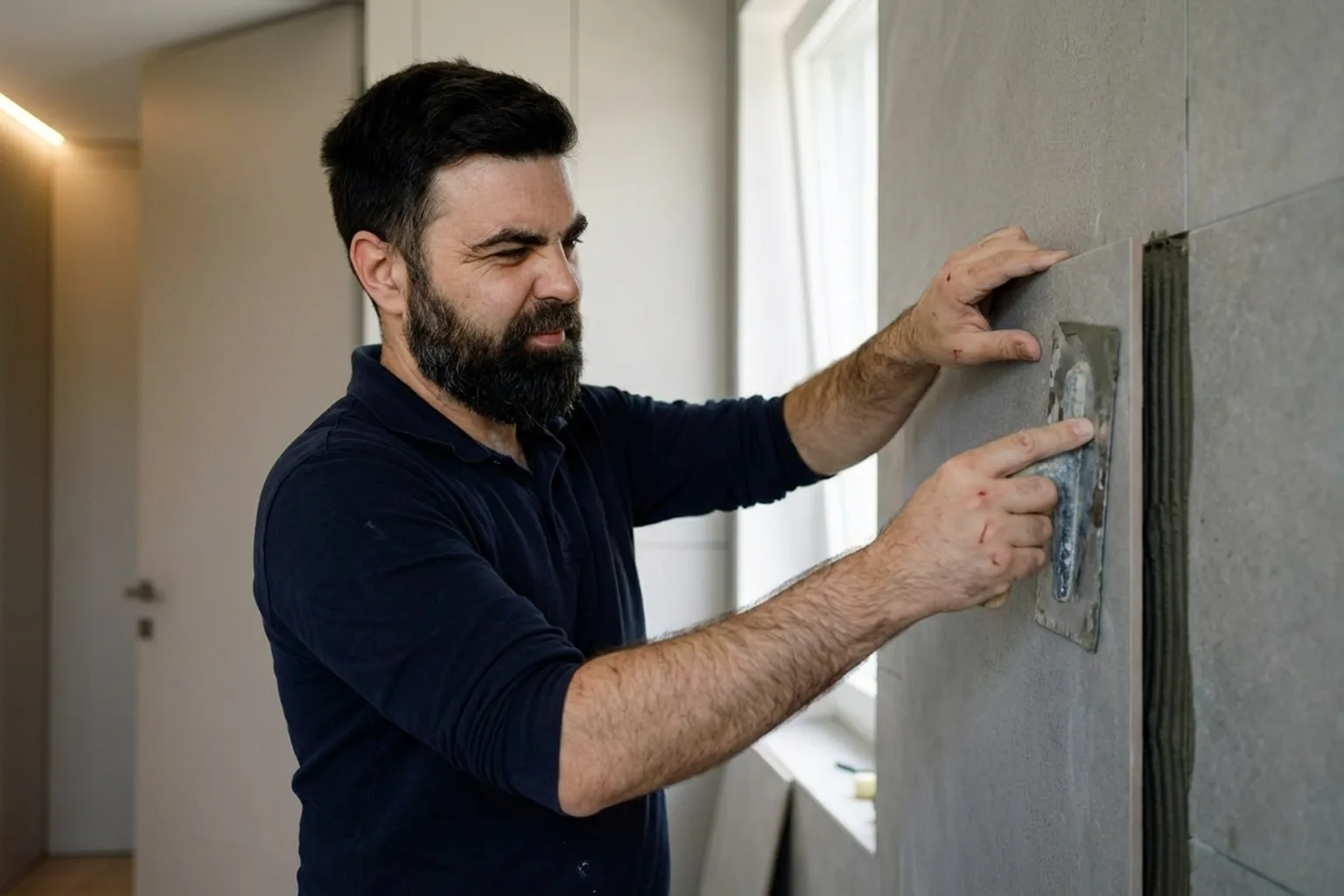
- Measurement and wall assessment. Tradespeople check the wall with a straight edge, anything over 3 mm per metre is not acceptable for large format wall tiles. If the surface is uneven, they recommend levelling with Knauf HP Start plaster or plasterboard.
- Surface preparation. Tradespeople prime the wall with two coats. Plasterboard has to be moisture-resistant (green board) and the joints must be reinforced.
- Dry layout. Tradespeople decide where full tiles will sit and where cuts will be needed. Cuts are placed in corners, behind furniture, behind mirrors. In bathrooms they line everything up with the plumbing: access panels, mixer outlets, niches.
- Adhesive application. On walls they use C2 TE S1 adhesive with extended open time: Mapei Keraflex Maxi S1, Ceresit CM 17, Litokol K80. Tradespeople apply it both ways: 10-12 mm notched trowel on the wall and a thin coat on the tile.
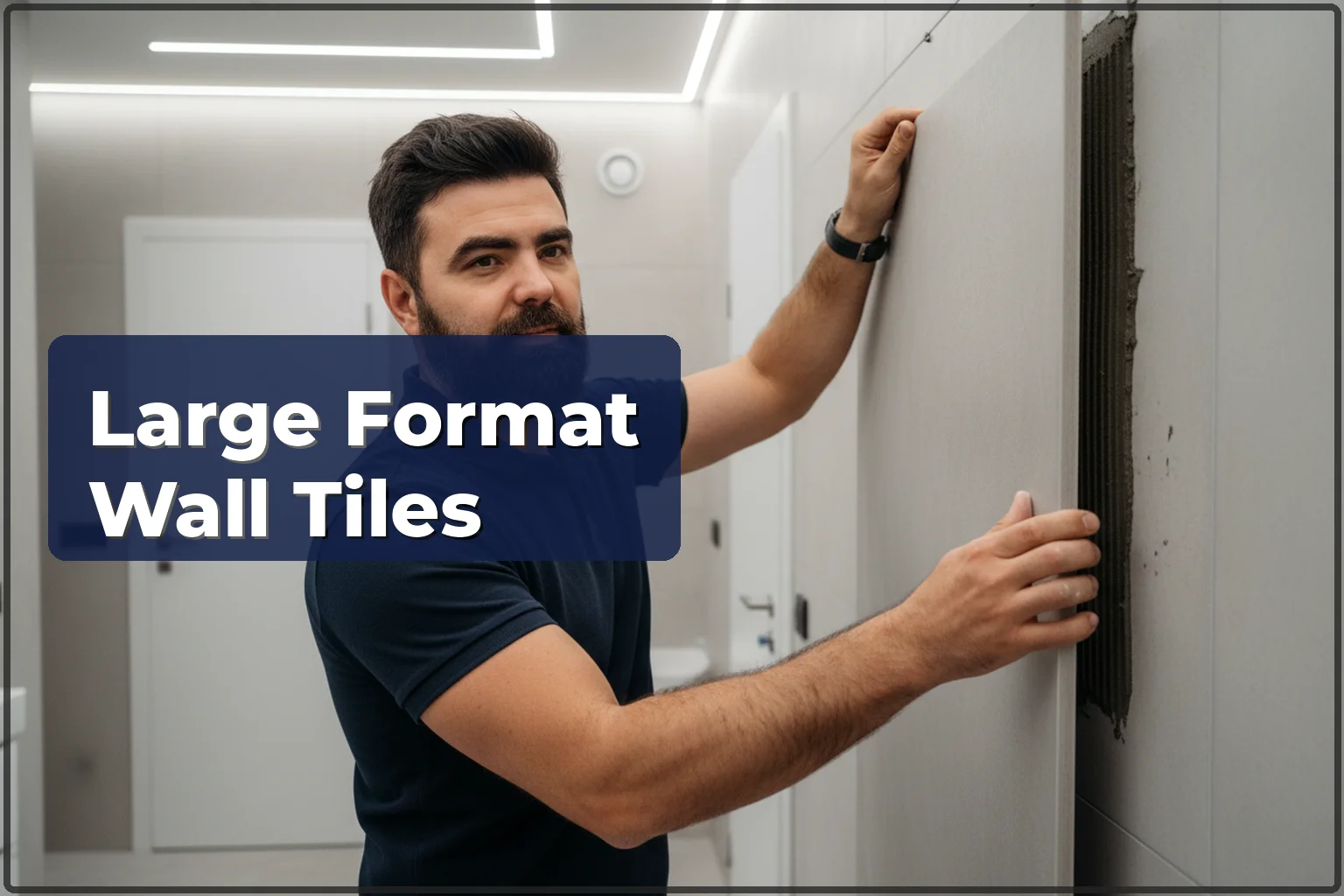
- Tile mounting. Two installers work as a team: one supports the tile, the other positions it. Suction cups are required from 80 cm format upward. A levelling system (SVP) keeps everything locked in place until the adhesive cures.
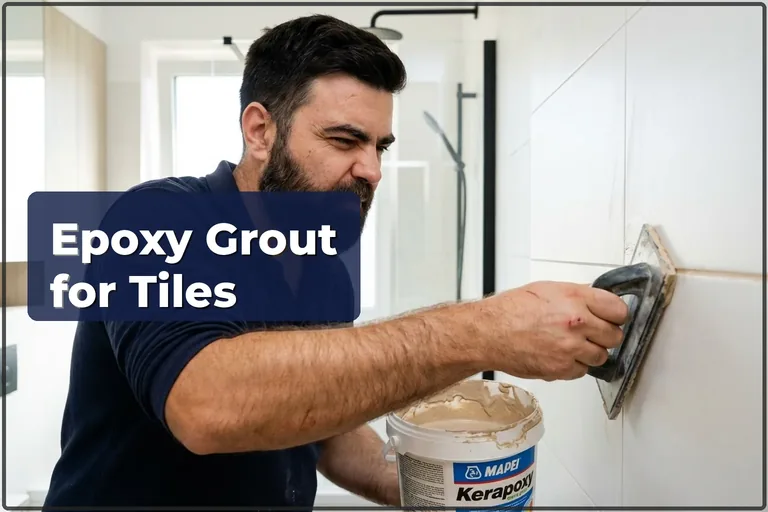
- Grouting after 24-48 hours. For bathroom walls they suggest epoxy grout (Mapei Kerapoxy, Litokol Starlike) — it does not take in water and does not grow mould. Joints against the wall and sanitary fittings are sealed with sanitary silicone.
- Final check: flatness of the surface, grout finish, tile cleanliness. Tradespeople also explain how to care for the tiles.
Common mistakes with large format wall tiling
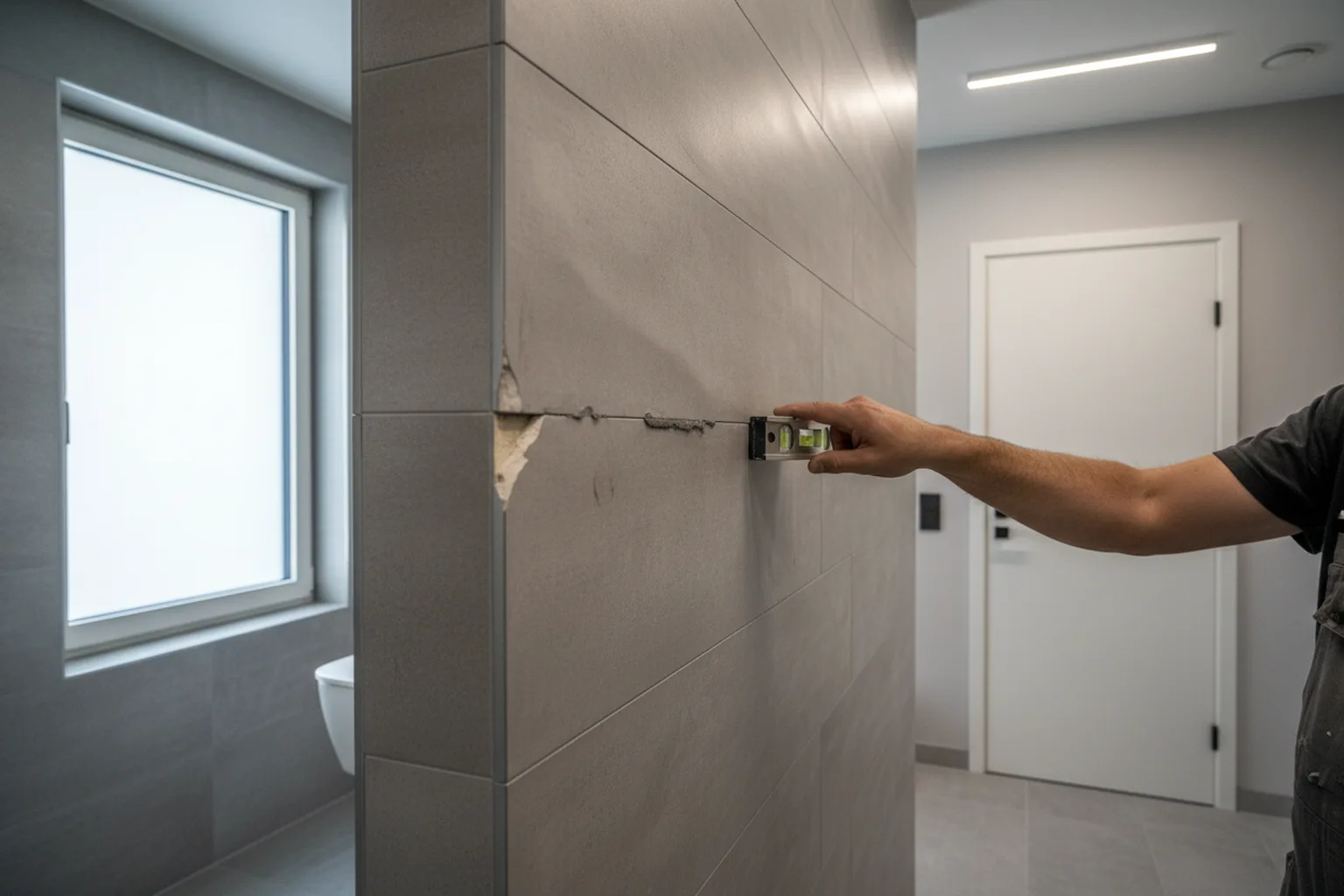
- Laying tiles on an uneven wall: the tile will not sit flat, the adhesive bed varies, and corners start to protrude. Large format shows every millimetre of unevenness.
- Using standard C1 adhesive, a tile weighing 20+ kg slips down the wall before the adhesive cures. Walls need at least C2 TE S1 with thixotropic properties.
- Skipping suction cups: lifting the tile by hand. The result can be a chipped corner, a crack, or an injury. Sigma or Montolit suction cups are basic equipment.
- Cutting freehand with an angle grinder — cuts come out uneven and the glaze gets chipped. Large format tiles should be cut on an electric tile cutter with a diamond blade and water cooling.
- Putting adhesive only on the wall: empty spots stay under the heavy tile. Later, when drilling for hooks or shelves, the tile cracks exactly in those places.
- No grout joints: so-called smooth installation ends with edge chipping from thermal expansion.
- Starting from the top — the tiles slide before the adhesive cures. On walls you always begin at the bottom, using a support batten.
What to prepare before the technician arrives
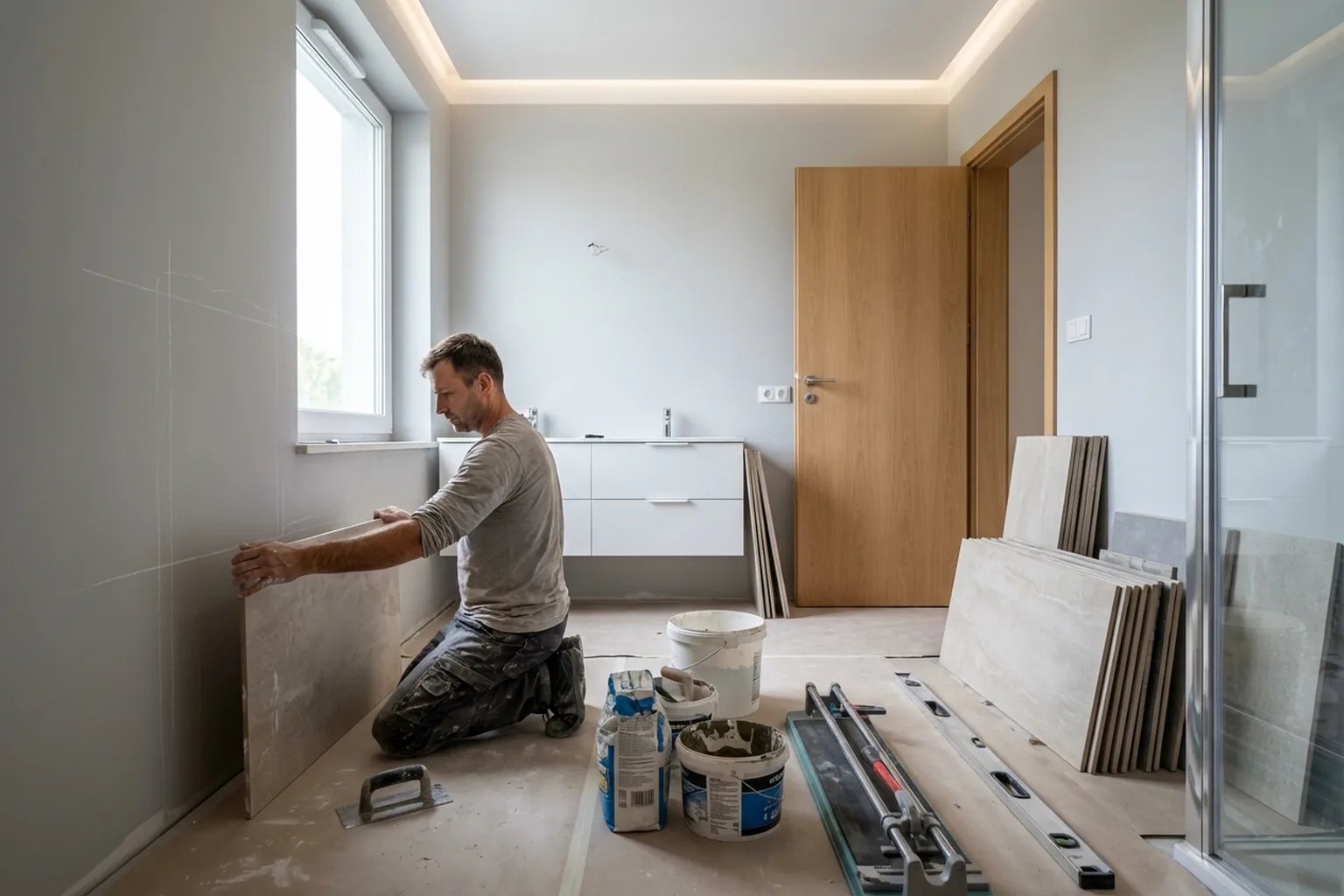
- The wall should be plastered and fully dry. Fresh plaster needs at least 14 days before tiles can go on.
- Plasterboard: only moisture-resistant type with a double frame for large format.
- Buy tiles with a 10-15% extra allowance. Cuts, chips during transport, and fitting adjustments create more waste than with standard tiles.
- Check that all tiles come from the same batch: the shade and calibre need to match.
- Adhesive for walls — C2 TE S1: Mapei Keraflex Maxi S1, Ceresit CM 17. Consumption 5-7 kg/m².
- Grout: epoxy for bathrooms, cementitious for dry rooms. Pick the colour in advance.
- Remove sanitary fittings, mirrors, and wall cabinets: you need full access to the wall.
- Protect the floor and bathtub with sheeting — cutting and installation create dust and adhesive splashes.
- Make sure there is electricity and water near the work area.
- Let the technician know the tile size, quantity, and layout plan (photos of the room are useful).
A real case from Warsaw: large format wall tile installation
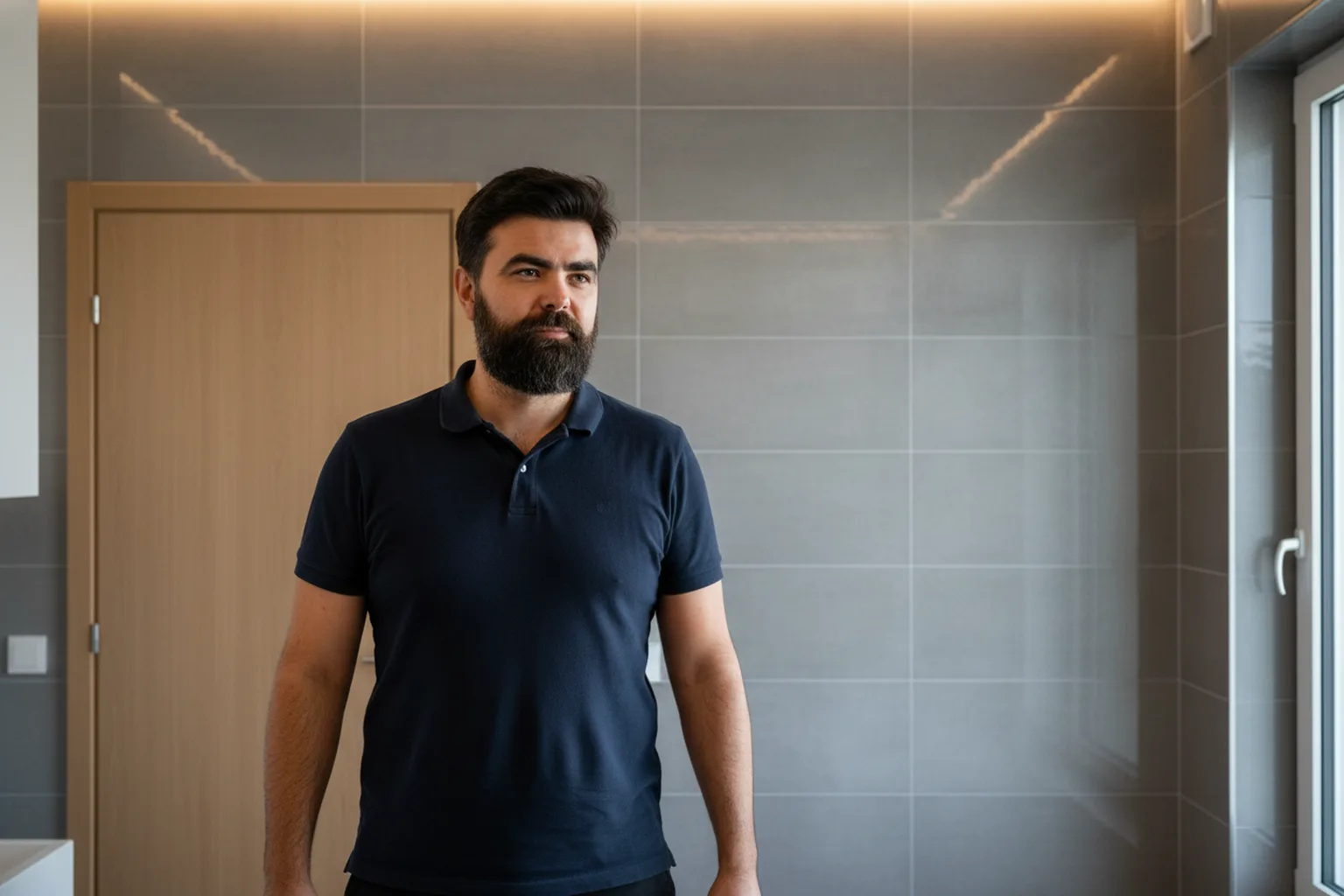
A bathroom in Wola, 6 m²: the client picked Paradyż 60×120 porcelain in light marble for all walls. Tradespeople took off the old tiles and found the plaster was coming away in some spots. Tradespeople removed the weak sections, levelled the surface with Knauf HP Start, and left it for a week to dry. Then they primed it and used dual application of Mapei Keraflex Maxi S1 with a 10 mm trowel. Tradespeople worked as a pair with Sigma suction cups — each slab weighed around 18 kg. Levelling clips were used on every joint. All four walls were completed in three days. Grout: Litokol Starlike, white. Openings for the mixer and access panel were cut on a rail-guided tile cutter. The bathroom now looks like a room in a good hotel, very few grout lines, one continuous light surface.
Large-format Cerrad porcelain tiles
Cerrad is a Polish maker of porcelain tiles, including large formats for floors and walls. Porcelain is hard and barely absorbs water, and a large slab means fewer grout lines, but also higher demands on the base and the tiler: on an uneven screed one edge stands proud of the next and the glaze chips over time.
The tiler checks the base with a long straightedge, spreads adhesive on both the base and the back of the slab, and a levelling system keeps the edges flush until the adhesive sets. Large slabs are heavy and break if handled wrongly, so ask in the quote whether the tiler works with this format. Long slabs are safer laid with a one-third offset than a half offset. And before buying, make sure the slabs will fit in the lift and up the stairs.
Frequently asked questions
Can the wall support the weight of large format tiles?
Brick or concrete — no issue. Plasterboard: only moisture-resistant type with a double frame and stud spacing no greater than 40 cm. Standard single-layer board is not suitable for formats above 60 cm.
Is a support batten needed for wall installation?
Yes. An aluminium profile is fixed along the lower edge of the second row. It stops the tiles from slipping before the adhesive cures. The bottom row (cut tiles) is fitted last.
Can large format tiles be used on a kitchen wall?
Yes, large format porcelain works very well for kitchen splashbacks and walls. Fewer joints make cleaning easier.
Which adhesive should be used on walls?
C2 TE S1: flexible, thixotropic (non-slip), with extended open time. Mapei Keraflex Maxi S1, Ceresit CM 17, Litokol K80.
Why is dual adhesive application necessary?
Adhesive goes on both the wall and the tile. That gives 100% coverage. Without it, voids stay underneath, and the tile can come loose or crack when drilled.
Is smooth installation possible?
Completely smooth — no. A minimum 1.5-2 mm joint is required for thermal expansion. Still, with large format tiles and matching grout, the joints are almost invisible.
How are cut-outs for sockets and mixers made?
Round holes: with a diamond core bit. Rectangular openings: with a tile cutter or angle grinder and guide. Always using water cooling to avoid chipping.
How long does wall installation take?
One wall of 3-4 m² — from half a day to a full day. A bathroom with 15-20 m² of walls: 3-5 days, plus one more day for grouting.
Are materials included in the price?
No. Tiles, adhesive, grout, and primer are bought by the client. The labour price includes consumables: levelling clips, suction cups, and cutting discs.
What if a tile is damaged after installation?
Replacing one large format tile is possible, but it takes more work than replacing a standard tile. Keep 1-2 spare tiles. The technician will carefully cut out the damaged piece and install a new one.
What does large format tiling cost per m²?
From 220 to 500 zł/m². A 60×120 wall sits mid-range, slabs over 120 cm are priced separately because of transport and two-person lifting, and shower walls are the dearest, they add waterproofing and cut-outs around the mixer.
Can large format tiles be laid around a linear drain?
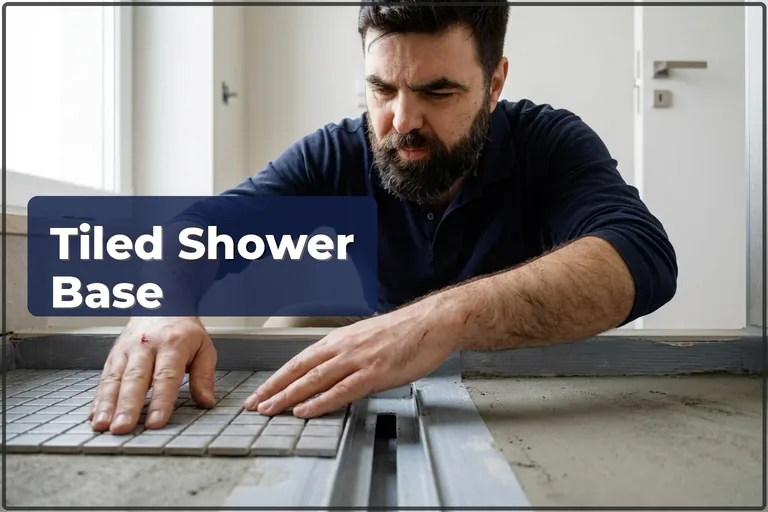
Yes, and it is the most common use of large format in a bathroom: one slab across the whole shower area, with no grout lines where the water collects. The slab has to be cut to fall towards the channel — that is a separate line in the quote, priced per cut.
Who does the work
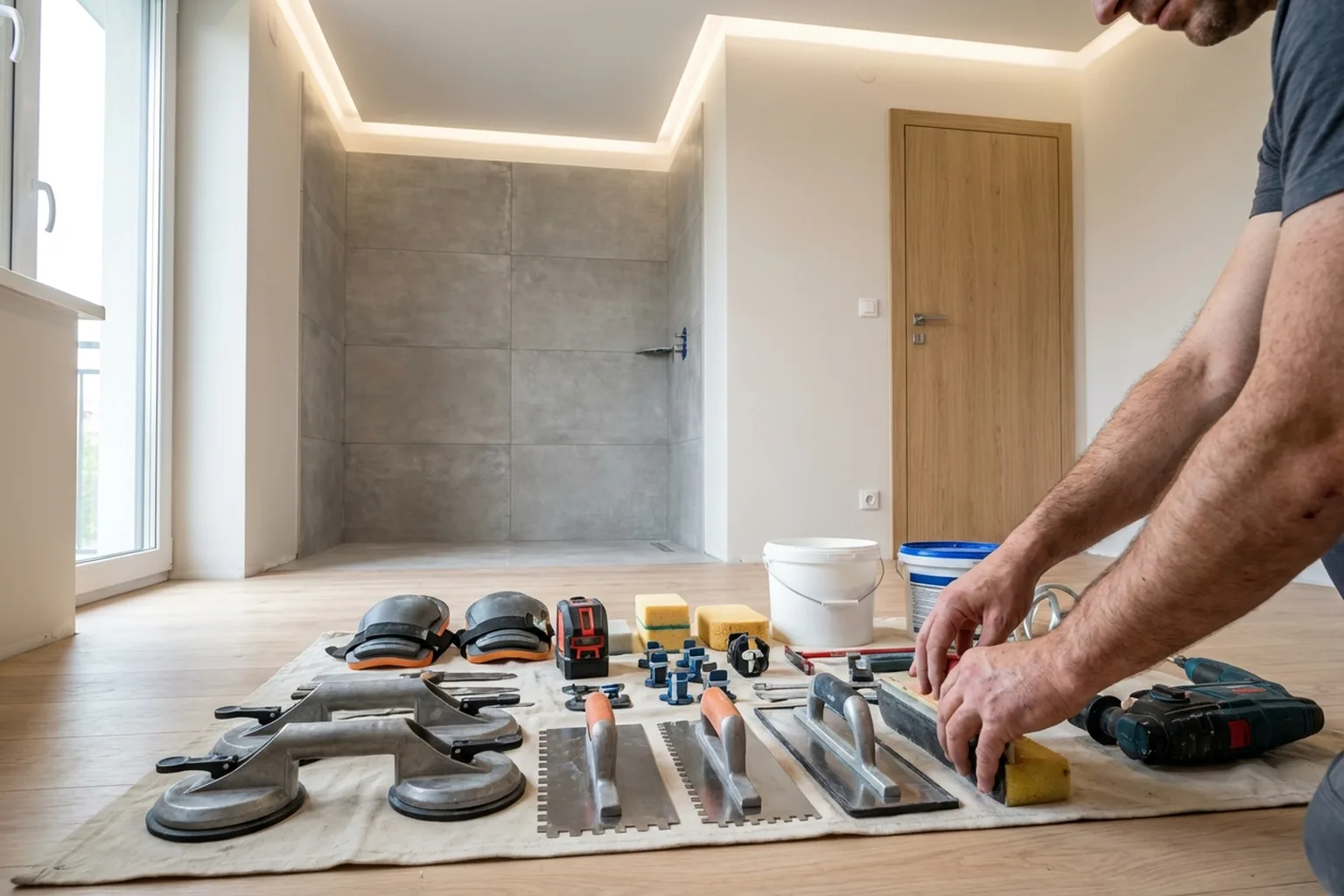
Large format wall tiles are fitted by technicians with direct experience in oversized formats: this is a separate kind of work. They come with a professional tile cutter, suction cups, a complete levelling system, and a laser level. They work in pairs: lifting and placing a 60×120 slab accurately on a wall is not something one person can do alone. They cover the whole of Warsaw and nearby suburbs: post a request in the HandyMan24 app to get offers.
Order in the app
Describe the job, add photos and the address. Tradespeople send their own prices and dates, and you pick one of the offers.
Open the app