Composite Countertop Installation in Warsaw — Quartz, Acrylic, Silestone, Corian
A composite countertop is not chipboard and not natural stone either. It is a man-made material: quartz agglomerate (Silestone, Caesarstone) or acrylic stone (Corian, Staron). These slabs are really heavy — quartz comes in at around 50 kg per square metre, acrylic is lighter but still not something you casually move around. Trying to fit one without practice is a fast way to ruin costly material. We work all over Warsaw, from Mokotow to Ursynow, and we come with the right tools and a second person for carrying.
How much does it cost and what affects the price

The installation price depends on the countertop length, how many cutouts there are (sink, hob), whether a wall upstand is required, and how difficult it is to fit the top neatly to the walls. You can find exact rates for all kitchen services in the table below. Fixings are part of the labour price. The countertop itself, colour-matched adhesive sealant, and delivery of the material are billed separately. Carrying heavy slabs upstairs is also priced separately — a 3-metre quartz countertop weighs about 150 kg.
| Service | min | max |
|---|---|---|
|
Kitchen furniture installation (complete set)
Book this service → |
20% od ceny | 25% od ceny |
|
Kitchen base cabinet installation
Book this service → |
250 zł | 400 zł |
|
Wall cabinet installation
Book this service → |
250 zł | 400 zł |
|
Kitchen cabinet door adjustment
Book this service → |
80 zł | 150 zł |
|
Hinge replacement
Book this service → |
60 zł/szt | 120 zł/szt |
|
Kitchen countertop installation
Book this service → |
200 zł/mb | 350 zł/mb |
|
Laminate countertop installation
Book this service → |
150 zł/mb | 250 zł/mb |
|
Composite countertop installation
Book this service → |
250 zł/mb | 400 zł/mb |
|
Countertop joining
Book this service → |
190 zł/szt | 300 zł/szt |
|
Countertop cutout (sink / hob)
Book this service → |
120 zł/szt | 200 zł/szt |
How the on-site installation works
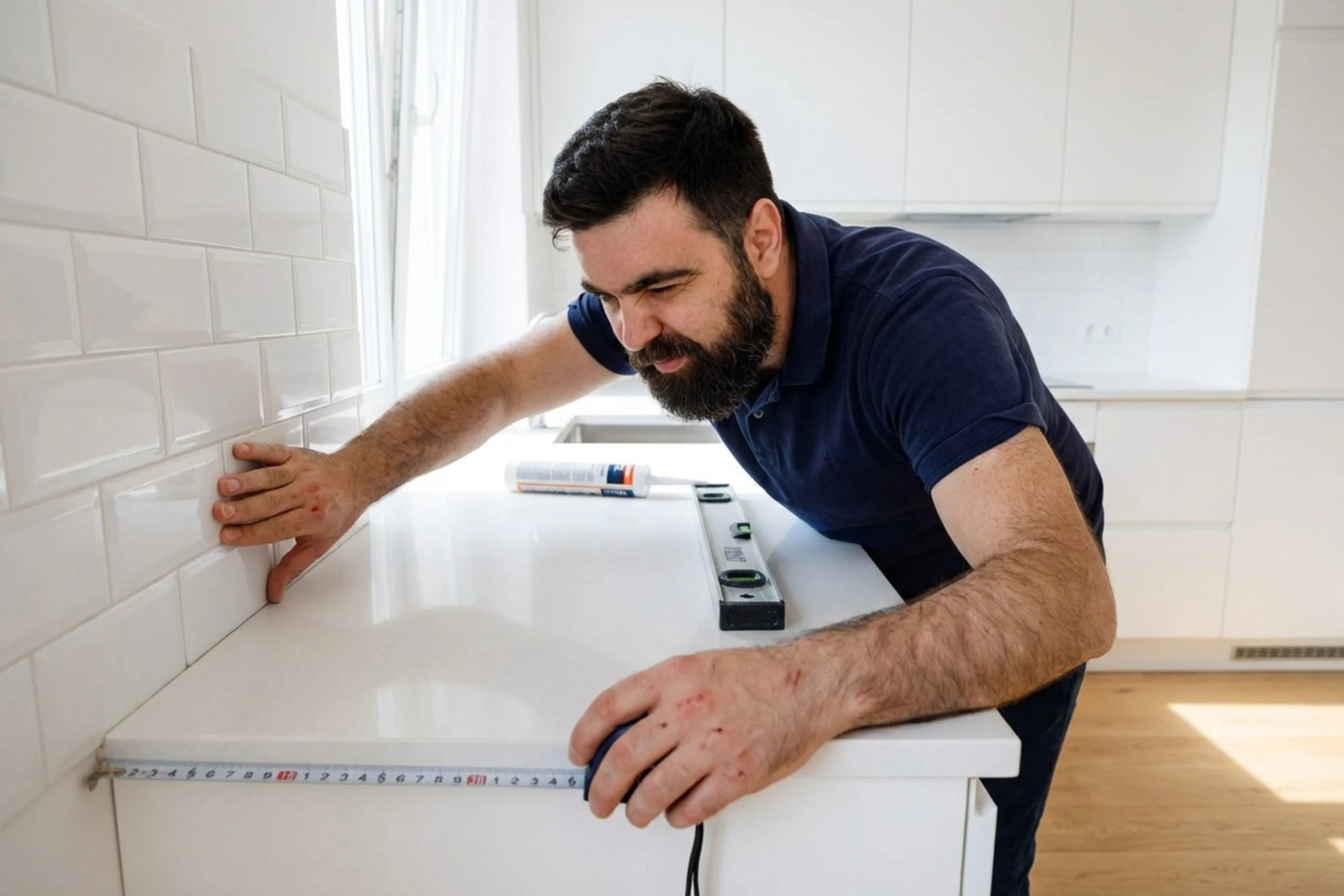
- You send photos of the kitchen and the measurements — the technician reviews the job and gives you an estimated price.
- We set a date. We come as a pair in most cases — two people are needed to carry the slab safely.
- We inspect the cabinet level. If the frames are uneven, we level them first — otherwise the countertop may crack once it is under load.
- We bring the slab in and set it onto the cabinets. Sink and hob cutouts are often done at the factory, but if any adjustment is needed on site, we use diamond tools.
- The countertop is fixed with silicone adhesive sealant and mechanical fixings from underneath.
- Joints between sections (if the countertop comes in more than one piece) are glued with a colour-matched two-component adhesive. With acrylic, the seam can be almost invisible; with quartz, a slight joint line will still remain.
- We fit the wall upstand and seal the joint where it meets the wall.
- We check level, stability, and the finish of all joints. After that, we clean the area.
Common mistakes when installing composite countertops
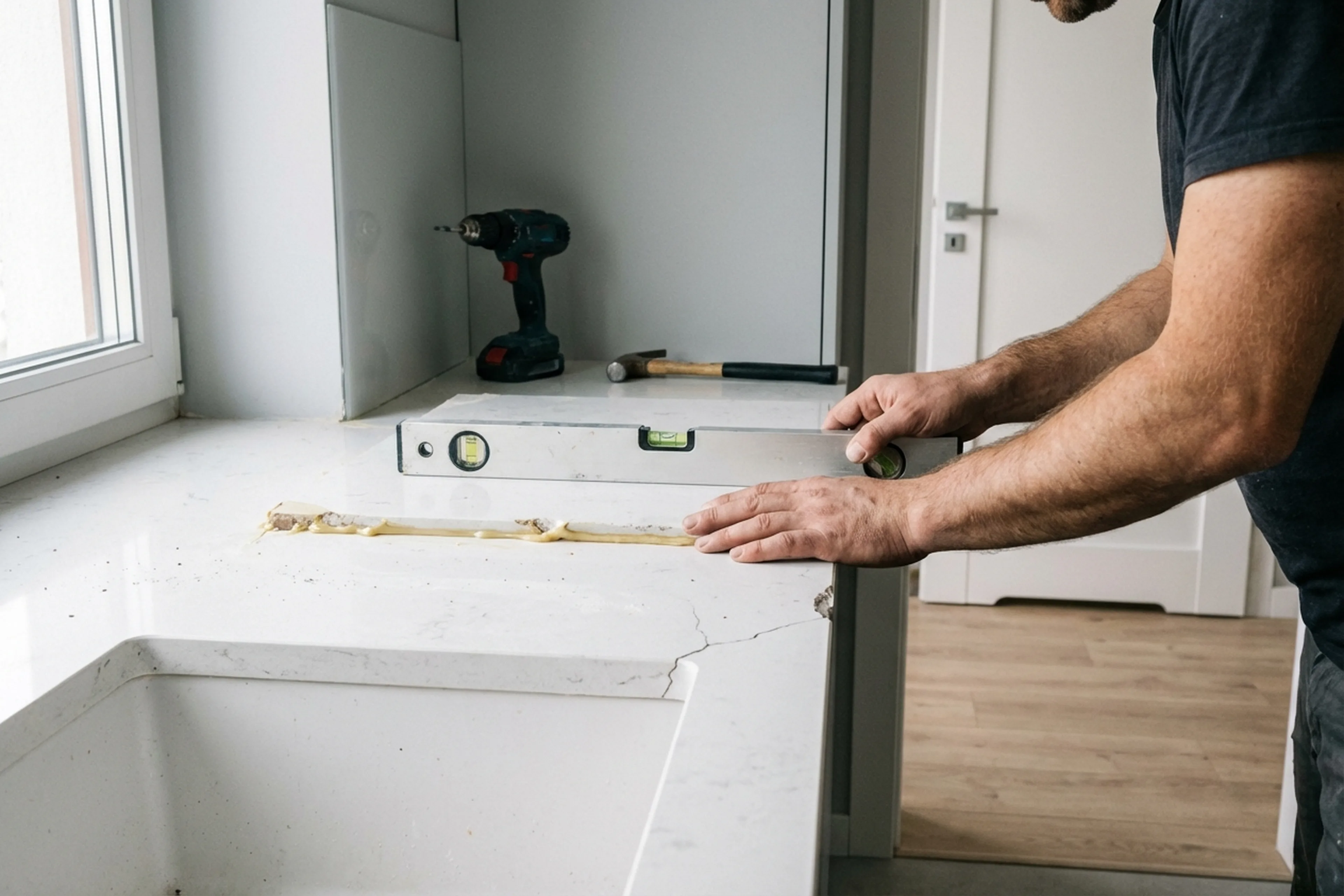
- The cabinets are uneven but the countertop is placed “as is” — six months later a crack shows up near the sink because the slab has been working under bending stress.
- Leaving out supports — for example, a span of 60+ cm between cabinets with nothing underneath. Quartz is heavy and should be supported at least every 50 cm.
- Using regular silicone instead of proper stone adhesive — the bond turns yellow and starts peeling.
- Tightening mechanical fixings too much — acrylic can split at the fixing point.
- No expansion gap at the walls — with temperature changes, the countertop expands and presses against them, which can cause chips.
- Cutting the sink opening with an angle grinder and no guide — the result is rough edges and micro-cracks.
- Not sealing the cutout edge with a hydrophobic sealant (for quartz) — moisture gets into the structure.
What to prepare before the technician arrives

- The kitchen cabinets must already be assembled and standing in place. The countertop is fitted onto a finished frame.
- Check that the countertop has been delivered and is in the apartment or by the entrance. If it has to be carried upstairs, tell us beforehand.
- Verify that everything is complete: countertop, wall upstand, end strips, colour-matched adhesive (if supplied by the manufacturer).
- Remove boxes and unnecessary things from the kitchen — we need room to turn and position a long slab.
- If you have a kitchen drawing from the manufacturer, send it to the technician in advance.
- Make sure the water and drainage points for the sink are ready.
- Check that the electrical connection for the hob is already prepared (if a cutout is needed).
- Arrange access to the building: intercom code, lift, unloading space.
- If the apartment has just been renovated, let us know so we can protect the floors and furniture.
A real case from Warsaw
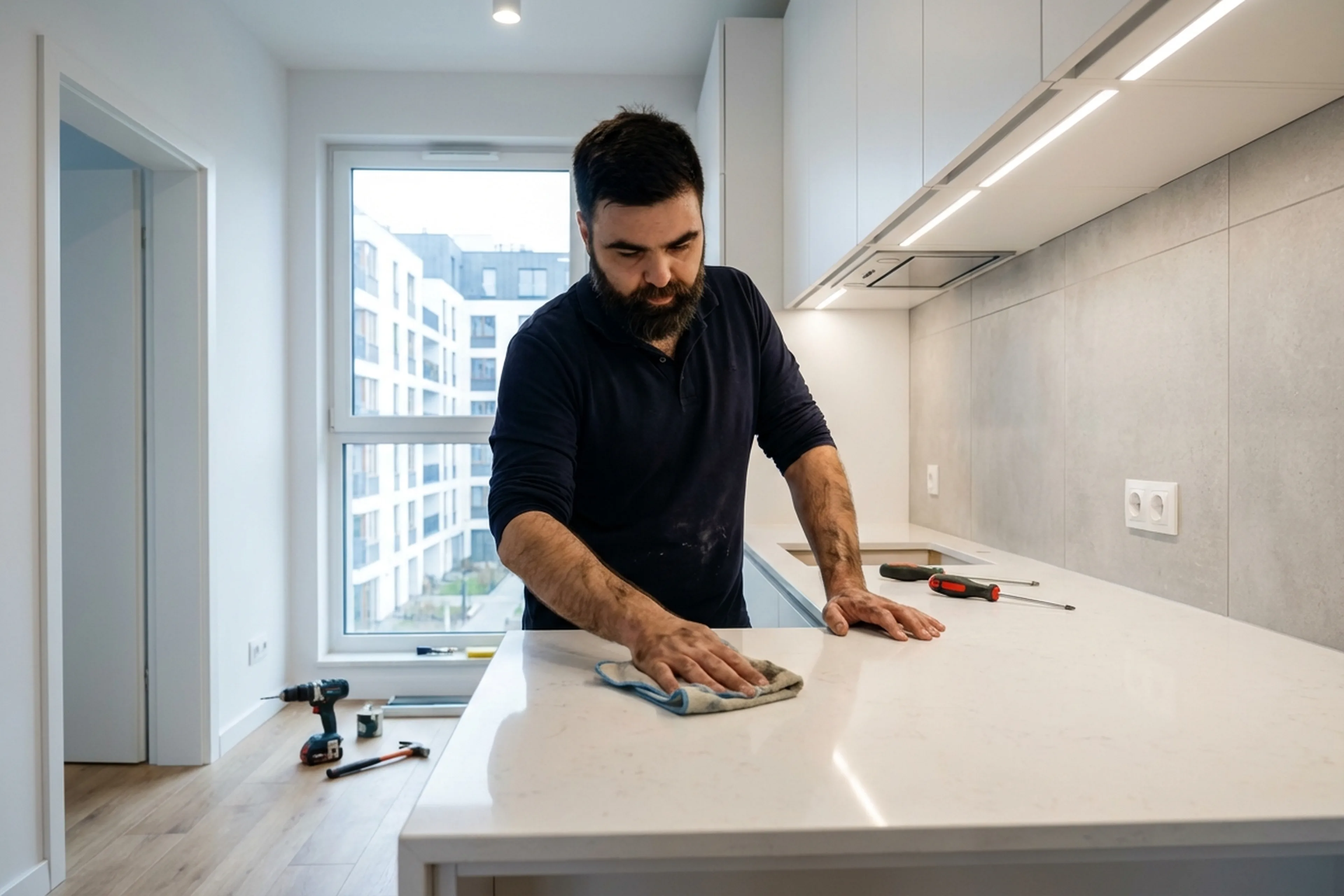
A client in the Wilanow district ordered a kitchen with a 3.2-metre Silestone quartz countertop. The slab was delivered in two pieces, with the joint landing in the sink area. During measurement we found that one base cabinet was 5 mm out of level — a common thing after self-assembled frames. We levelled the cabinet using adjustable feet and checked the whole run. We carried the slabs in together, set them on the frame, and glued the joint with two-component adhesive in “Calacatta Gold” colour. After curing, the seam was barely noticeable to the touch. We finished the under-sink cutout with edge treatment and fitted the wall upstand. The whole job took about 3 hours. The client said that without a helper it would have been physically impossible to get the countertop up to the second floor. The lesson is simple: always check cabinet level before installation — once the countertop is mounted, you can no longer correct a tilt (compatible with IKEA, Nobilia, BRW and similar).
Frequently asked questions
Can a composite countertop be installed on old cabinets?
Yes, as long as the frame is strong enough for the load. Quartz weighs about 50 kg/m2 — for a standard 3 m kitchen that gives 150 kg. Cabinets made from 16 mm chipboard may be too weak; they need to be checked first.
What is the difference between quartz and acrylic countertops?
Quartz is harder and stands up better to scratches and heat, but it is heavier and the seam will always be visible. Acrylic is lighter, seams can be made invisible, but the material is softer and reacts badly to hot pans.
Do you make the sink cutout or does the factory?
It is best to order the cutout from the factory — it is more accurate and there is no dust on site. But if an on-site adjustment is needed, we use diamond tools with a vacuum.
How long does installation take?
A straight countertop with no complicated cutouts takes 2–3 hours. An L-shaped kitchen with one joint and two cutouts takes 3–5 hours.
What is included in the price and what is not?
The price includes labour, fixings, and travel within Warsaw. The countertop, adhesive, delivery, and carrying the material are charged separately.
Can the countertop be installed without a wall upstand?
Yes, but then the joint with the wall has to be sealed properly. Without an upstand, water will get behind the countertop.
Who does the work

Composite countertop installation is done by technicians who have hands-on experience with quartz agglomerate and acrylic stone. We come as a two-person team so heavy slabs can be handled safely. We work across all of Warsaw and nearby areas. To book, call or message us — we answer within an hour and will tell you what to get ready before the visit.