How much does picture and mirror mounting cost in Warsaw?
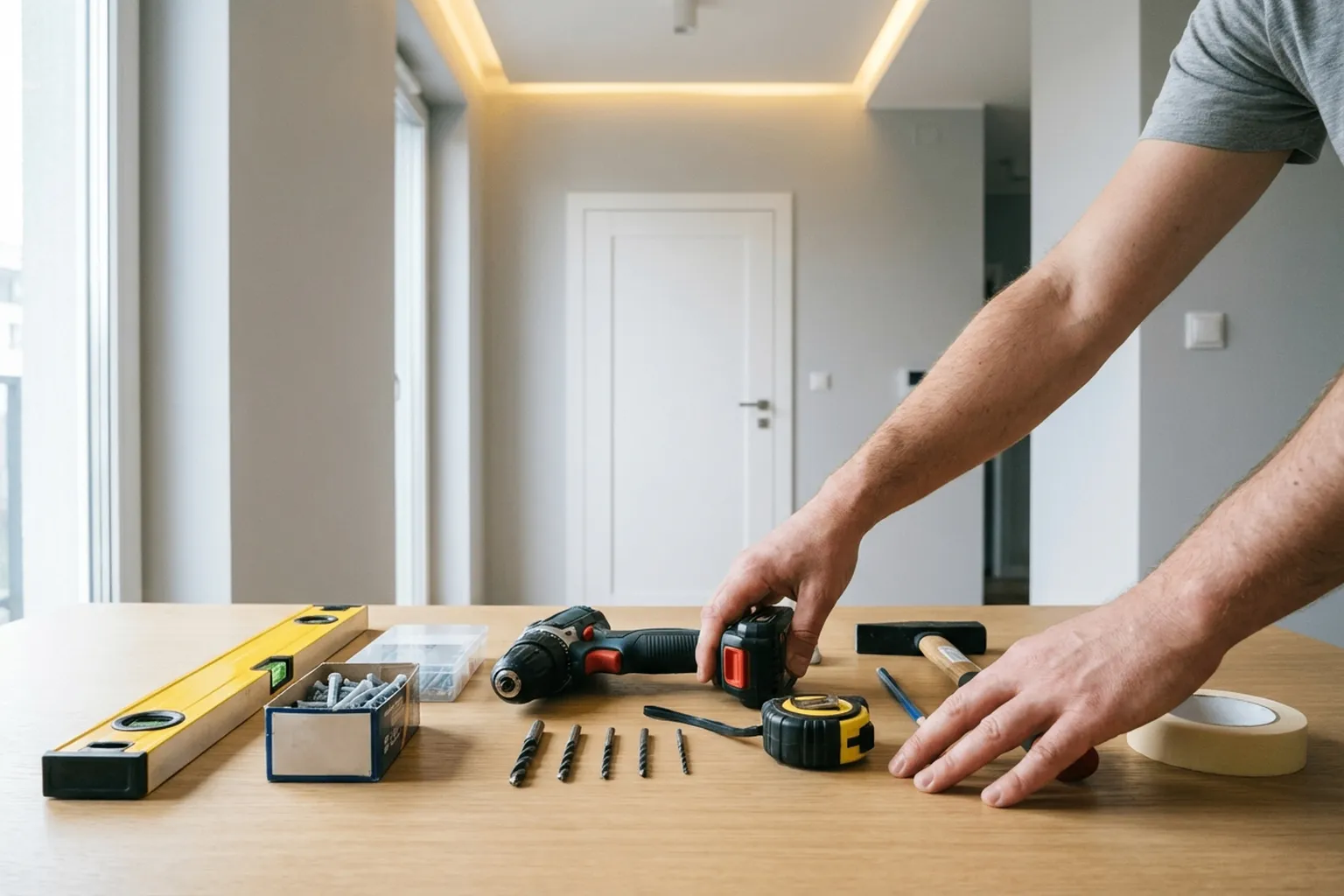
The price depends on how many items need hanging, how heavy they are, and what kind of wall you have. A small picture on concrete is one thing. A large frameless mirror on plasterboard with adhesive mounting is a different job altogether. The final cost is affected by: whether drilling is required, which fixings are needed (plugs, anchors, specialist hooks, adhesive systems), and how many mounting points are necessary. Basic fixings are included; specialist systems are billed separately. You can check current prices in the table below.
| Service | Price |
|---|---|
| Picture and mirror hanging | 80–300 zł/szt |
| Hang a wall shelf | 80–250 zł/szt |
Indicative prices. Ranges for a typical scope. Fixings included, materials separate. Minimum order 300 zł.
Rather hand the job over? More here: mirror hanging in Warsaw.
How picture and mirror mounting is done

- You send a photo of the item and the wall — the technician checks the weight, dimensions, and mounting method.
- Each tradesperson says in their offer when they can come, and you pick the one that suits you.
- On site, the technician checks the wall type (concrete, brick, plasterboard, aerated concrete) and picks the right fixings.
- Mounting points are marked using a laser level, so the picture hangs straight, not just judged by eye.
- Drilling, fitting plugs or anchors, and hanging the item.
- Stability check: the fixing is tested under load to make sure nothing shifts.
- Drilling dust is cleaned away and the final level is checked.
Common DIY mounting mistakes

- Putting a heavy mirror on a single nail in plasterboard, a week later it ends up on the floor.
- Not checking where the wiring runs, and drilling straight into a cable.
- Using standard screws in aerated concrete — they come loose under weight.
- Hanging by eye without a level: the lean shows in any light.
- Forgetting the frame weight when choosing fixings, calculating only for the mirror and overlooking the solid-wood frame.
- Fixing a mirror with double-sided tape — it dries out and the mirror drops after a couple of months.
- Drilling through tiles without a specialist bit: the tile splits.
What to prepare before the technician arrives

- Decide on the exact spot where the item will hang, moving a mirror after installation means making new holes.
- Check the item’s weight (even roughly) — this matters when choosing proper fixings.
- Take photos of the wall and the item and send them to the technician beforehand.
- Clear the space in front of the wall: move furniture, decorations, and rugs aside.
- Check what type of wall it is: if you do not know, the technician will verify it on site.
- If the mirror has no mounting loops, say so in the order in advance — adhesive mounting or specialist clips will be required.
- Make sure the item is unpacked and ready to be mounted.
- Provide the intercom code and parking details.
A real case from Warsaw: picture and mirror mounting

Tradespeople were called to a flat in Wilanow: the client had bought a large frameless mirror, 120×80 cm, weighing about 18 kg. The wall was plasterboard on a metal frame. Standard toggle bolts would not carry that load safely. Tradespeople used spring-toggle anchors with a load-spreading plate so the force was spread across an area instead of one point. Four mounting points were marked with a laser level, drilled carefully, and the mirror was installed. The final check showed a firm hold with only a minimal gap from the wall. The client was concerned that plasterboard would not manage it, but with the correct fixings, it works fine. The whole job took about 40 minutes.
A second case: four panels in a 2×2 grid
Four textured panels in thin wooden frames. From the outside it looks easy: four nails and you are done. The whole difficulty is geometry: the eye reads a grid as one object, so a three or four millimetre difference in the gap between frames shows immediately, even when each panel on its own hangs perfectly level.
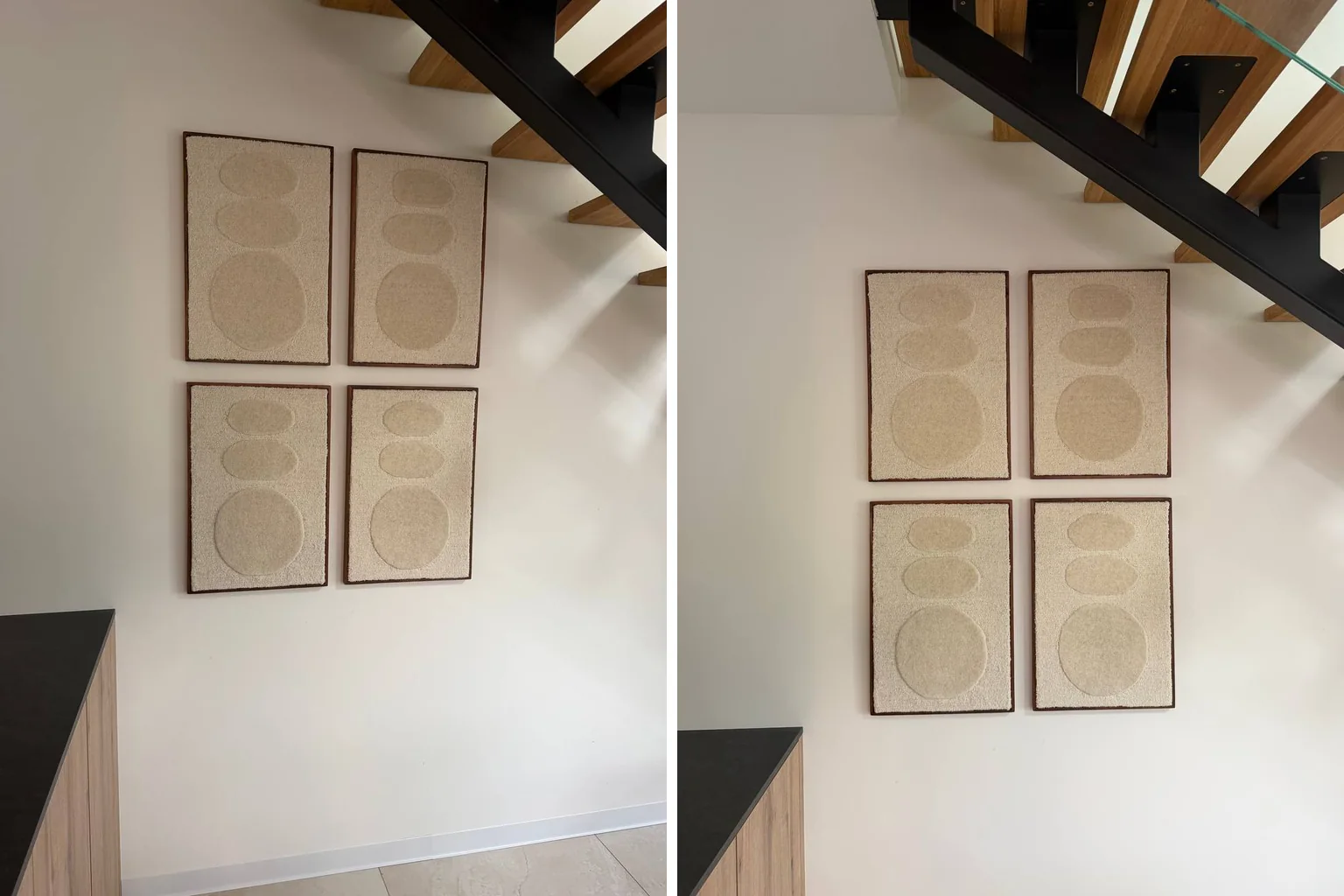
The spot added work. On the left a kitchen worktop sets the horizontal, on the right a flight of stairs runs diagonally above the wall. Hang the block dead centre on the wall and the top row visually runs into the stringer. So the centre of the composition went against the free field between the worktop and the stairs, not against the wall, and the gaps were measured from there.
The order is simple. First mark it out with masking tape straight on the wall: rectangles the size of the frames. Then step back two metres and look: here the whole block went down a centimetre. Only then drill. Fixings are chosen for the wall: what holds in concrete will pull out of plasterboard along with a chunk of the board. This is where people cut corners: they grab the plug that came in the box with the picture and never check what it is going into.
Time-wise, four panels in a grid take longer than eight pictures scattered across a wall. The layout eats more time than the drilling.
Frequently asked questions
Can a tradesperson hang a mirror on plasterboard?
Yes, with the proper fixings: spring-toggle anchors, butterfly plugs, or backing plates. Plasterboard handles up to 30 kg without trouble.
What about aerated-concrete walls?
Aerated concrete requires specialist plugs — standard screws will pull free. The technician chooses the fixings on site.
Do tradespeople hang frameless mirrors?
Yes. Tradespeople use hidden clips or adhesive mounting, depending on the weight and the wall type.
How many items can be hung in one visit?
As many as needed: you pay for the working time. In most cases 5-10 pictures take an hour to an hour and a half.
Does the wall need to be drilled?
Not in every case. For lightweight frames (under 2 kg), adhesive hooks can be used without drilling. For heavier items, drilling is required.
How do you hang several pictures in a straight line?
The technician uses a laser level and a tape measure, every point is marked before any drilling starts.
What is included in the price?
The technician’s work and basic fixings (plugs, screws, hooks). Specialist anchors or adhesive systems are charged separately.
Can a mirror be moved to a different wall?
Yes. Tradespeople take it down, patch the old holes, and mount it in the new place. This is counted as a separate job.
Do tradespeople work on weekends?
Yes, Saturday and Sunday are normal working days.
How quickly can a tradesperson come?
It depends on the tradesperson you choose: each one states in their offer when they can come. If it can’t wait, mark the job as urgent in the app. Tradespeople usually charge extra for urgent call-outs.
Who does the work

Pictures and mirrors are mounted by a technician who knows exactly when to use a concrete plug and when a plasterboard anchor is needed. Tradespeople work with a laser level — no guessing. Tradespeople cover all of Warsaw and nearby suburbs.
Order in the app
Describe the job, add photos and the address. Tradespeople send their own prices and dates, and you pick one of the offers.
Open the app

