
How much does it cost and what affects the price
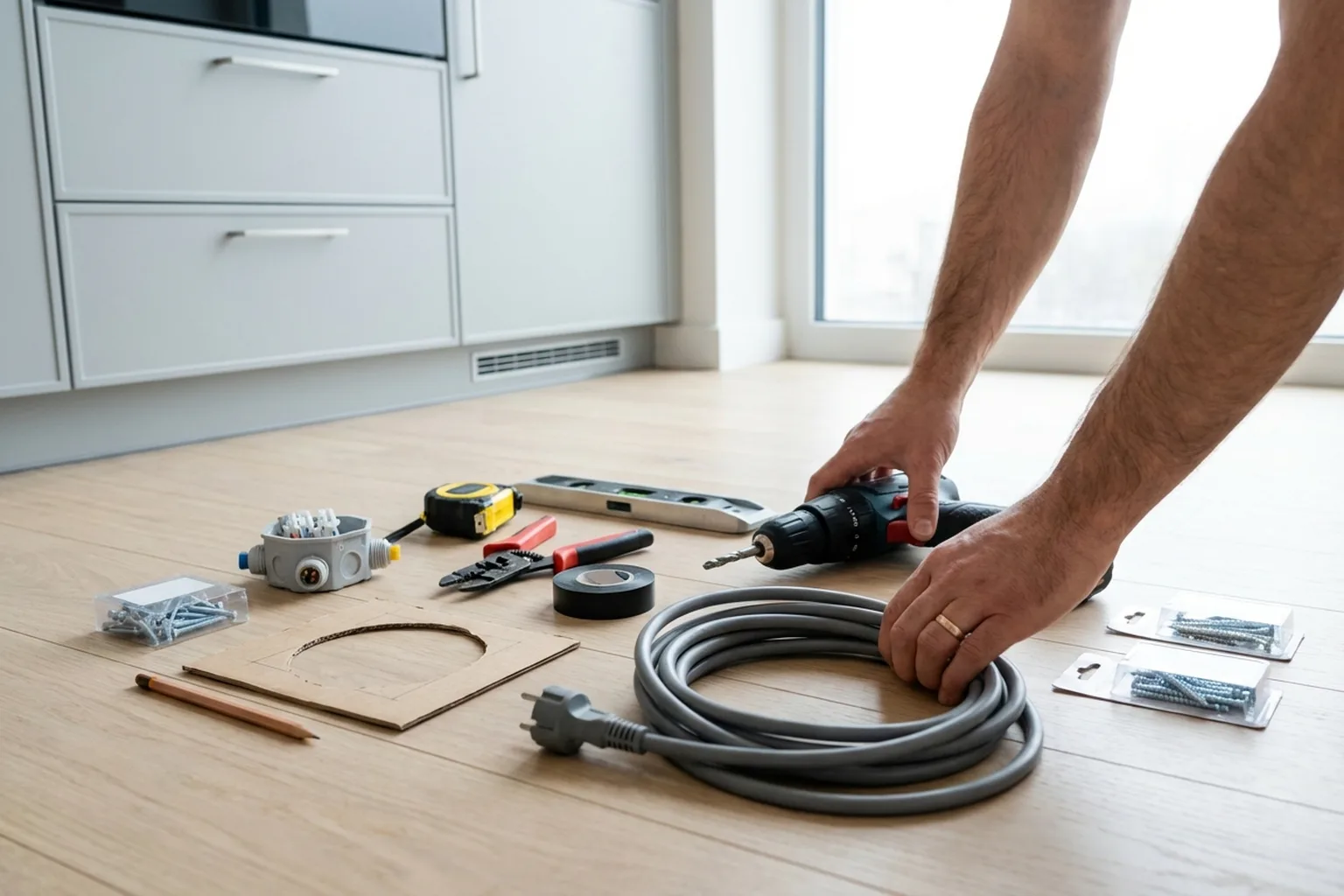
The price of fitting and connecting a built-in oven depends on a few things: whether the niche has the correct size, whether there is a suitable socket close by, and whether the cabinet needs altering. If the kitchen is new and everything was allowed for in the design — the work takes about an hour to an hour and a half. If the niche is non-standard or the socket is some distance away, the amount of work goes up. Fixings are included in the price; materials for cabinet alterations are charged separately. Current prices for kitchen services are shown in the table below.
| Service | Price |
|---|---|
| Assemble kitchen units (base and wall cabinets) | 400–1000 zł/mb |
| Base kitchen cabinet installation | 120–270 zł |
| Wall kitchen cabinet installation | 120–270 zł |
| Kitchen front adjustment | 80–250 zł |
| Kitchen worktop installation | 70–200 zł/mb |
| Laminate worktop installation | 70–135 zł/mb |
| Composite worktop installation | 250–400 zł/mb |
| Worktop joining | 190–300 zł/szt |
| Worktop cut-out (sink, hob) | 150–300 zł/szt |
Indicative prices. Ranges for a typical scope. Fixings included, materials separate. Minimum order 300 zł.
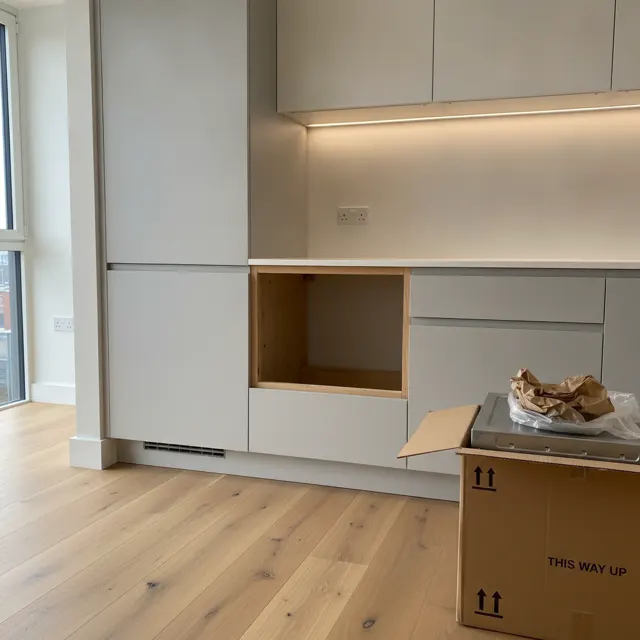
Rather hand the job over? More here: built-in oven installation in Warsaw.
Fitting into units or just connecting?
Fitting into units means furniture work: the recess, fixings and ventilation. If the oven is already in place and only needs a circuit, a new socket or the right breaker, oven connection is enough.
How oven installation works step by step
- You send photos of your kitchen, the niche, and the oven model, the technician reviews the scope of work.
- You agree the visit time with the tradesperson you choose; it depends on their schedule.
- On site, the technician checks the niche dimensions: the standard is 60×60 cm, depth from 55 cm. If there are differences, they make adjustments.
- Tradespeople provide ventilation gaps: at least 5 mm on each side, 40-50 mm at the back so hot air can escape.
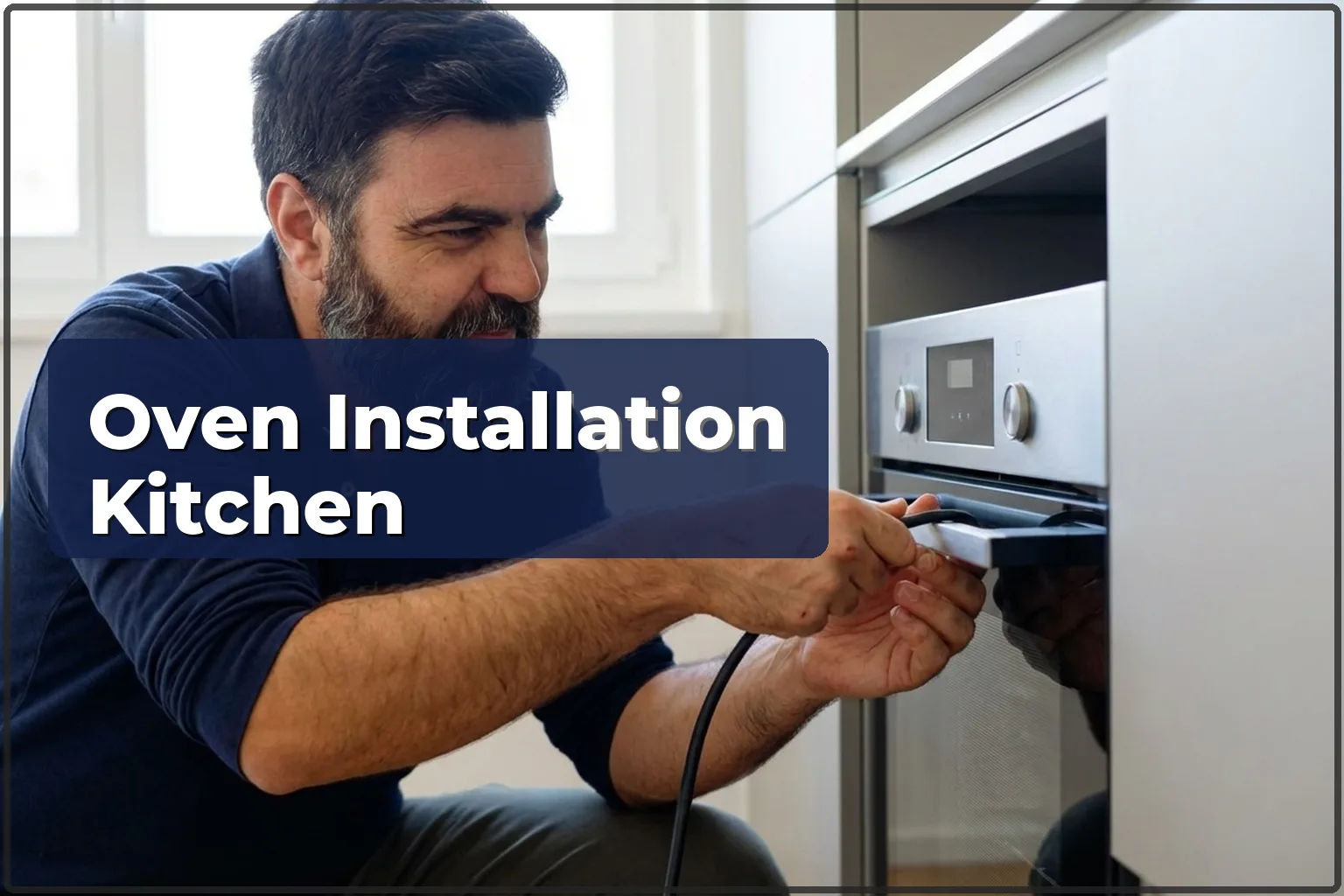
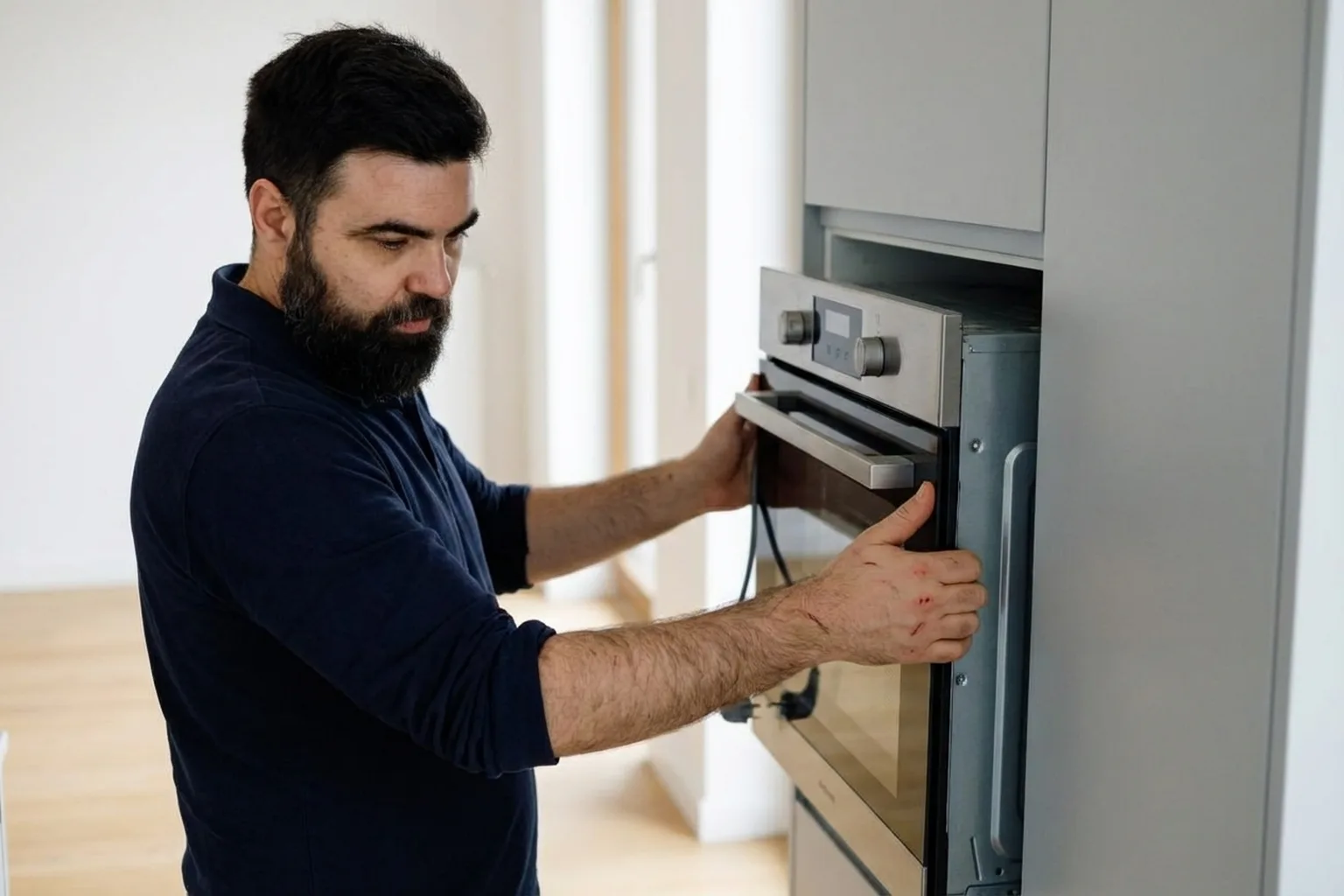
- The oven is set into the niche, levelled, and fixed with the factory-supplied screws through the side mounting holes.
- Electrical connection: they inspect the socket, wire cross-section, and earthing. Most ovens draw 2.5-3.5 kW, a standard 16A socket handles that without a problem.
- Test run: they heat the oven to maximum temperature, check that all modes work, and make sure there is no smell of burning wiring.
Important: an oven is connected to mains electricity. If you do not have a dedicated earthed socket: do not plug the appliance into an extension lead or adapter. That is a fire risk. Call a professional to inspect the electrics.
Common mistakes when installing an oven (and how to avoid them)
- Not checking the niche dimensions before buying — the oven will not fit or sits loose. Standard niche is 60×60 cm, but models also come in 45 cm and 90 cm widths.
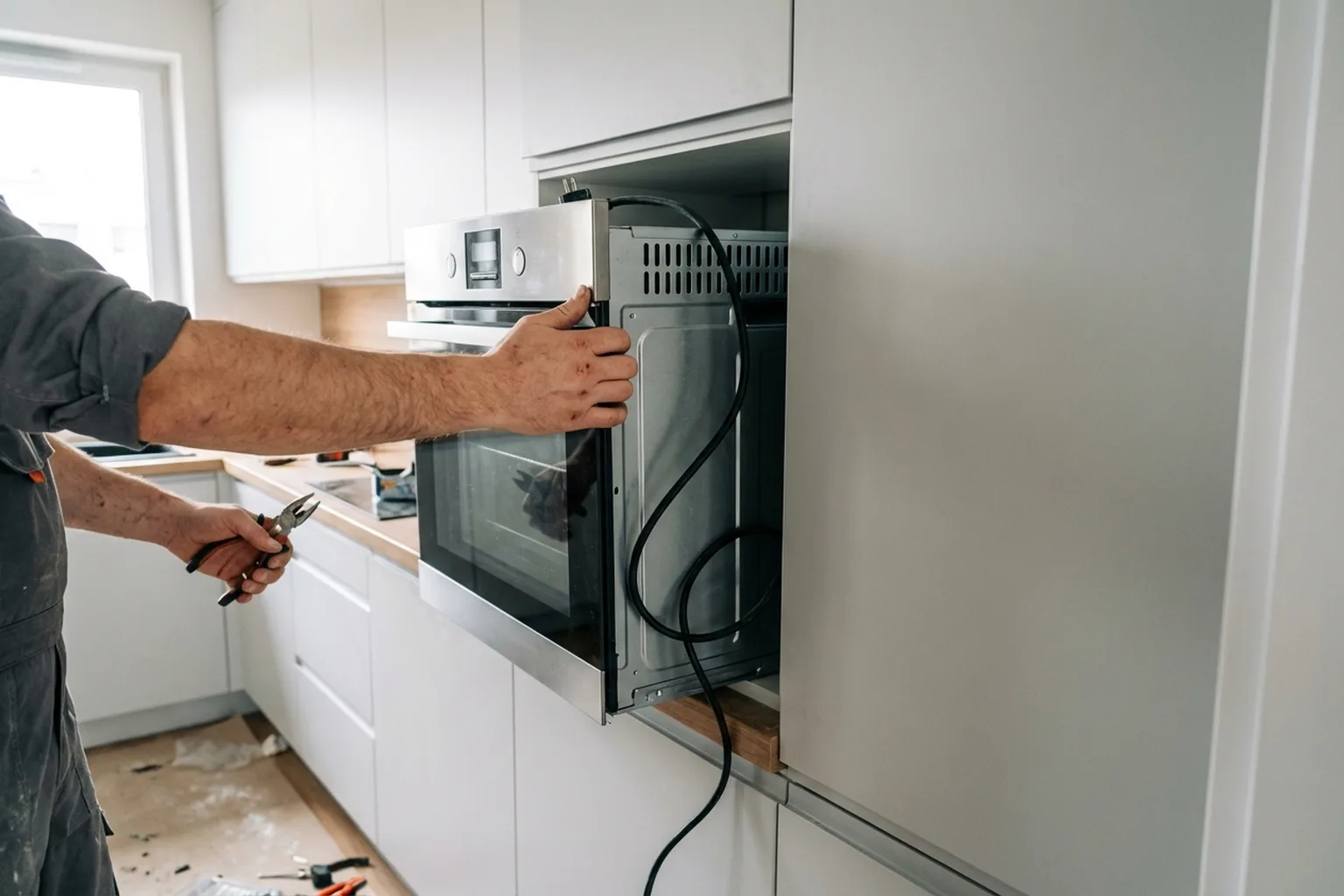
- Ignoring ventilation gaps: the rear panel of the cabinet overheats, the chipboard warps and goes dark.
- Installing the oven tight against the rear panel, no air circulation, electronics overheat.
- Plugging it into a standard household extension lead — it is not designed for a constant 3 kW load and may melt.
- Leaving the back panel of the cabinet in place, the oven has nowhere to release heat.
- Not fixing the unit with screws: when you open the heavy door, the oven slides out of the niche.
- Installing the oven under a hob without a thermal insulation strip — the countertop overheats.
- Not checking whether the socket has earthing: in the event of an electrical fault, there is a risk of electric shock.
What to prepare before the technician arrives
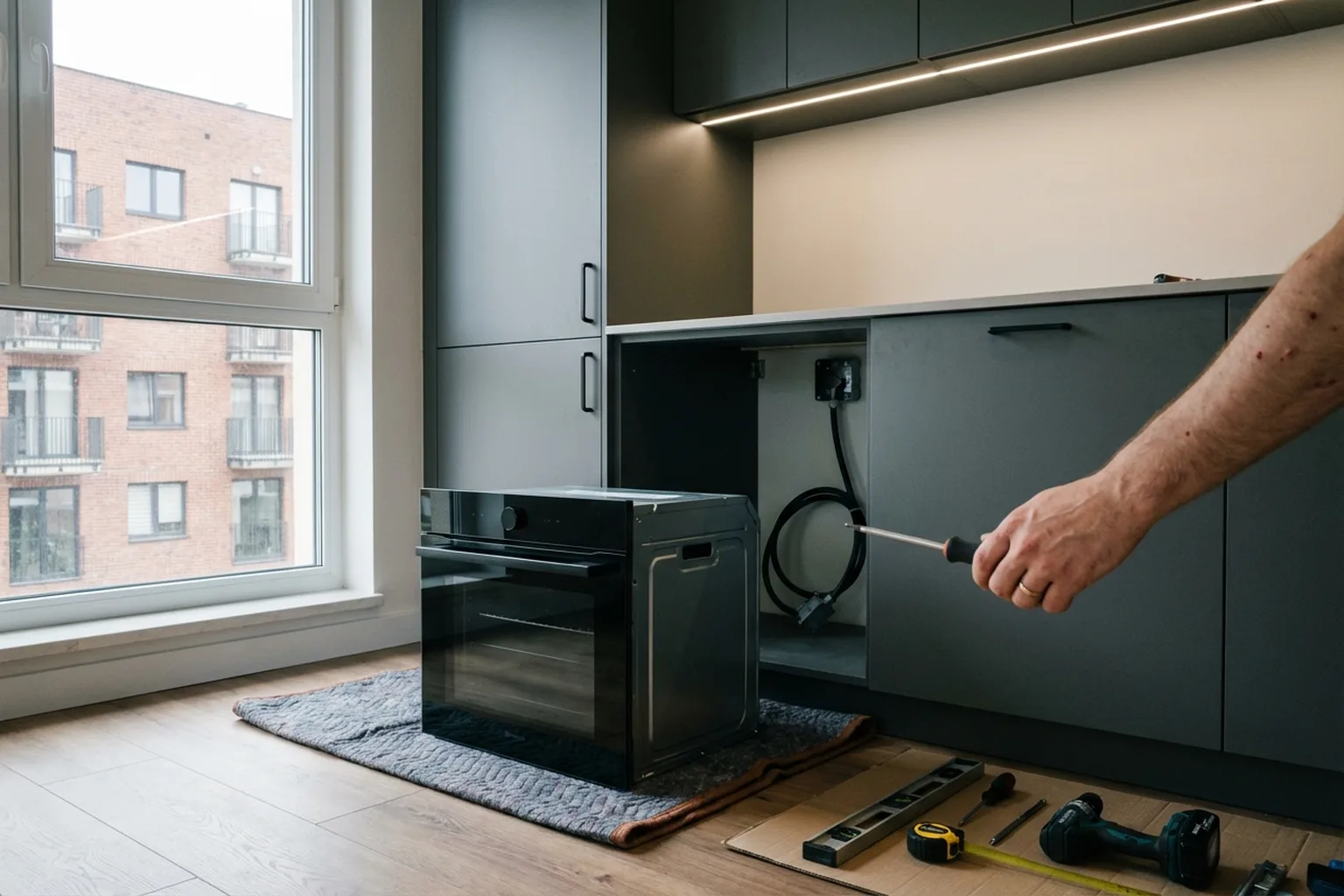
- Unpack the oven and check that all parts are there (trays, racks, mounting screws, manual).
- Make sure the niche in the kitchen unit is ready — empty, with no shelves and no back panel.
- Measure the niche: width, height, depth. Take a photo and send it to the technician beforehand.
- Check whether there is a socket behind the installation area, it should be reachable without removing cabinets.
- Clear the space in front of the kitchen: the technician needs room to work.
- If the oven is being installed in a tall unit at eye level — make sure the structure can carry the weight (25-35 kg).
- Arrange access to the apartment: intercom code, parking, floor number.
- Do not throw away the packaging until the oven has been tested: in case of a factory defect.
- Confirm the oven model and connection type (standard plug or terminal block).
A real case from Warsaw
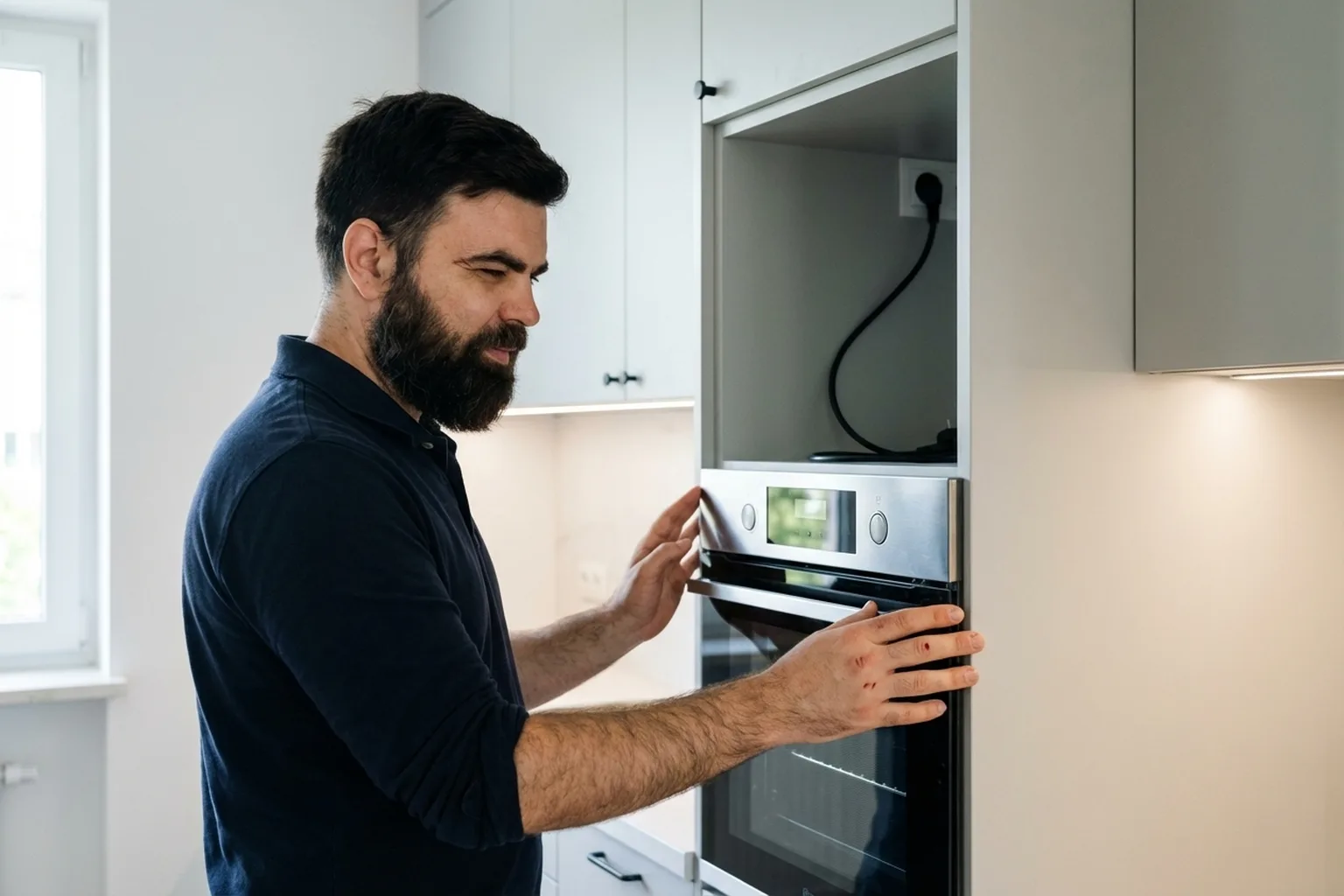
A client from Mokotow bought an IKEA kitchen and a separate Bosch 60 cm oven. During kitchen assembly, it turned out that the base cabinet for the oven had been assembled with an internal shelf, and the fibreboard back panel was still in place. The niche was 2 cm too narrow because the side panels had been fitted incorrectly. The technician took the cabinet apart, repositioned the sides in line with the manufacturer’s instructions, and removed the back panel and shelf. After fitting the oven, he made sure the correct gaps were left on the sides and at the back, and secured the unit with four screws. He plugged it into a socket that an electrician had earlier routed behind the adjacent cabinet. A test heat-up showed that everything was working properly. The whole job took about two hours. Takeaway: when ordering a kitchen, ask the supplier exactly which cabinet you need for your oven model — niche dimensions can differ even within the same manufacturer.
Frequently asked questions
Can I install the oven myself?
Physically: yes, if the niche is ready and the socket is in place. But if cabinet alterations or electrical checks are needed, it is better to call a professional. Mistakes with ventilation and wiring can damage furniture or cause a fire.
What kind of socket does an oven need?
A standard 230V 16A socket with earthing. Most domestic ovens draw 2.5-3.5 kW — that is enough. A dedicated circuit from the consumer unit is recommended but not always necessary.
Do I need to remove the back panel of the cabinet?
Yes, always. The fibreboard back panel cannot handle heat and blocks ventilation. Every oven manufacturer states this in the manual.
What gaps are needed for a built-in oven?
At least 5 mm on each side, 40-50 mm at the back, and at the bottom, according to the specific model’s instructions. This is necessary so hot air can escape.
Can I install the oven in a tall unit at eye level?
Yes, if the unit is made for it and can support the weight. It is a handy option: no need to bend down. The technician will check the structure is solid enough.
What is included in the installation price?
Labour, fixings, travel within Warsaw. Cabinet alterations, if needed, are priced separately. Packaging removal is an extra charge.
How long does installation take?
If the niche is ready — about an hour. If cabinet or electrical work is needed, two to three hours.
Who does the work
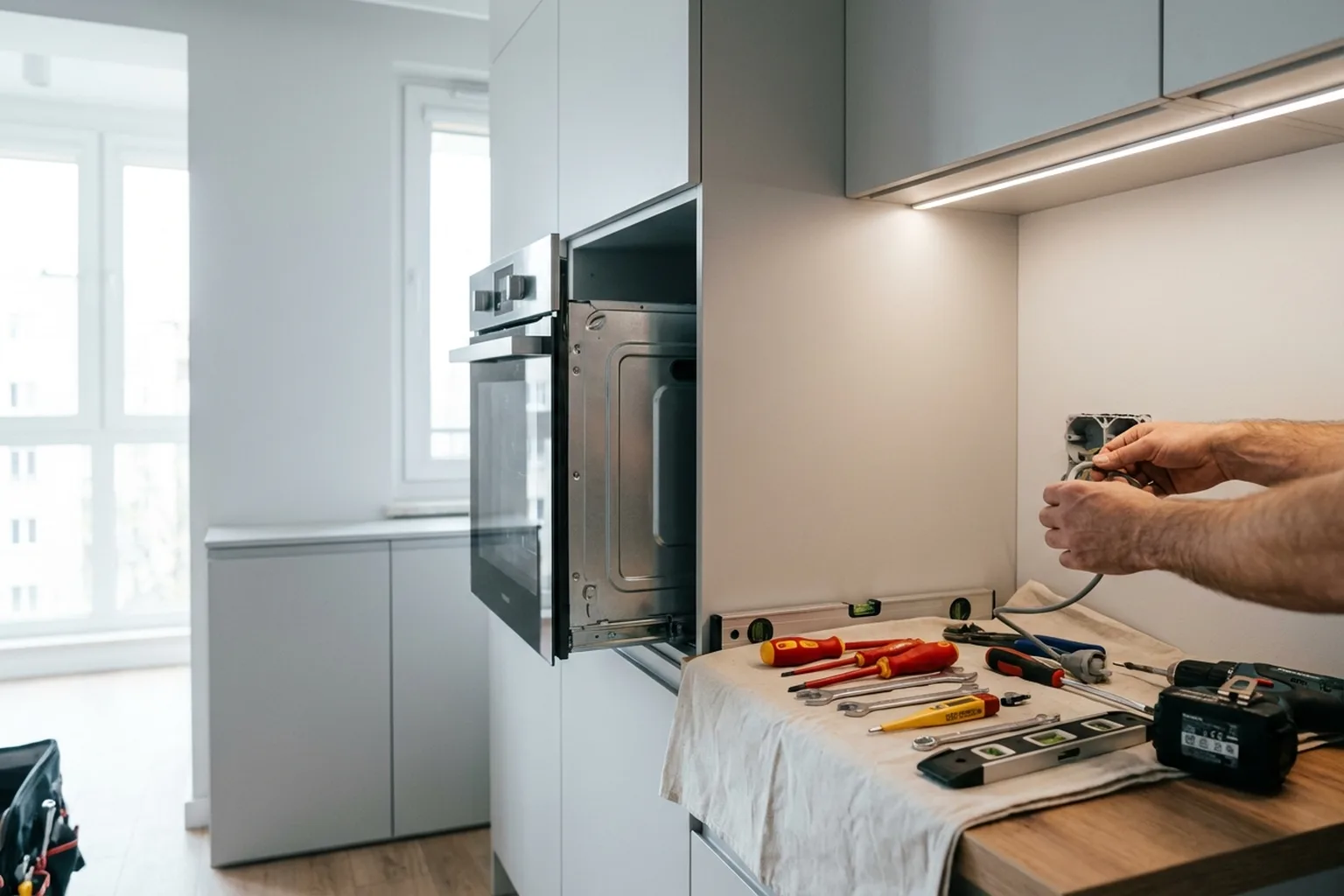
Kitchen appliance installation is done by professionals with hands-on experience in kitchen assembly and fitting built-in appliances. Tradespeople know IKEA, Leroy Merlin, Castorama, and bespoke kitchen units well. Tradespeople cover all of Warsaw and nearby areas.
Order in the app
Describe the job, add photos and the address. Tradespeople send their own prices and dates, and you pick one of the offers.
Open the app