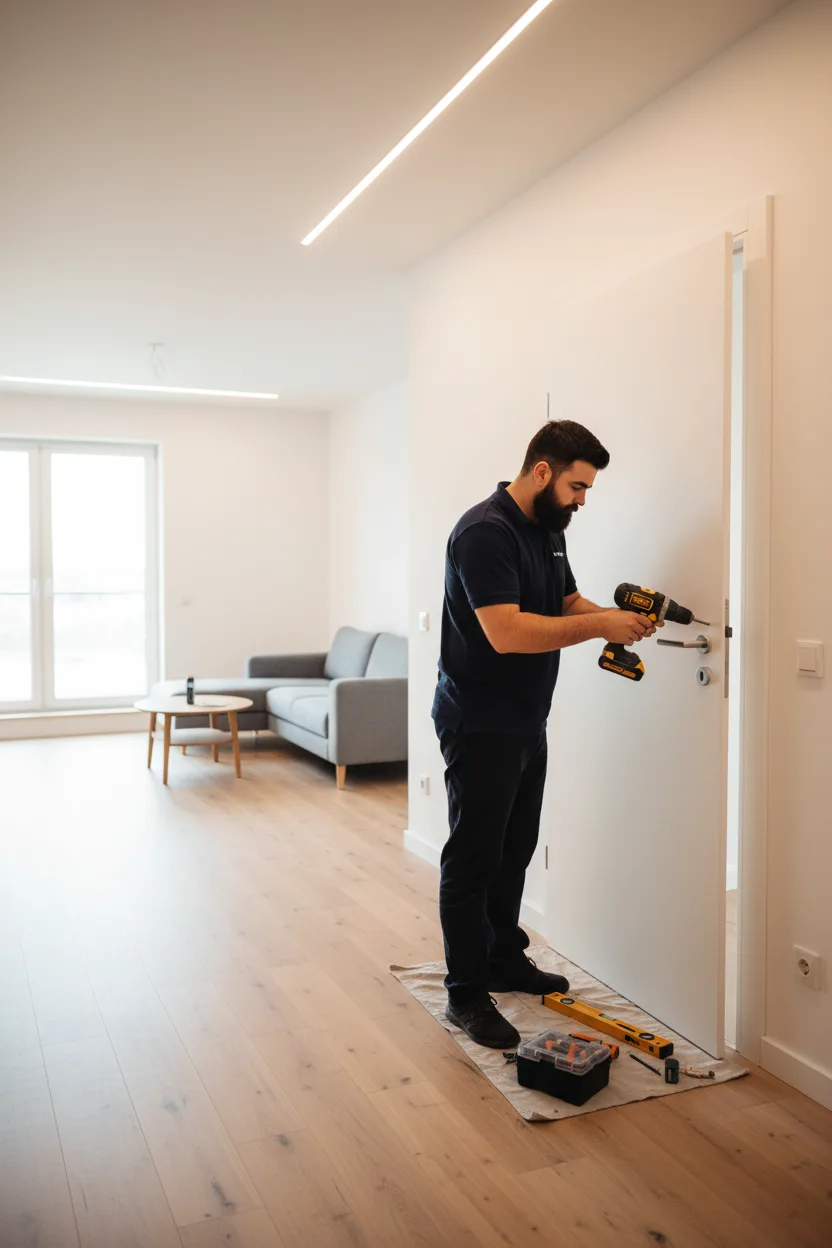

You bought the panels, carried them upstairs, looked at the floor — and it turns out it is not flat? Or maybe it looked alright, but once installed the boards start creaking, clicking at the joints, and opening up after a couple of months? That is the usual outcome when laminate goes down without proper prep. We fit laminate flooring all over Warsaw — in new builds and older flats, in houses and offices. We come with our own tools, inspect the subfloor, and install everything with the right expansion gaps and proper method. If you want a floor that stays even and problem-free for years, give us a call.
How much does laminate installation cost and what affects the price
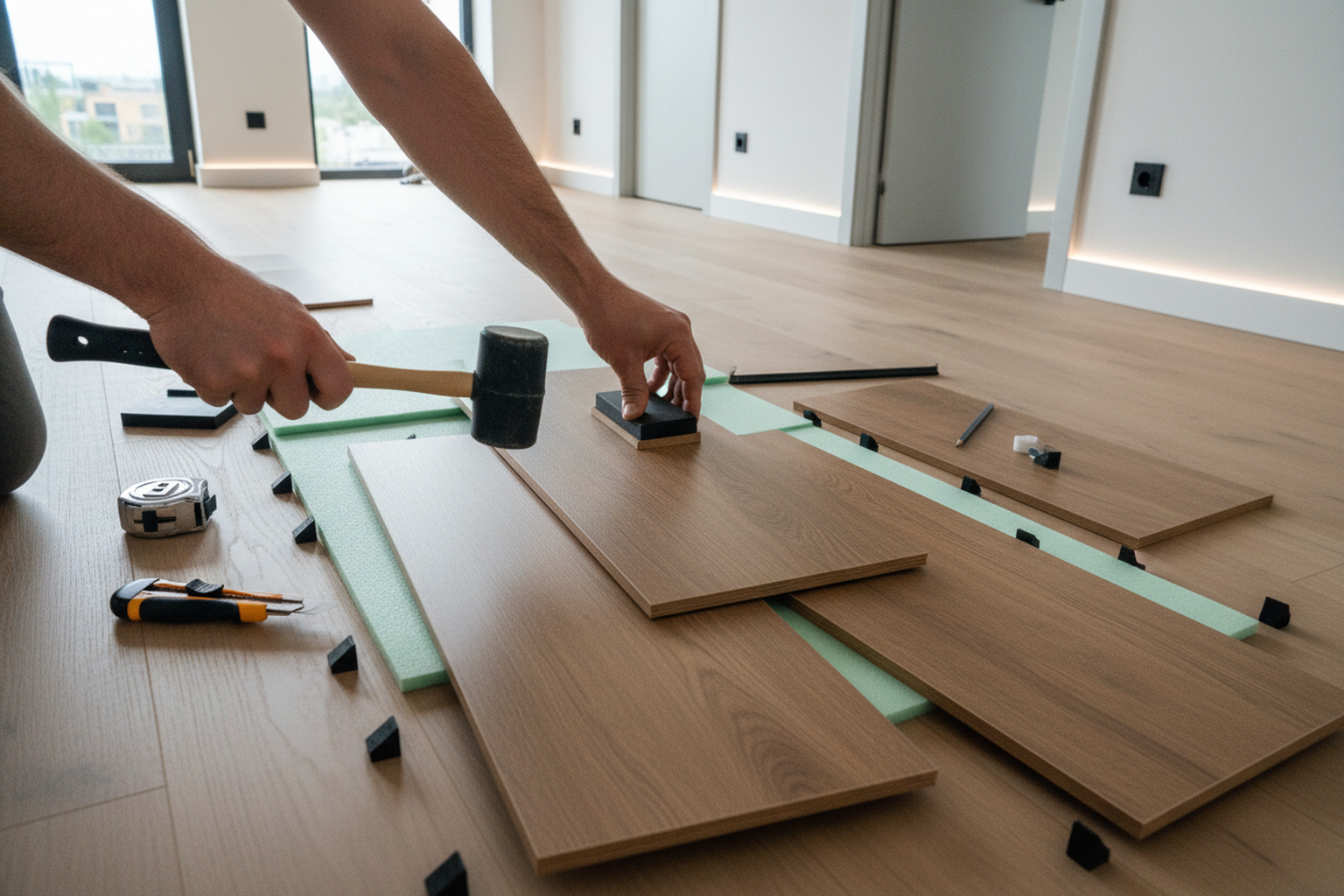
The cost depends on the area, the state of the subfloor, and the panel type. Standard click-lock laminate is charged at one rate; glue-down vinyl planks at another. If the floor is uneven and needs prep work (levelling, priming), that increases the final amount. Removal of old flooring, skirting boards, and thresholds is charged separately. Underlay and the laminate itself are provided by the client — we install what you already have or advise what to purchase. Current prices are in the table below.
| Service | min | max |
|---|---|---|
| Floor panel removal | 15 zł/m² | 25 zł/m² |
| Floor panel installation | 70 zł/m² | 90 zł/m² |
| Floor panel replacement | 70 zł/m² | 100 zł/m² |
| Vinyl panel installation | 80 zł/m² | 120 zł/m² |
| Baseboard installation | 30 zł/mb | 45 zł/mb |
| Baseboard removal | 15 zł/mb | 25 zł/mb |
| Old flooring removal | 12 zł/m² | 20 zł/m² |
| PVC flooring installation | 45 zł/m² | 75 zł/m² |
| Glue-down flooring installation | 45 zł/m² | 75 zł/m² |
| Floor threshold installation | 180 zł | 300 zł |
| Door trimming after floor installation | 120 zł | 250 zł |
How the on-site installation works
- You send a photo of the room and the approximate area — the technician assesses the scope and gives you an estimated cost.
- On site we inspect the subfloor: level, moisture, and condition of the screed. If there are dips greater than 2 mm per metre, we tell you immediately — levelling is required.
- We remove the old flooring if needed: linoleum, carpet, old laminate. Skirting boards are removed carefully — if they are in good condition, we reinstall them.
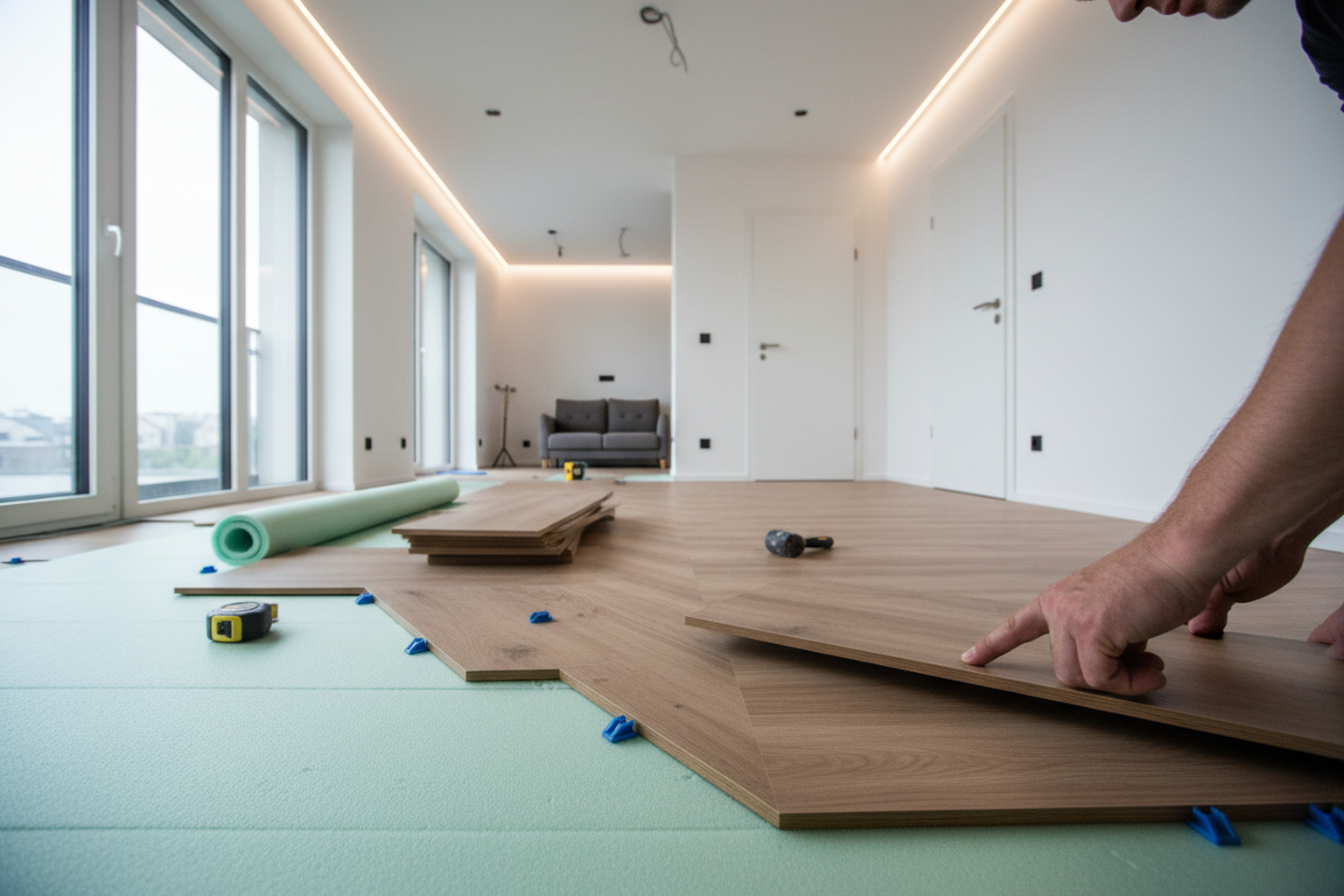
- We roll out the underlay with overlap and tape the joints. Underlay reduces noise and takes up small uneven spots.
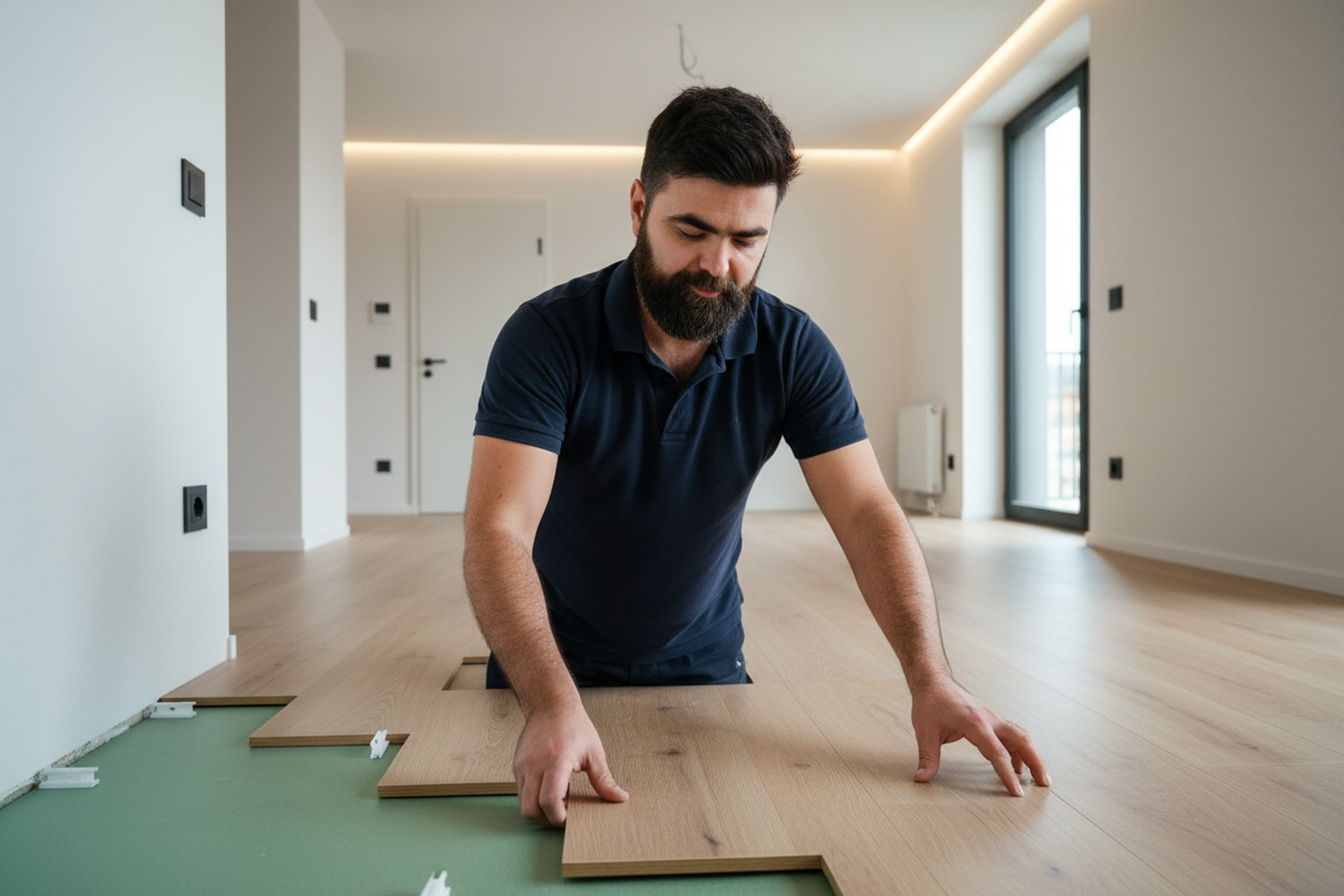
- Panels are installed from the far wall towards the door, with joints staggered by at least 30 cm. Wedges are placed along the walls to keep an 8–10 mm expansion gap.
- The last panels in each row are cut with a jigsaw or circular saw. In awkward spots (pipes, thresholds, corners) we make accurate cut-outs.
- We fit skirting boards and thresholds. We check there are no gaps, no creaks, and that every lock has fully clicked together.
Common mistakes people make installing laminate themselves
- Not checking whether the floor is level — panels are laid on an uneven screed, and within six months the locks crack under load.
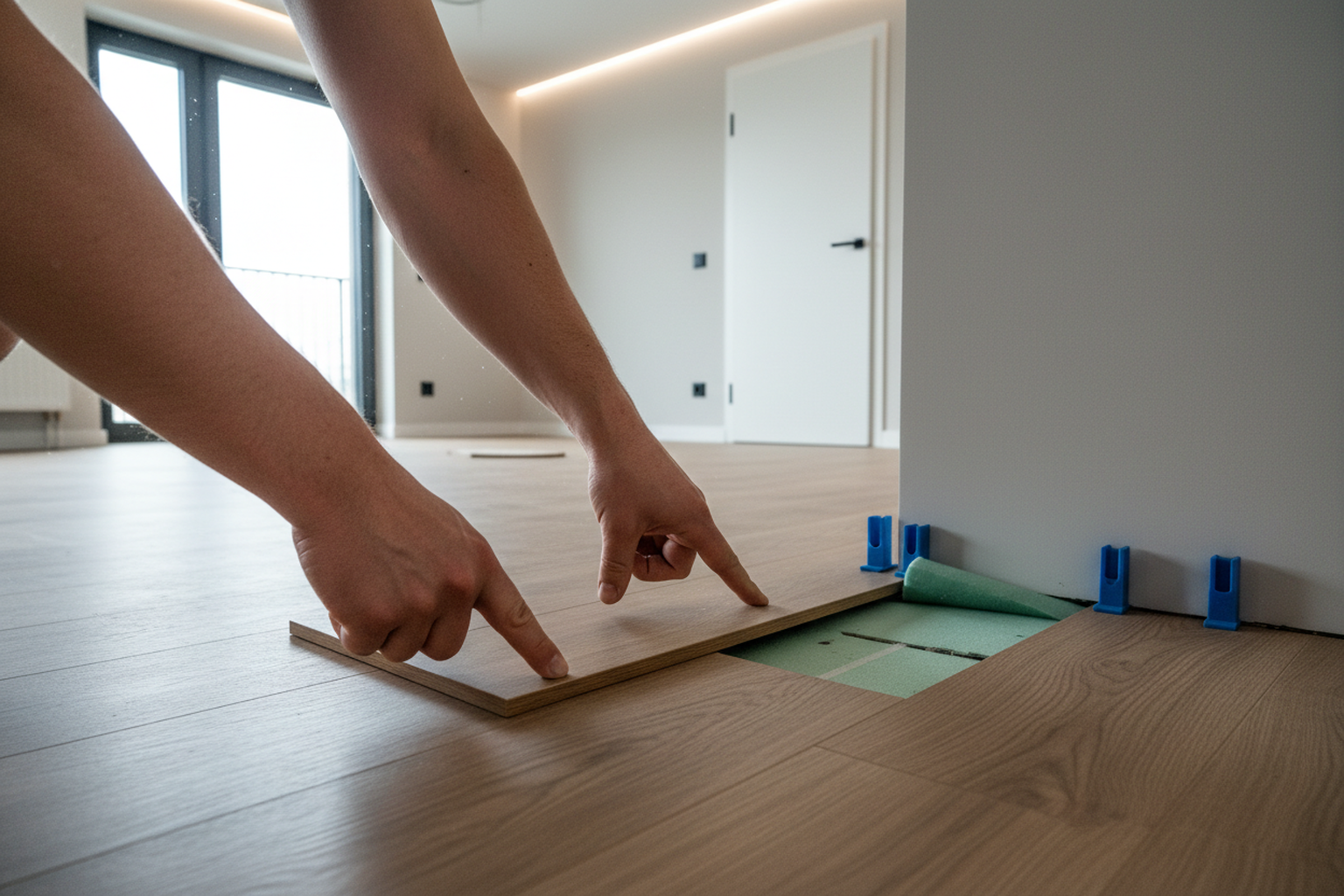
- Forgetting the expansion gap — the laminate presses against the wall and lifts in the middle of the room.
- Putting down double underlay “for softness” — the boards begin to bend and squeak.
- Skipping acclimatisation — unpacking and laying straight away, then seeing the panels expand or shrink over the next weeks.
- Not staggering the joints — seams end up lined up, which makes the floor weak and look bad.
- Hammering panels without a tapping block — chipped locking edges, then gaps appear.
- Installing laminate in the bathroom without waterproofing — water gets underneath and the boards swell.
- Not trimming the doors — the door rubs on the new surface and scratches the finish.
What to prepare before the technician arrives
- Empty the room of furniture. The technician does not move wardrobes — that is a separate service.
- The laminate should stay in the room for at least 48 hours before installation — acclimatisation.
- Check that you have enough panels: the recommended spare is 5–10 % of the area for offcuts.
- If old flooring needs to be removed, tell us beforehand — it affects the schedule.
- Identify the subfloor type: concrete screed, wooden floor, plywood. This decides the underlay.
- Buy the underlay if the technician has advised a specific one. Standard thickness is 2–3 mm.
- Have skirting boards and thresholds ready — best to install them right after laying.
- Make sure there is a power socket nearby for the tools.
- If you have underfloor heating, let us know in advance — a special underlay is needed.
- Provide the intercom code and parking details.
A real case from Warsaw

A client in the Bemowo district bought a second-hand flat — 55 square metres, with old linoleum over concrete throughout. He wanted laminate in every room apart from the bathroom. We began with demolition: removed the linoleum and found adhesive residue plus a screed with up to 4 mm of unevenness. Two rooms needed a self-levelling compound; in the third, sanding was enough. A day later, once the compound had cured, we rolled out the underlay and installed the laminate. In total — 48 square metres over two working days. We also trimmed three doors that would not close after the new floor was laid, fitted skirting boards around the perimeter, and installed thresholds in every doorway. The client moved in the next day — the floor is flat, nothing creaks, and the doors close properly. Three months later he messaged us saying everything is still perfect (compatible with Quick-Step, Egger, Kronopol and similar).
Frequently asked questions
What laminate should I choose?
For a flat, class 32 is enough; for an office or hallway, choose class 33. An 8 mm thickness is the best middle ground. Vinyl planks are a good choice for kitchens and rooms with higher moisture.
Does the floor need levelling?
If the deviation exceeds 2 mm per metre — yes, absolutely. Otherwise the locks will stay under stress and sooner or later break.
How long does installation take?
A standard room of 15–20 m² takes around 3 to 4 hours on a level subfloor. With demolition and levelling, allow a full day.
Can I lay laminate over old linoleum?
Yes, as long as the linoleum lies flat with no bubbles or waves. It works as extra underlay. But removing it is the better option — there may be moisture or unevenness underneath.
What if the laminate buckles?
Most often the reason is a missing expansion gap. Remove the skirting, trim the panels 8–10 mm back from the wall, and let the floor settle. If the buckling comes from water damage, the affected panels need to be replaced.
Do you install vinyl planks as well?
Yes, we install both vinyl (LVT/SPC) and classic laminate. Vinyl needs a smoother subfloor but holds up longer in damp areas.
Do you work on weekends?
Yes, Saturdays and Sundays included. Book in advance if you can — weekends are our busiest days.
Are materials included in the price?
No, materials (laminate, underlay, skirting) are bought by the client. We help calculate quantities and can recommend a brand.
Who does the work and how we operate
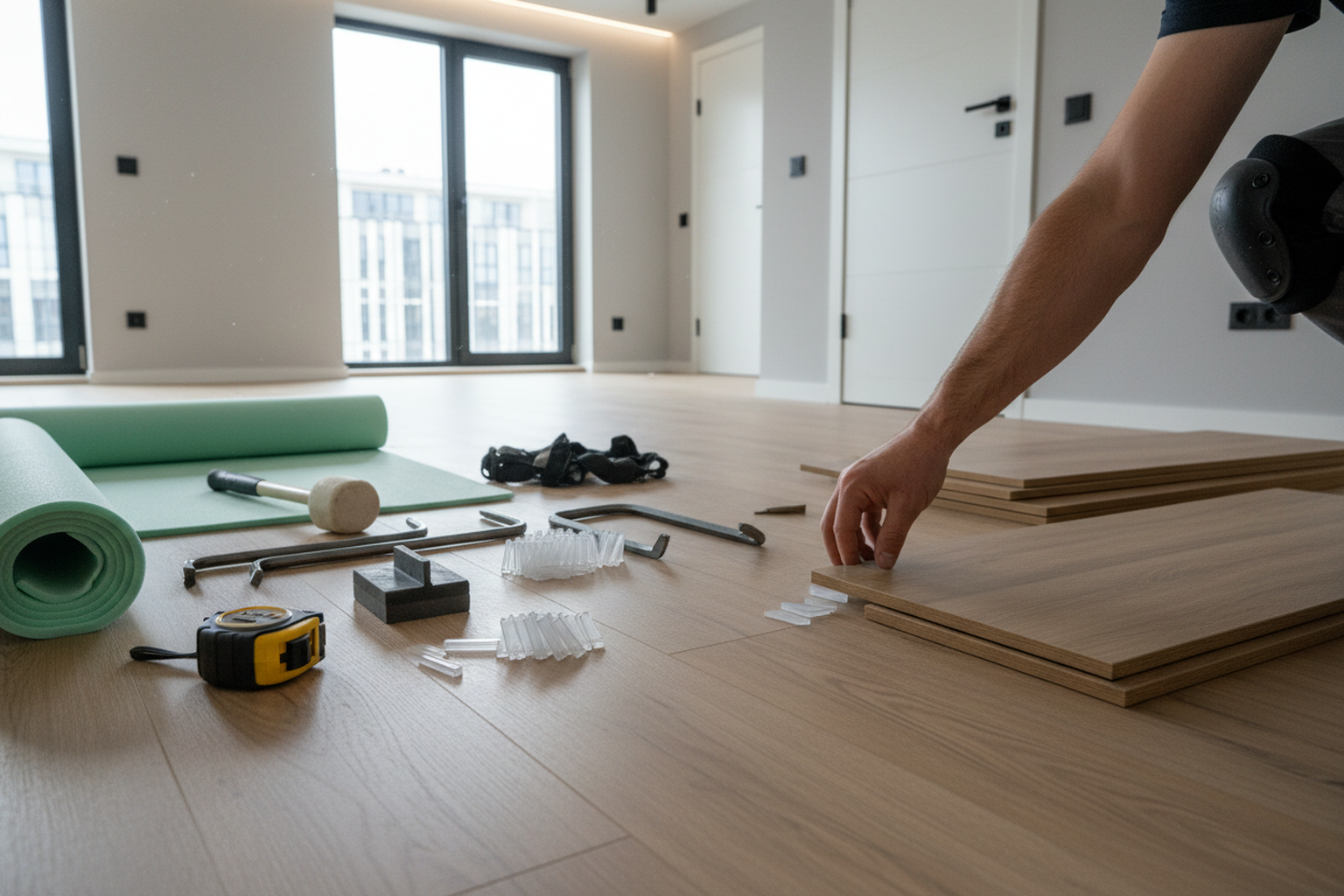
Installation is done by technicians with hands-on experience in floor coverings — laminate, vinyl, parquet. We do not send beginners — the person who comes out knows the difference between a Click and a Lock joint, understands why the expansion gap matters, and can cut a panel neatly around a pipe. We cover all of Warsaw and the nearby suburbs: Bemowo, Wola, Mokotow, Ursynow, Wilanow — distance is not a problem. If you need flooring installed, call or message us. We reply within an hour and arrange a time that suits you.