How much does precision cutting cost and what affects the price
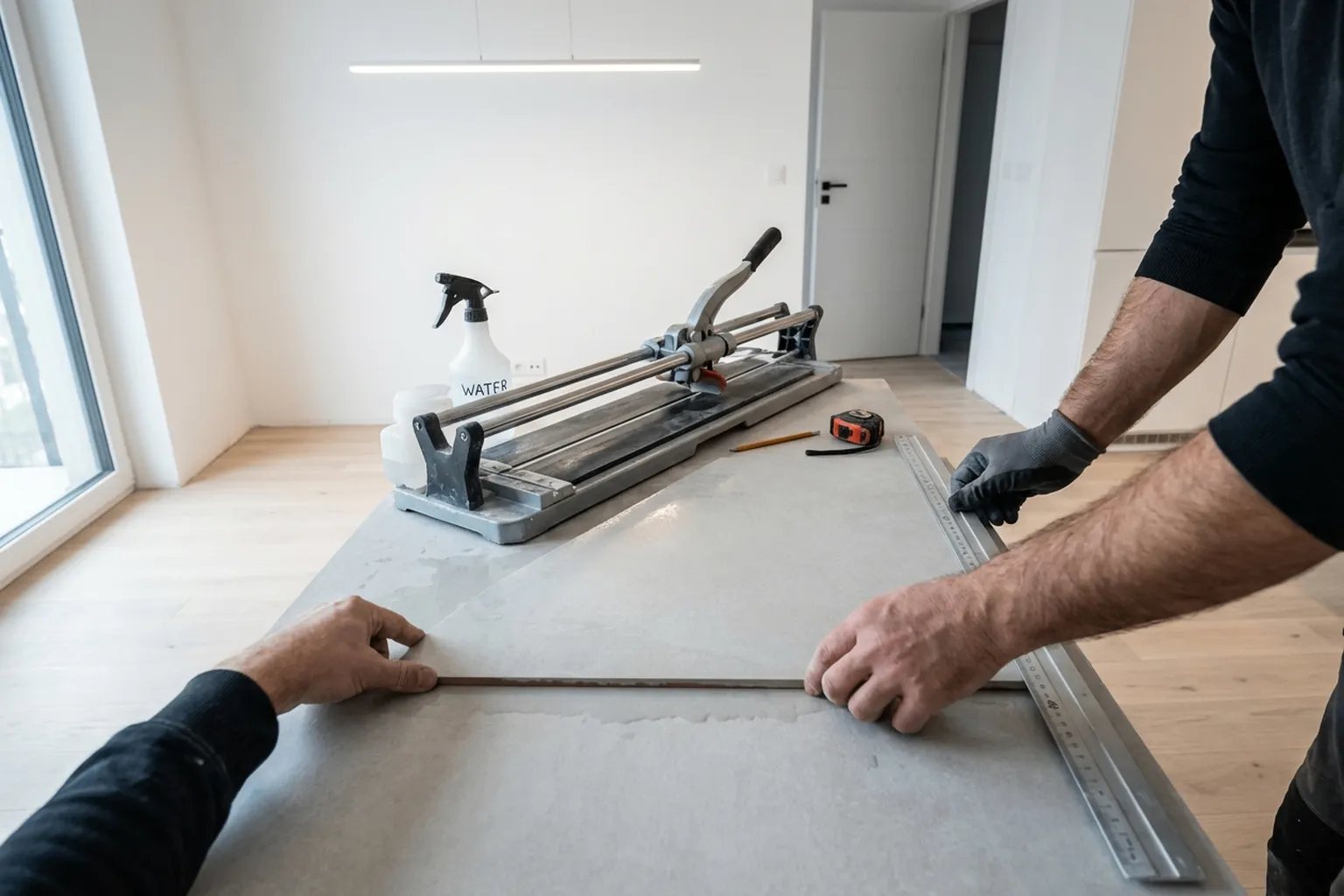
Precision tile cutting in Warsaw costs from 25 zł/mb for a straight cut along a factory edge up to 140 zł/mb for sintered stone; large format runs 60–100 zł/mb, and cutting around a drain is quoted separately. The current rates are in the table below. The price depends on the kind of material, the number of cuts, and how difficult they are. Sintered stone (Dekton, Neolith, Laminam) needs a dedicated diamond blade that costs much more than a regular one: that is included in the quote. A 45-degree mitre cut for finishing external corners is charged separately because there is almost no room for mistakes. Fasteners are part of the installation price; materials and tiles are billed separately. Check the current rates in the table below.
| Service | Price |
|---|---|
| Large format precision cut | 60–100 zł/mb |
| Sintered stone precision cut | 80–140 zł/mb |
| Straight precision cut (factory edge) | 25–40 zł/mb |
| Precision cut around drain | 120–250 zł |
Indicative prices. Ranges for a typical scope. Fixings included, materials separate. Minimum order 300 zł.
What it costs and how to book: large format tiling in Warsaw.
What materials get cut
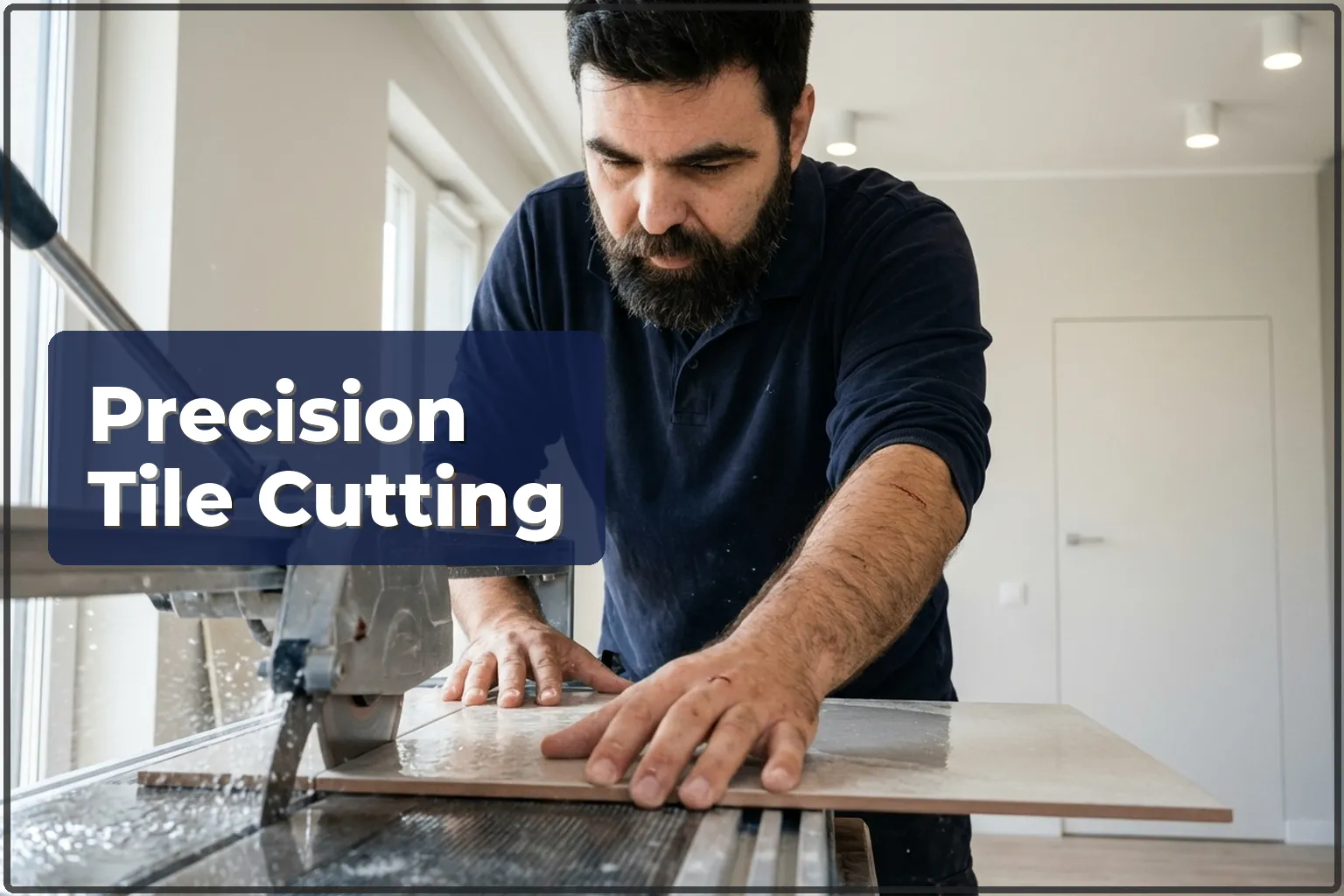
On a water-cooled bridge saw they cut porcelain and standard ceramic tiles, large format porcelain slabs from 60×120 upwards, and sintered stone: Dekton, Neolith, Laminam. Each material needs its own blade and feed rate: ceramic is the easiest, large format porcelain needs a rail guide across the full length of the cut, and sintered stone needs a continuous-rim blade and a single pass with no stopping. Tradespeople also cut natural stone and glass mosaic, where hand nippers leave a ragged edge. Furniture boards: chipboard, MDF, laminated panels, are not cut on this machine; they need a panel saw, and they handle that as a separate service.
How precision cutting works on site
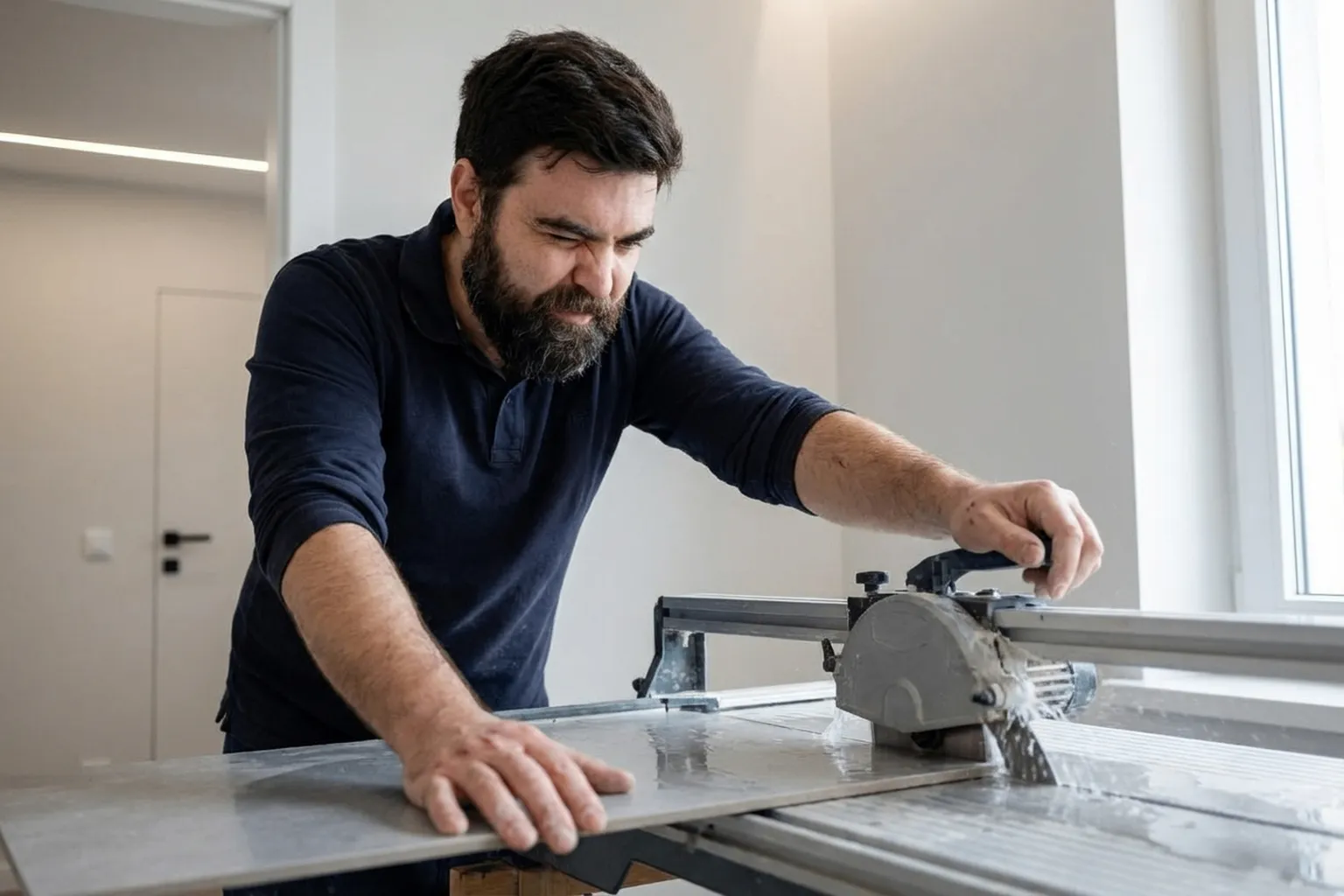
- The specialist checks the material: looks at thickness, structure, and whether there is reinforcing mesh (in sintered stone). Then selects the blade type and feed speed.
- Marks the cut line with grout joints and compensation in mind. For curved cuts, a template is used.
- Fixes a guide rail on the tile: this stops it from moving. Rubi and Montolit have dedicated clamping systems.
- Makes the cut with water cooling. Water keeps the blade from overheating and washes away dust. On large format, the cut is done in one pass — if you stop, chipping starts.
- Finishes the edge: removes the chamfer, polishes the face with a diamond sponge if needed. For 45-degree mitres, the edge is refined fully.
- Checks the result: uses a square, confirms straightness. If the cut goes along a wall, tolerance is within 0.5 mm.
- Cleans the area, removes off-cuts. Large tile leftovers are kept: they can come in handy for trimming in corners.
Common mistakes when cutting tiles (and how to avoid them)
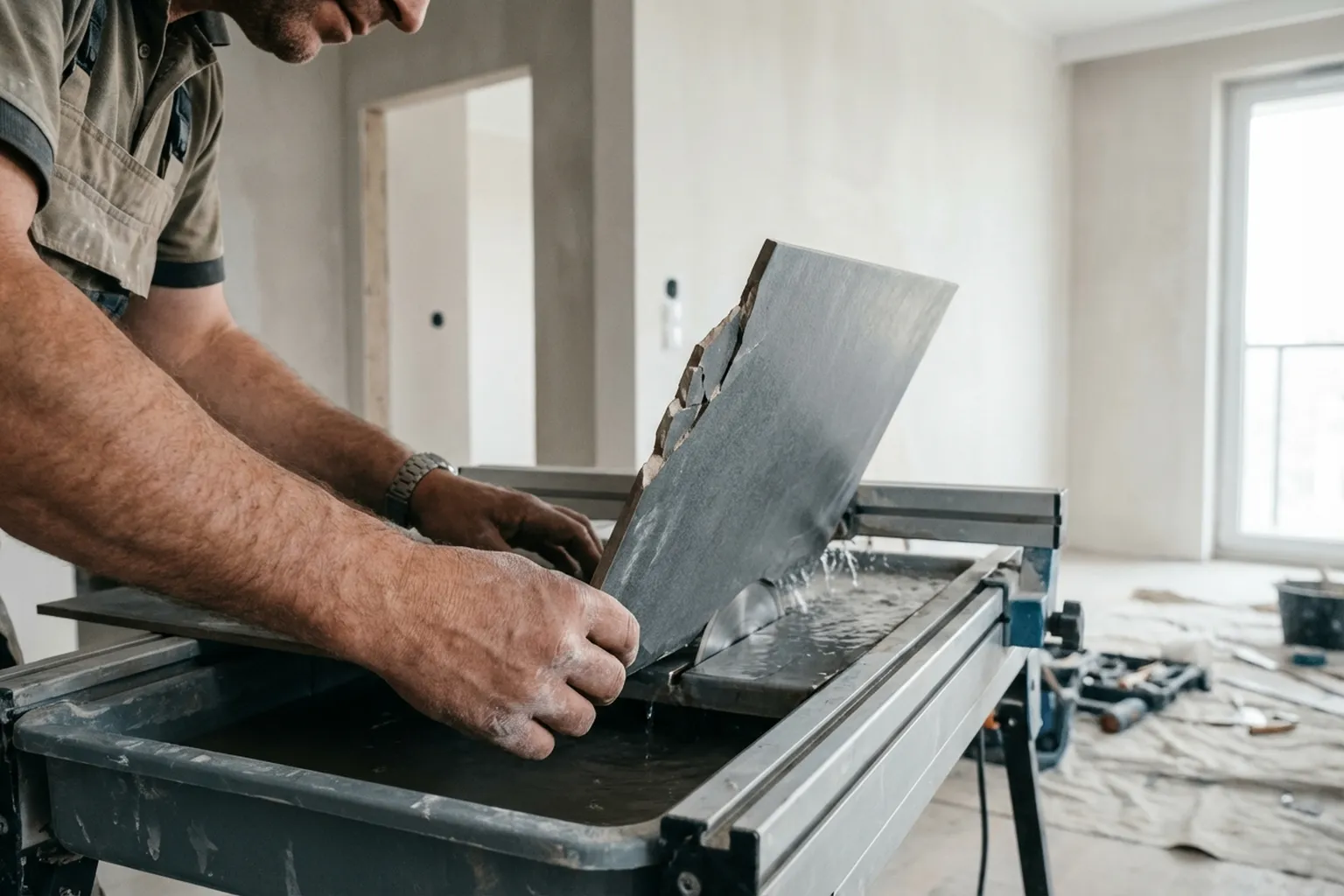
- Cutting large-format tiles with an angle grinder and no guide, the edge comes out wavy, and chips show up on the glaze. An angle grinder is fine for rough cuts on standard ceramic, but not for large format and sintered stone.
- Using a cheap blade on sintered stone: the blade is finished after two cuts, the stone overheats and cracks. You need a continuous-rim blade matched to the material’s hardness.
- Cutting without water: dry cutting of porcelain stoneware means a cloud of dust and overheating. The result is micro-cracks that appear six months later.
- Trying a 45-degree mitre on brittle porcelain without practice: the thin edge breaks away. On 6 mm sintered stone this is especially serious.
- Cutting tiles on an uneven base: vibration damages the material. For large format (60×120 and above) you need a flat table or polystyrene foam underlay.
- Trying to finish the cut from the back side: the two lines miss each other and leave a step. The cut has to be done in one pass.
- Ignoring pattern direction during marking — the cut piece does not line up with the texture of the adjacent tile.
What to prepare before the specialist arrives
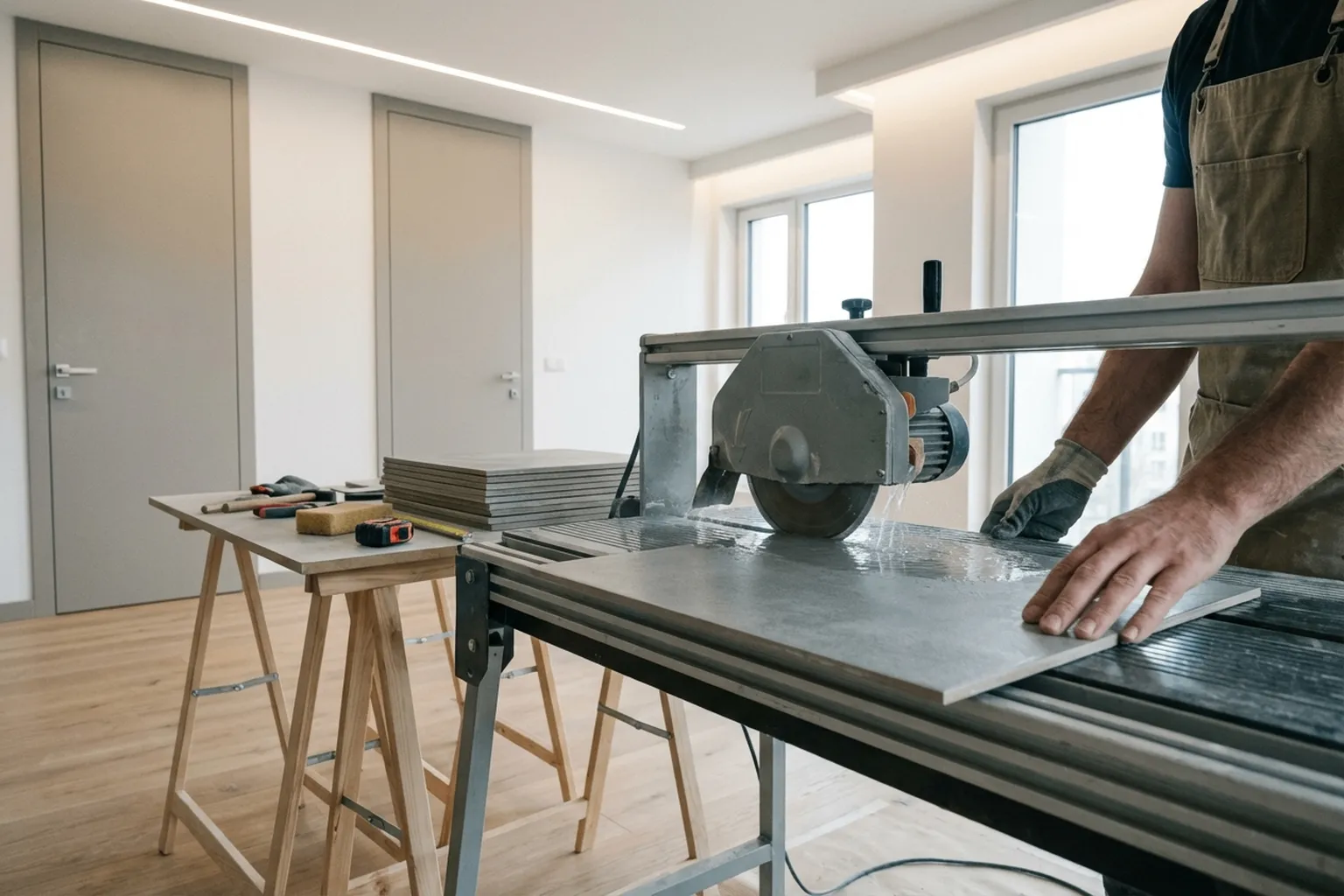
- Buy tiles with a 10-15% surplus: cutting large format can lead to losses, especially with complex shapes.
- Confirm the exact thickness and material type with the seller (porcelain stoneware, sintered stone, quartz agglomerate): this decides the blade choice.
- Remove furniture and unnecessary items within a 2-metre radius of the work area.
- Make sure there is access to water: wet cutting needs a hose or bucket nearby.
- Prepare a 220V outlet within 5 metres of the work zone.
- If tiles are stored vertically, tell the specialist so they can lay them flat carefully for marking.
- Take exact measurements of niches, corners, and cutouts, send the specialist a sketch with dimensions before the visit.
- If cuts are needed for plumbing (pipes, outlets), mark the exact coordinates of the holes on the wall.
- Protect finished surfaces (bathtub, countertop) with film or cardboard: wet cutting causes splashes.
- Share details about building access, intercom, and available parking nearby.
Case study: cutting sintered stone in Ursynow
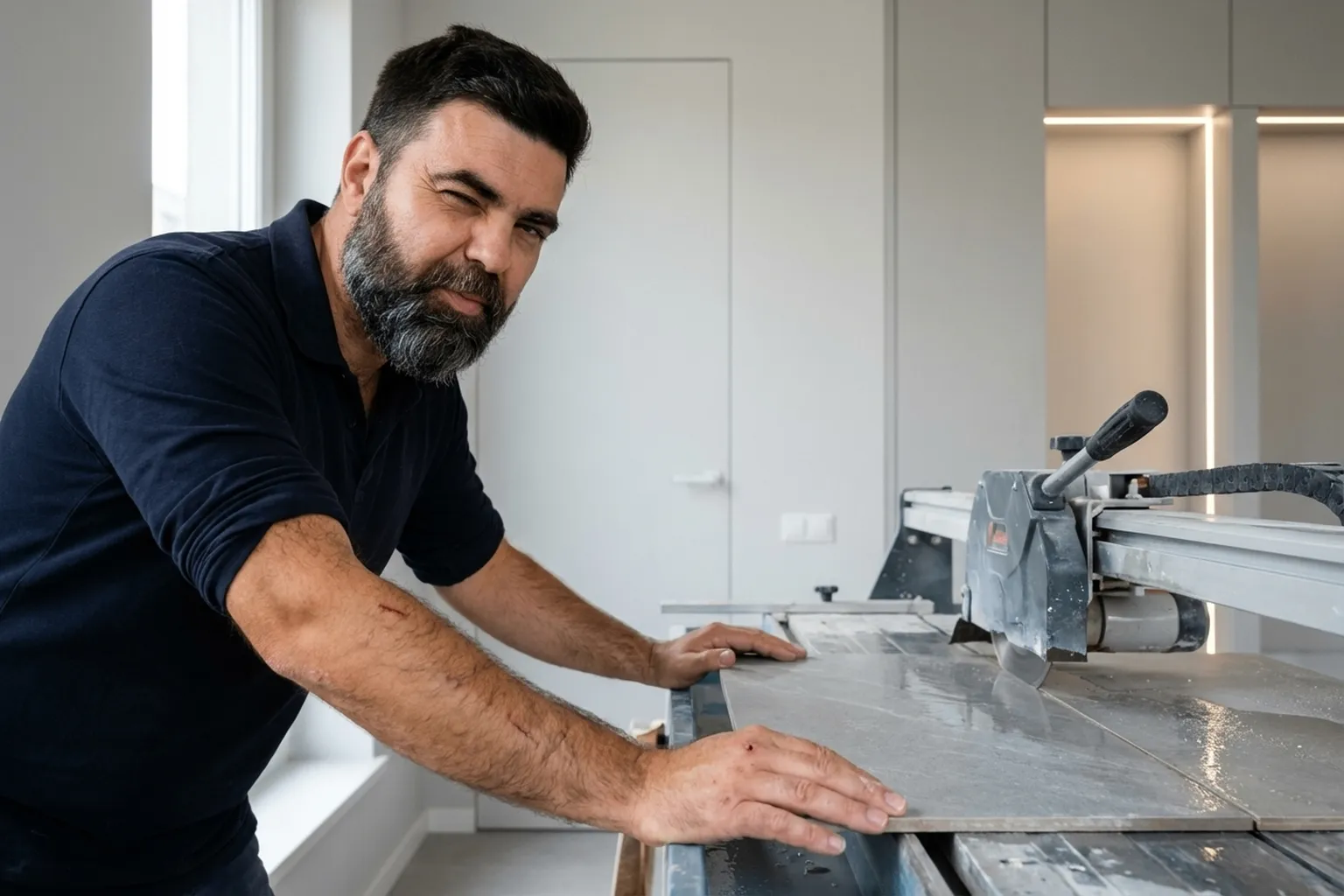
A client ordered installation of Dekton slabs 320×144 cm in a bathroom. The previous contractor tried to cut them with an angle grinder, destroyed two slabs, each worth over a thousand zlotys. Tradespeople came with a Rubi DC-250 electric tile cutter and a diamond blade for sintered stone. First, they marked all cuts on the floor, with polystyrene foam underneath for support. The tricky part was an L-shaped cutout for the Geberit installation frame, it needed two perpendicular cuts accurate to the millimetre. Every cut was done with water cooling in a single pass. The mitre on the external corner was made at 45 degrees and finished with a P400 diamond sponge. The whole job (14 cuts including 4 mitres) took about 3 hours. The client would have saved time and two slabs by calling a specialist from the beginning. After installation, joints were grouted with Mapei Keracolor, the finish looks like one solid surface.
Frequently asked questions about precision tile cutting
What is the difference between precision cutting and standard cutting?
Standard cutting is a straight cut through ceramic tile with a manual cutter like Sigma. Precision cutting means working with porcelain stoneware, large format, or sintered stone on an electric tile cutter with water cooling. The edge after precision cutting is smooth, without chips, and ready for installation with no extra finishing.
Can you cut large-format tiles with an angle grinder?
Technically yes, but the result will be weak. An angle grinder cannot hold a straight line on long cuts (60 cm and above), vibration causes chipping, and without water: overheating. For large format and sintered stone: only an electric tile cutter with a rail guide.
What is mitre cutting (45-degree cut) and why is it needed?
Mitre cutting means trimming the tile edge at a 45-degree angle to finish external corners. Instead of a plastic trim profile, two tiles meet at their edges and form a clean right angle. It looks more expensive and modern but needs accurate cutting: tolerance under 1 mm.
What equipment is used for precision cutting?
Tradespeople use Rubi and Montolit electric tile cutters with water cooling. For sintered stone: dedicated continuous-rim diamond blades. For finishing and mitring: diamond sponges in different grits (P120-P400).
How long does precision cutting take?
One straight cut on a 120×60 large-format tile takes 3-5 minutes including marking and guide setup. A mitre takes from 10 minutes per edge. A shaped cutout (for a socket or pipe) takes 10-20 minutes. The total time depends on the number and difficulty of the cuts.
Can a tradesperson make a circular cutout in a large-format tile?
Yes, circular cutouts are made with diamond core bits of the required diameter. Sintered stone can be drilled only with a diamond core bit using water.
Do tradespeople cut tiles on site or only in a workshop?
Tiles are cut directly on site. The electric tile cutter is mobile, and the tradesperson brings it along. This is more practical because you can test-fit the tile right away, adjust the size, and install it without extra transport.
What happens if a tile cracks during cutting?
With the right technique and equipment, waste stays minimal. Still, brittle materials (thin sintered stone 3-6 mm) come with some risk. That is why they advise buying tiles with a 10-15% surplus.
Is precision cutting needed for mosaic?
Mesh-mounted mosaic is often trimmed with scissors and individual chips are adjusted with nippers. But natural stone or glass mosaic may need careful cutting on a wet tile cutter to prevent chipping.
How do I order precision tile cutting in Warsaw?
Send a photo of the tile, specify the material type, number and type of cuts (straight, mitre, shaped). Each tradesperson says in their offer when they can come, and you pick the one that suits you.
How much does cutting sintered stone cost?
80–140 zł/mb. Sintered stone is harder than porcelain and needs a continuous-rim diamond blade that costs many times more than a standard one, that is already built into the rate. A 45° cut on sintered stone is priced separately.
How much does cutting large format tiles cost?
Large format from 60×120 is 60–100 zł/mb. A straight cut along the factory edge is cheaper, 25–40 zł/mb. The price goes up for curved cuts and cut-outs around drains or sockets.
Do tradespeople cut porcelain slabs to size in Warsaw?
Yes, they cut on site across Warsaw: Ursynów, Mokotów, Wola, Żoliborz, Praga. The saw is mobile, so a slab can be offered up and the dimension corrected straight away, without hauling it to a workshop and back.
Why trust precision tile cutting to a professional
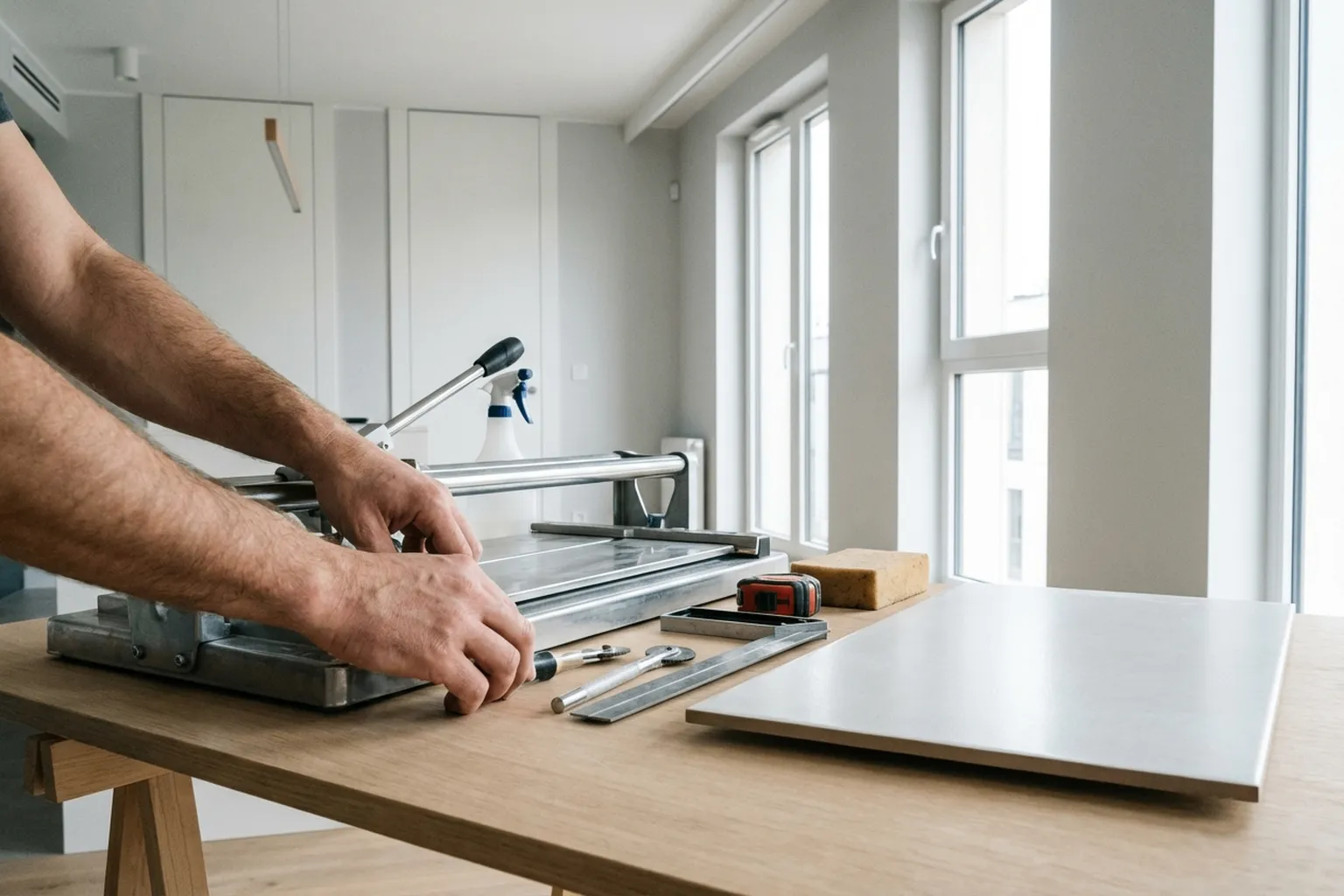
Tradespeople handle large-format tiles and sintered stone every day. Their equipment includes Rubi and Montolit electric tile cutters, DeWalt diamond blades for different material types, and a complete set for mitring and shaped cutouts. Tradespeople work across all of Warsaw: Ursynow, Wola, Zoliborz, Praga. The specialist comes with their own equipment, cuts on site with water cooling, no dust. You can expect a clean edge without chips. If the job is unusual, send a photo and dimensions, and they will give you a free estimate.
Order in the app
Describe the job, add photos and the address. Tradespeople send their own prices and dates, and you pick one of the offers.
Open the app