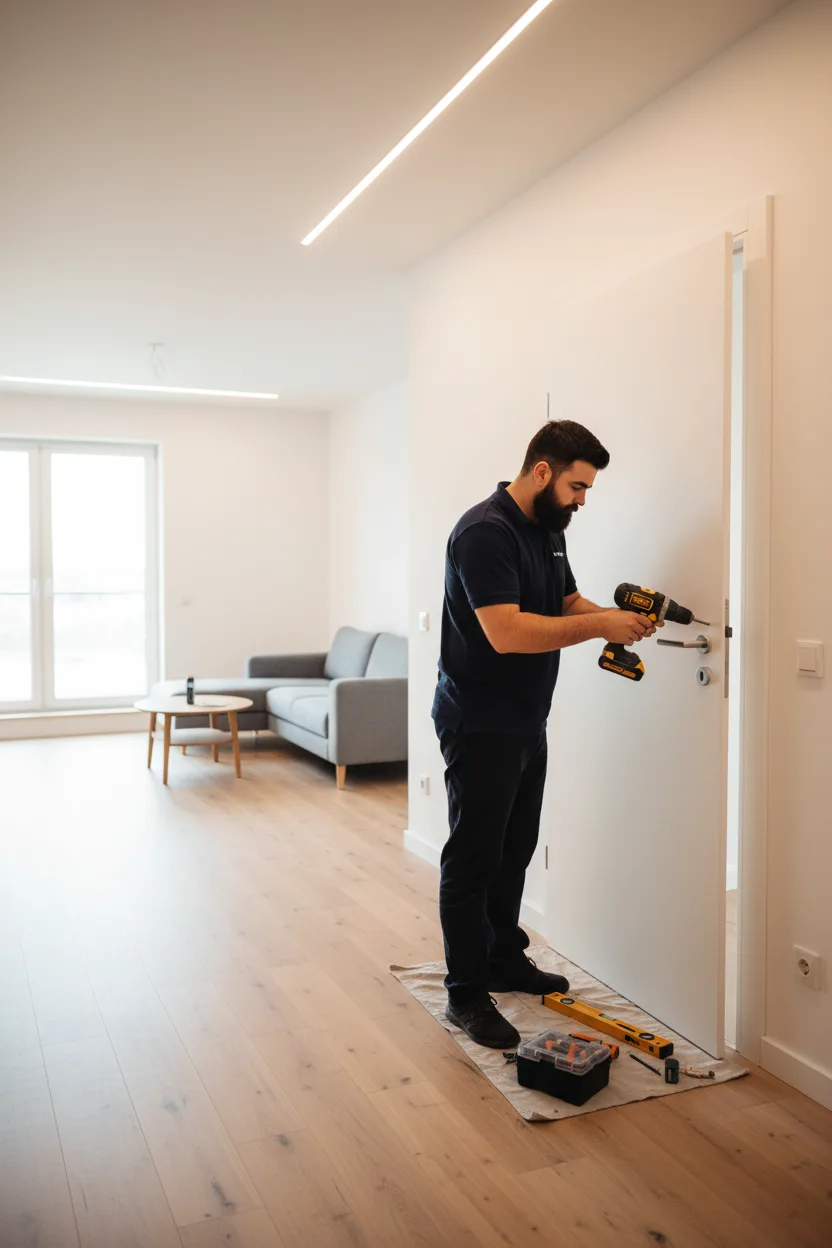
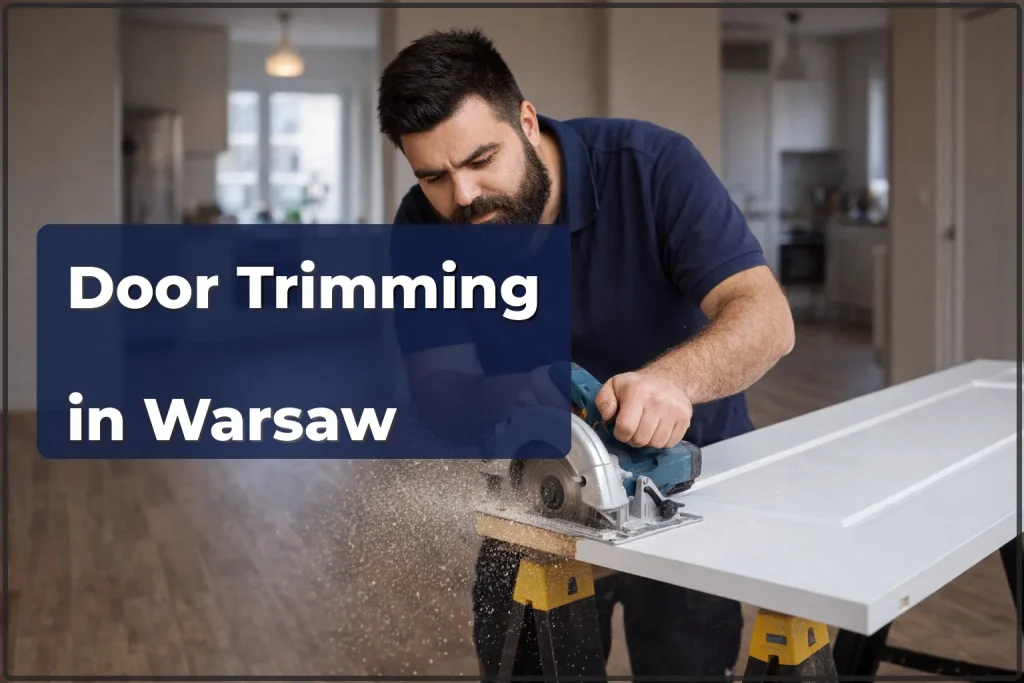
You’ve had laminate, vinyl or tiles fitted — and now the doors won’t shut properly. The leaf rubs on the new floor, drags across it, leaves marks. The issue is simple: the new flooring lifts the level by 8-15 mm, and the existing doors were never made for that change. The fix is to trim the bottom edge of the door leaf. The job is done on site — there’s no need to take the door away to a workshop. We trim doors all over Warsaw — interior, laminated, veneered, solid wood. If a few doors need shortening after floor renovation, we can come and sort them all in one visit.
How much does door trimming cost and what affects the price
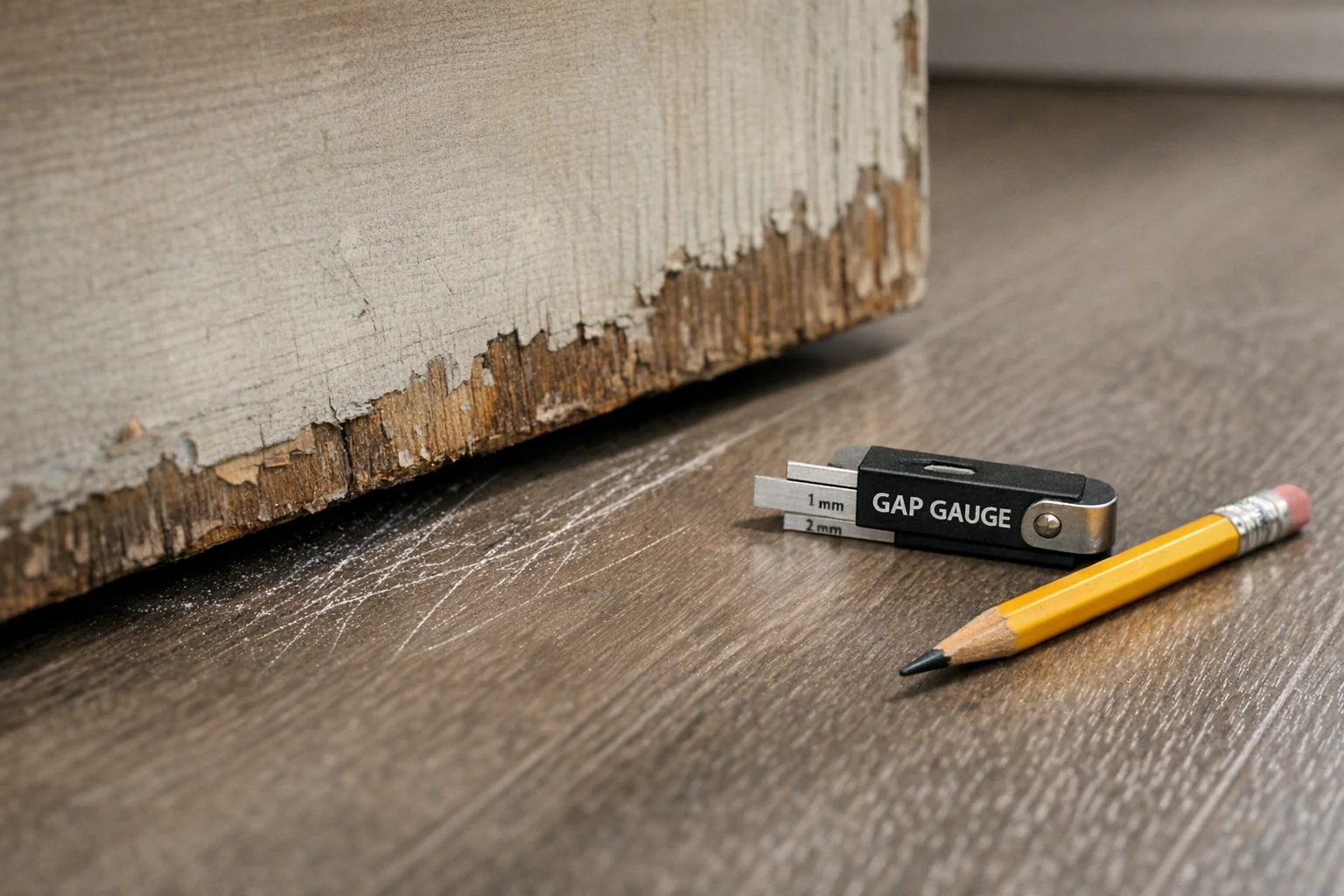
The price of trimming is based on the door material and how thick a section needs to be removed. The easiest job is a hollow-core laminated door with 5-10 mm to cut off. More work is involved with a solid timber door that needs shortening by 15-20 mm and then finishing on the cut edge. MDF doors with laminate coating are a separate case: remove too much and the hollow centre becomes exposed, so it then needs closing up with a timber insert.
Fixings and consumables are part of the labour price. If the cut edge needs staining, varnishing or sealing after trimming, that is included as well. Waste removal (shavings, offcuts) is a separate service, although trimming creates very little mess. If you order trimming for several doors, the price per door drops. Current rates for all our door services are shown in the table below (compatible with Porta, VOX, Erkado and similar).
| Service | min | max |
|---|---|---|
|
Door removal
Book this service → | 150 zł | 300 zł |
|
Door trimming
Book this service → | 120 zł | 250 zł |
|
Door frame installation
Book this service → | 250 zł | 450 zł |
|
Door adjustment
Book this service → | 30 zł | 60 zł |
|
Squeaky door lubrication
Book this service → | 40 zł | 80 zł |
|
Lock replacement
Book this service → | 180 zł | 350 zł |
|
Door handle replacement
Book this service → | 80 zł | 150 zł |
Send a photo of the door and the gap — the technician will check the scope of work and give you an exact quote with no hidden add-ons.
How door trimming works: step by step

Door trimming is precise work — even a one-millimetre mistake stands out straight away. This is how the technician handles it:
- Measuring the gap. The technician checks exactly how much has to be removed. Measurements are taken in several places — the floor may not be level, and the trim has to allow for that. A clearance of 3-5 mm is left so the door moves freely.
- Removing the leaf from the hinges. The door is lifted off the hinges and placed flat on trestles or supports. The hinges remain on the frame — they are not taken off.
- Marking the cut line. A clean line is marked from the measurements, with floor unevenness taken into account. The line is drawn on both sides of the leaf.
- Cutting with a plunge saw or electric planer. The main tool is a plunge circular saw with a guide rail — it gives a straight cut without chipping. For small corrections (2-3 mm), an electric planer is used.
- Finishing the cut edge. This part matters a lot, especially with MDF and laminated doors. An open edge takes in moisture, swells and starts to break down. The technician sands the edge and, if needed, applies sealant or edging tape.
- Rehanging. The door is put back on its hinges. The technician checks how it swings — the leaf should open and close smoothly without touching the floor. If necessary, the hinges are adjusted.
The full job takes 20-40 minutes per door. If there are several doors, it is 15-25 minutes each after the first one, because the tools are already out and set.
Common mistakes when trimming doors
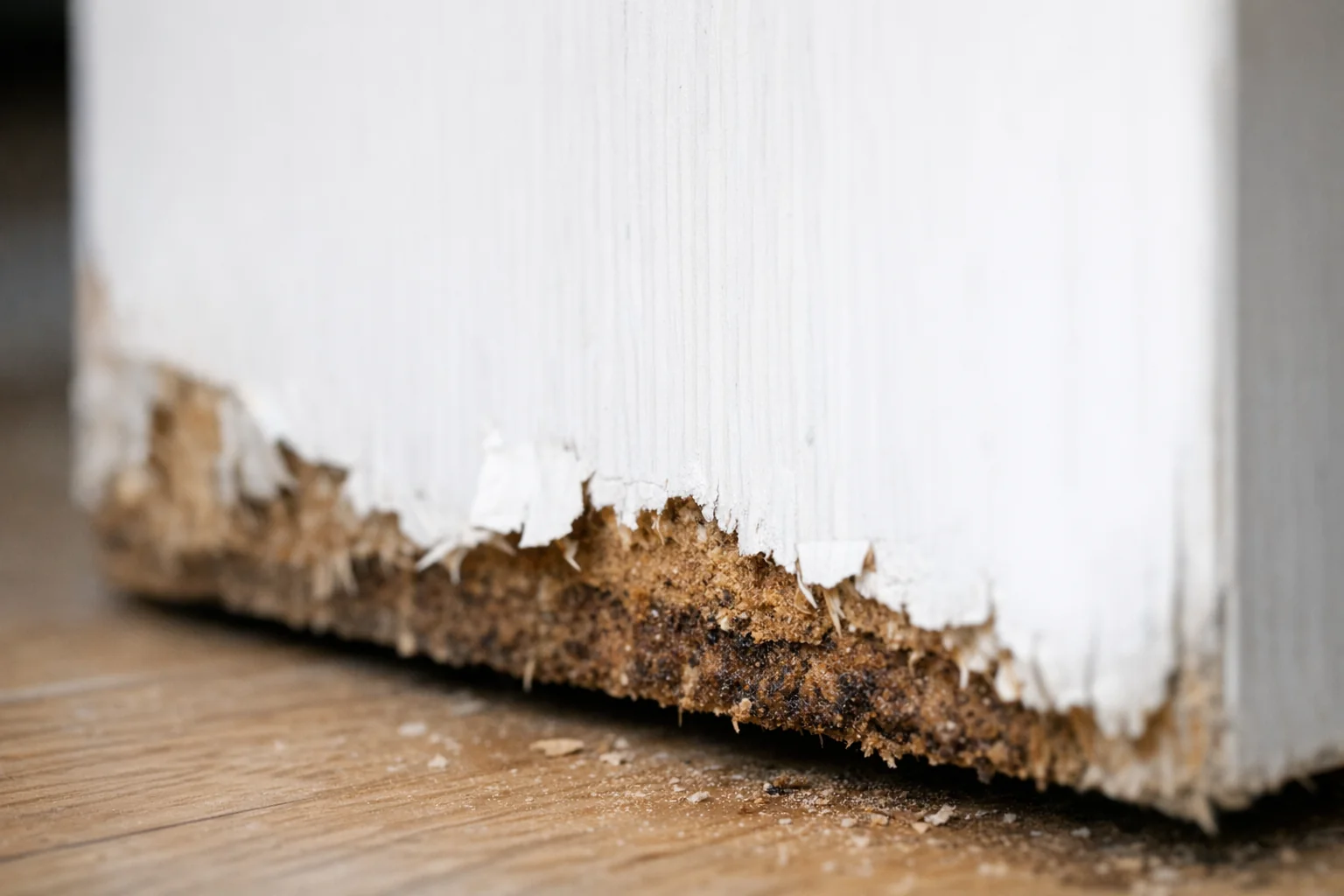
Trimming looks simple — just cut a few millimetres off the bottom. But this is exactly where people make mistakes that can ruin the door completely:
- Cutting with a jigsaw and no guide. The cut ends up wavy, with chips all along the edge — the door looks as if someone hacked at it with an axe. A circular saw with a guide rail, or at least a straight batten clamped in place, is a must.
- Not accounting for an uneven floor. One measurement is taken in one spot, but the floor has a 3-5 mm variation. The result: the door rubs on one side and leaves a gap on the other.
- Cutting off too much. A big margin “just in case” turns into a gap wide enough for two fingers, letting in draughts and giving a full view of the hallway. You can’t stick those millimetres back on.
- Not finishing the cut edge. This is especially serious with MDF doors: the exposed section soaks up moisture, especially in a bathroom. Within six months the edge swells and the laminate starts lifting.
- Trimming a hollow-core door too deep. Cheap laminated doors have a cardboard honeycomb inside. Remove more than 15-20 mm and you cut into the empty section. You need to know the door build before starting.
- Not removing the door from the hinges. Trying to cut it while it is still hanging upright. The outcome — a crooked line, chips and a damaged floor.
- Forgetting about architraves and seals. After trimming, the gap at the bottom gets bigger and the old seal may stop doing its job. This should be thought through before the cut is made.
What to prepare before the technician arrives
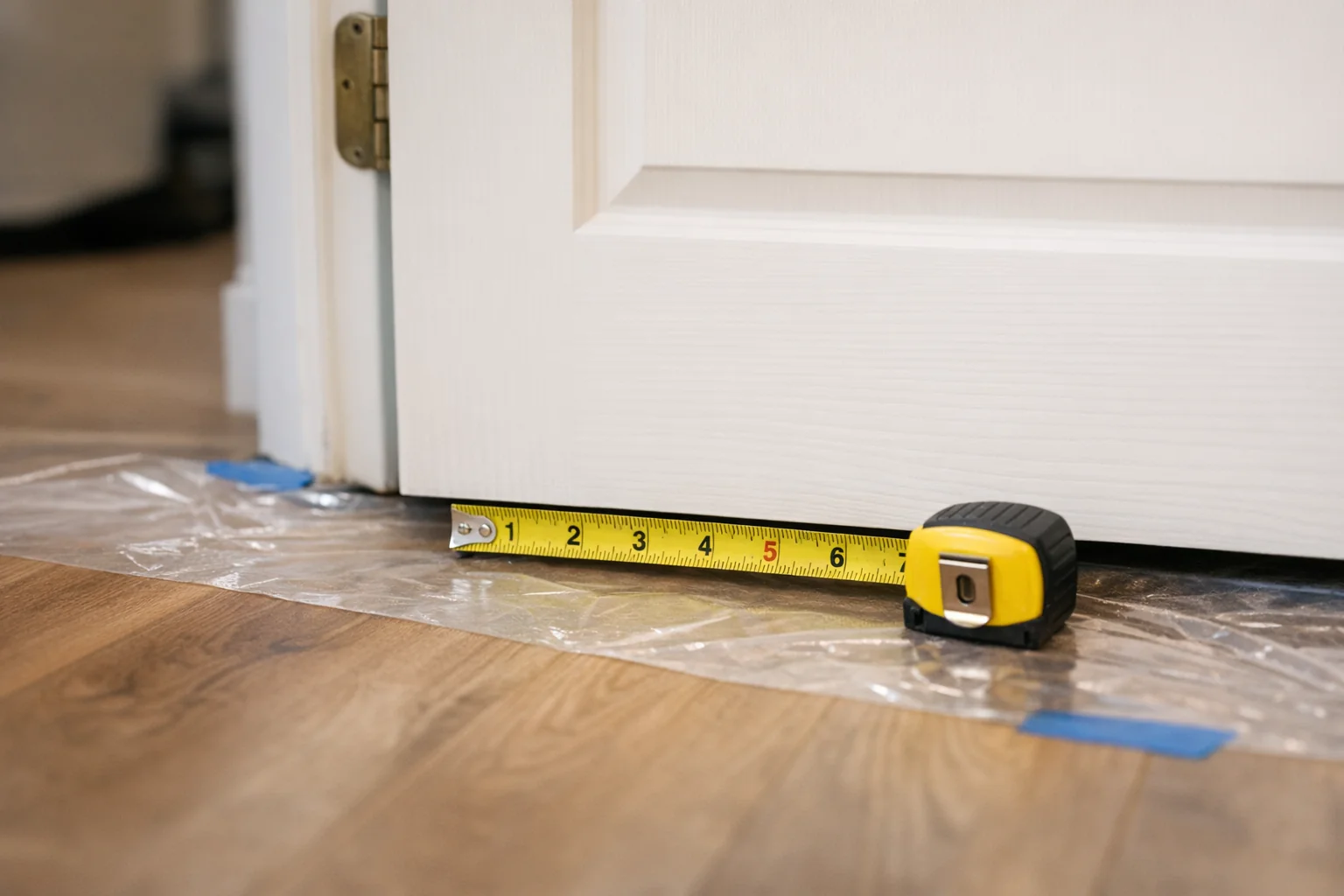
Trimming is fast work, but it makes dust. Here’s what to sort out beforehand:
- Work out which doors actually need trimming. Not every door starts rubbing after new flooring — check them one by one.
- Make sure the new floor covering is already installed and fixed in place. Trimming by estimate for a floor that is not down yet is asking for trouble.
- Clear the space around the doors — at least a metre on each side so the trestles can fit.
- Cover the floor in the work area with plastic or cardboard — there will be fine sawdust.
- Have a power socket within 5 metres of the door for the power tools.
- If the doors are hollow-core (budget laminated), let the technician know in advance — it affects how much can safely be cut off.
- Confirm whether the cut edge needs finishing after trimming (for bathrooms this is essential).
- If the doors are expensive (solid wood, veneer), agree the trimming method with the technician before the visit.
- Provide the entry code and floor number — especially if the technician is coming for the first time.
- Think about whether you also want hinge adjustment, lubrication or a lock replacement. It can all be done in the same visit.
A real case: trimming five doors after laying laminate in Wola
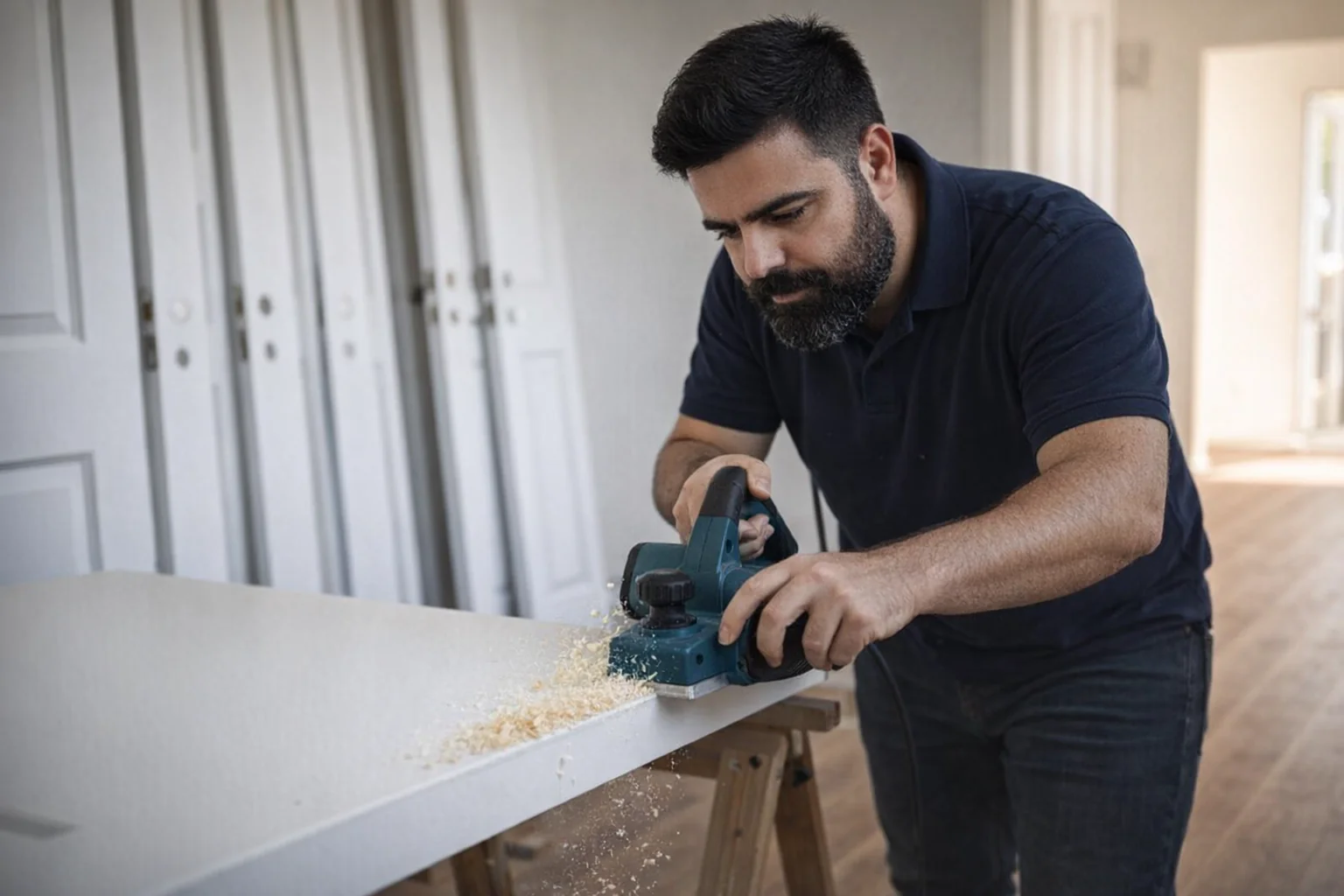
A client in Wola had installed 12 mm laminate with a 3 mm underlay across the whole flat. Five interior doors stopped closing — the leaves were pushing against the new floor. Three were hollow-core laminated doors, and two were veneered with a timber frame. The laminated doors were trimmed by 12 mm each — exactly the amount added by the new floor. On one of them, the cut came very close to the internal void, so we glued a timber strip into the edge and sanded it flush. The veneered doors were shortened by 14 mm — the kitchen floor sat a little higher because of a threshold strip. The edges were stained to match the veneer and sealed with varnish.
The whole job took around two and a half hours for five doors. The client also asked us to lubricate the hinges on all the doors — after six months without maintenance they had started squeaking. The lesson is simple: book trimming right after the floor goes down, while the technician is already there. It comes out cheaper and quicker than arranging a separate visit later.
Who does the work and what guarantees we offer
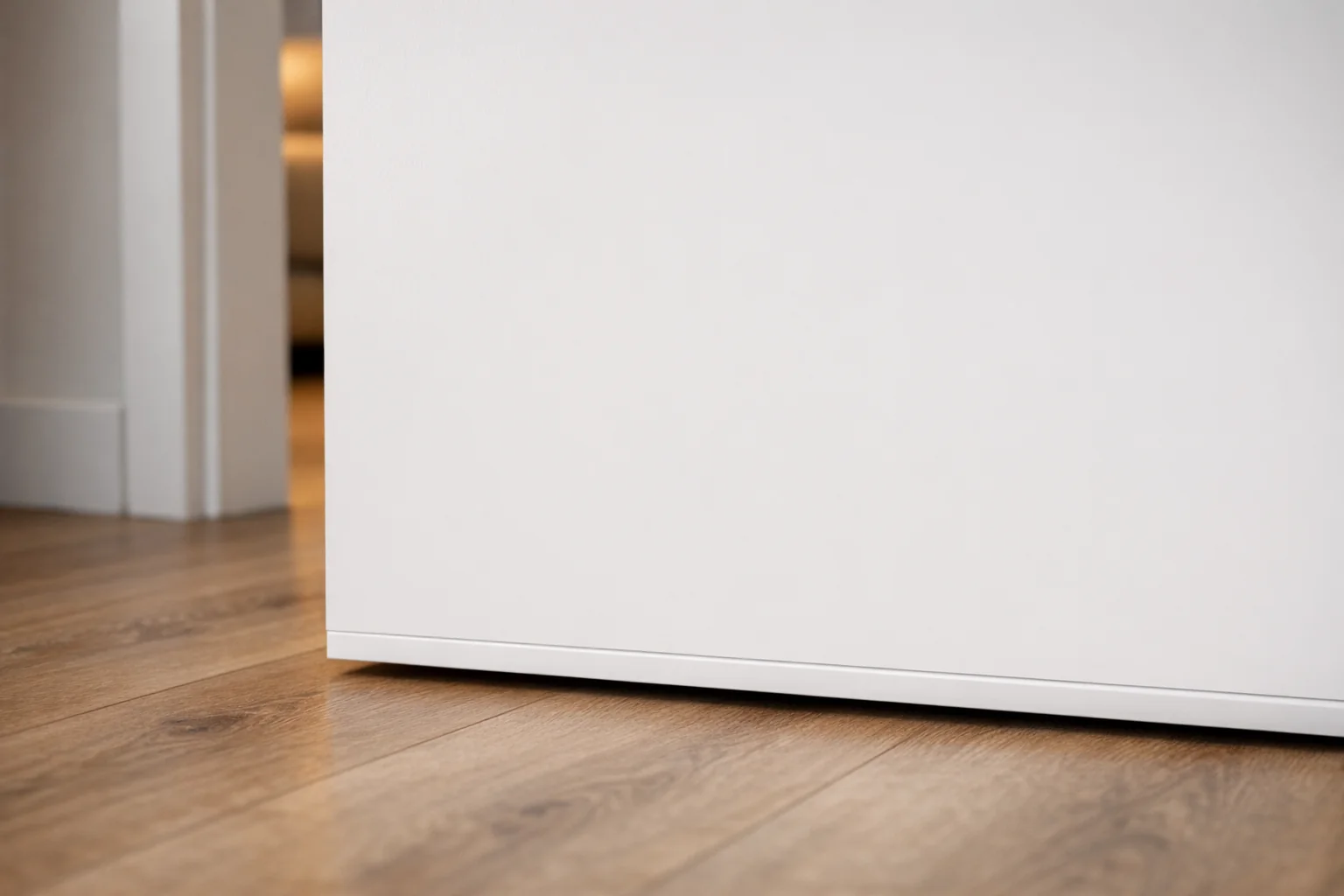
Door trimming is done by tradespeople with hands-on joinery and finishing experience — people who handle doors of all constructions and materials every day. We arrive with a full set of tools: plunge saw with guide rail, electric planer, sander and edging materials. We cover all of Warsaw and the surrounding area. You can expect a clean, straight cut without chipping and proper finishing of the edge. If the door still rubs after trimming or the edge has been finished badly, we fix it at our own cost. Call or message us — we usually reply within an hour and come at a time that suits you.