What the price depends on
There’s no set rate for a walk-in wardrobe; it’s quoted individually, based on measurements and your wish list. Size, the carcass and door material, the type of doors (hinged, sliding or none at all) and the interior all count. Drawers, a pull-down rail for the top level, shoe baskets, lighting: each one adds hardware and time. Soft-close drawers cost more than plain ones.
| Service | Price |
|---|---|
| Custom walk-in wardrobe | Individual quote |
Indicative prices. Ranges for a typical scope. Fixings included, materials separate. Minimum order 300 zł.
The offer usually lists materials (board, edging, profiles, sliding doors, hardware) separately from labour: cutting, assembly, fitting. Fixings are normally part of the fitting. Delivery of parts, carrying them upstairs and taking away offcuts and packaging are paid separately, so agree on that up front.
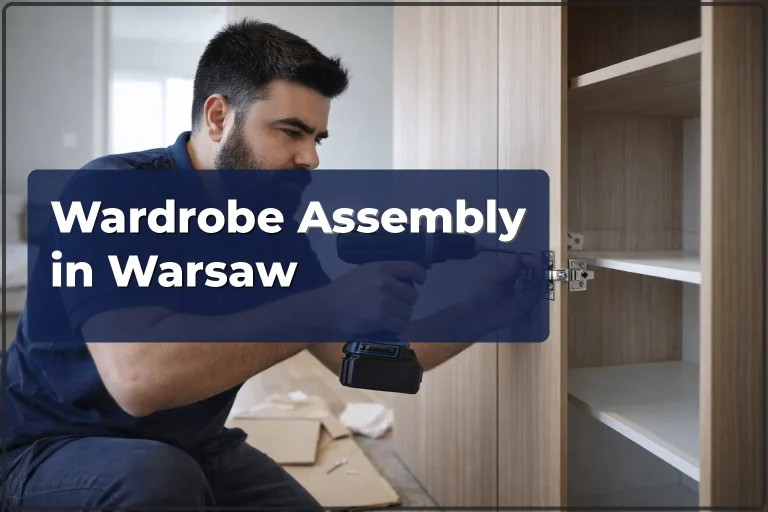
What it costs and how to book: wardrobe assembly in Warsaw.
Types of walk-in wardrobe
Carcass-built, from laminated board: sides, shelves and dividers cut exactly to size. It’s the usual choice for both an alcove and a separate room. It takes plenty of weight, and the inside can be laid out almost any way you like.
A rail system has no carcass at all. Vertical rails are screwed to the wall and shelves, hanging rails and baskets hook onto them, so you can move them around later. It works well in a box room that doesn’t need doors. The one condition is a wall that can take the load. On plasterboard without backing it will start to sag.
Sliding doors save space in front of the wardrobe because they don’t swing out, but half of it is always covered. Hinged doors open a whole section at once and need clear floor in front. In a separate dressing room the sections often have no doors at all.
Lighting is usually LED strip with a power supply that plugs into a socket. If power has to come from the wiring, or you want a new socket or switch, that’s a job for an electrician, with the circuit switched off while it’s done. The power supply gets warm, so it shouldn’t be wedged between clothes.
How the job goes
- The alcove or room is measured at several points. Walls and ceilings in flats are rarely true, and a couple of centimetres changes the cutting list.
- A talk about the interior: what hangs, what lies flat, how many shoes, whether you need a tall rail for coats and long dresses.
- The handyman sends a sketch with section sizes and agrees the materials with you.
- Board is ordered cut to size and edged. That takes time; the timing is in the offer.
- On site the carcass is levelled, fixed to the wall, doors hung and hardware adjusted.
- Last comes a check: drawers and doors run smoothly, gaps are even, nothing catches on the skirting or ceiling.
Common mistakes
- Hanging space built to shelf depth, so the hangers press against the doors.
- Shoes and suitcases remembered after assembly, with no room left for them.
- The bottom track of a sliding door laid on an uneven floor, so the door rolls open by itself.
- Top shelves run up to the ceiling without a pull-down rail. Nobody can reach them.
- The wardrobe now covers a socket or an air vent.
- A heavy carcass fixed to plasterboard with ordinary plugs.
What to prepare
- Photos and rough dimensions of the alcove or room: width, height, depth, plus the corners and ceiling.
- A list of what will go in. Rough is fine: how many coats, shirts, pairs of shoes.
- If you know where cables and pipes run, mark them. It’s still worth checking the wall with a detector before drilling.
- A few examples you like. Screenshots from the internet will do.
- On fitting day, a cleared room and a free path for long panels.
Frequently asked questions
Do I need a separate wardrobe design?
For an alcove with a standard interior, a furniture maker will often draw the sketch themselves. A separate design is worth it when the wardrobe fills a whole oddly shaped room, or when you want several handymen to quote on the same drawings. That’s a separate service.
How long until the wardrobe is ready?
Cutting the board and getting the hardware usually take the longest. Assembly on site is quicker, and the handyman gives exact timing in the offer.
Can I have one built in a rented flat?
Yes, if the landlord agrees to fixings in the wall. A carcass wardrobe can be taken apart and moved later, though it will need rework to fit different dimensions.
Which is more practical: sliding or hinged doors?
It depends on the space in front. In a narrow hallway, sliding doors win. In a bedroom with room in front of the wardrobe, hinged doors are handier: open one and you see the whole section.
How to order
Describe in the app where the wardrobe will go, add photos and dimensions and say what you want to keep in it. Tradespeople near you will send offers with their own price and lead time. Compare them by reviews and pick one; only that person sees your address.
You pay the handyman directly and they issue the invoice. They stand behind their own assembly and fitting and will adjust a door that’s hanging crooked or a drawer that sticks. Crooked walls, a weak substrate and other people’s work are not on them.
Build made-to-measure wardrobes? Create a profile and get jobs in your own town. You work for yourself and choose how your business is set up. Create a tradesperson profile
Order in the app
Describe the job, add photos and the address. Tradespeople send their own prices and dates, and you pick one of the offers.
Open the app