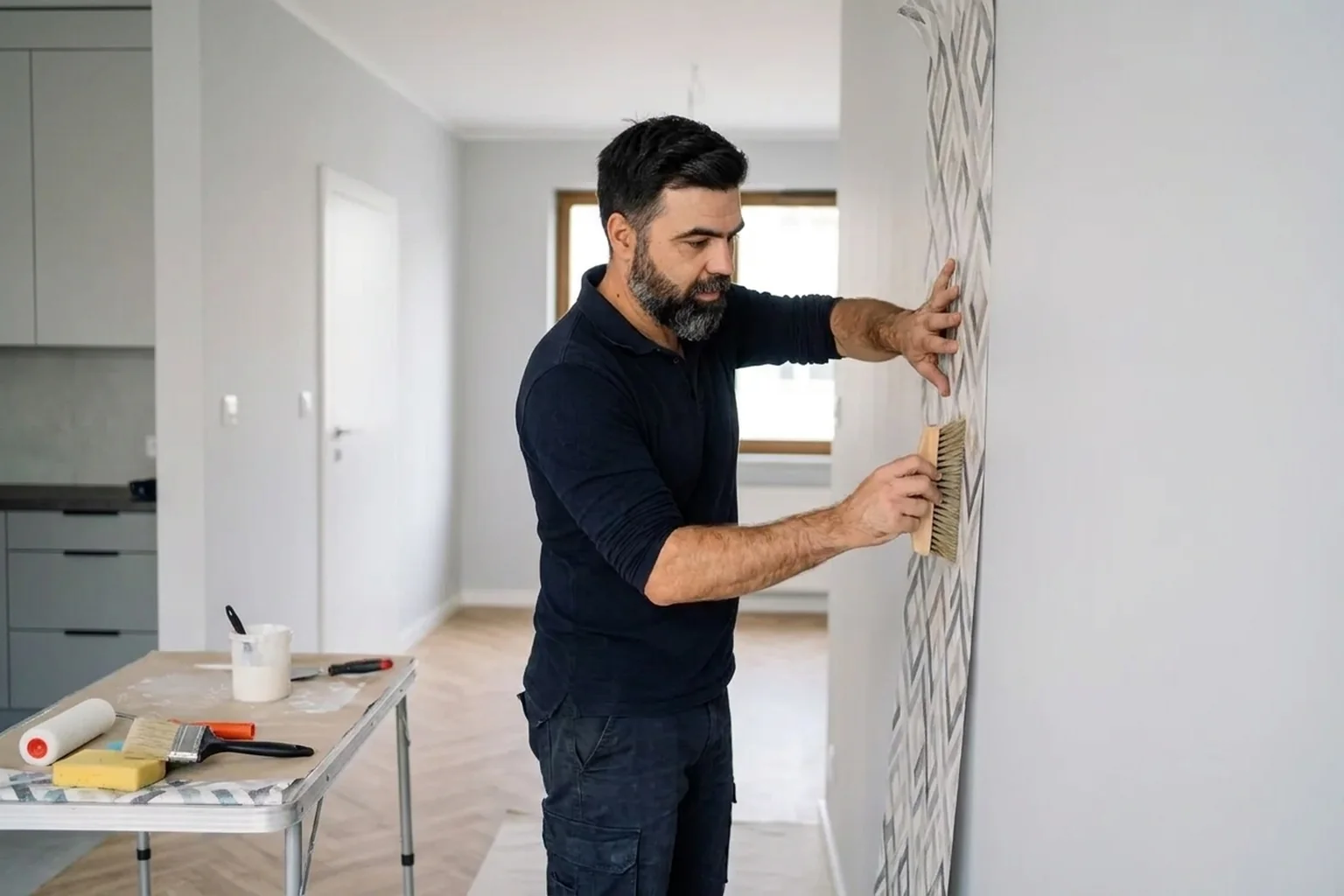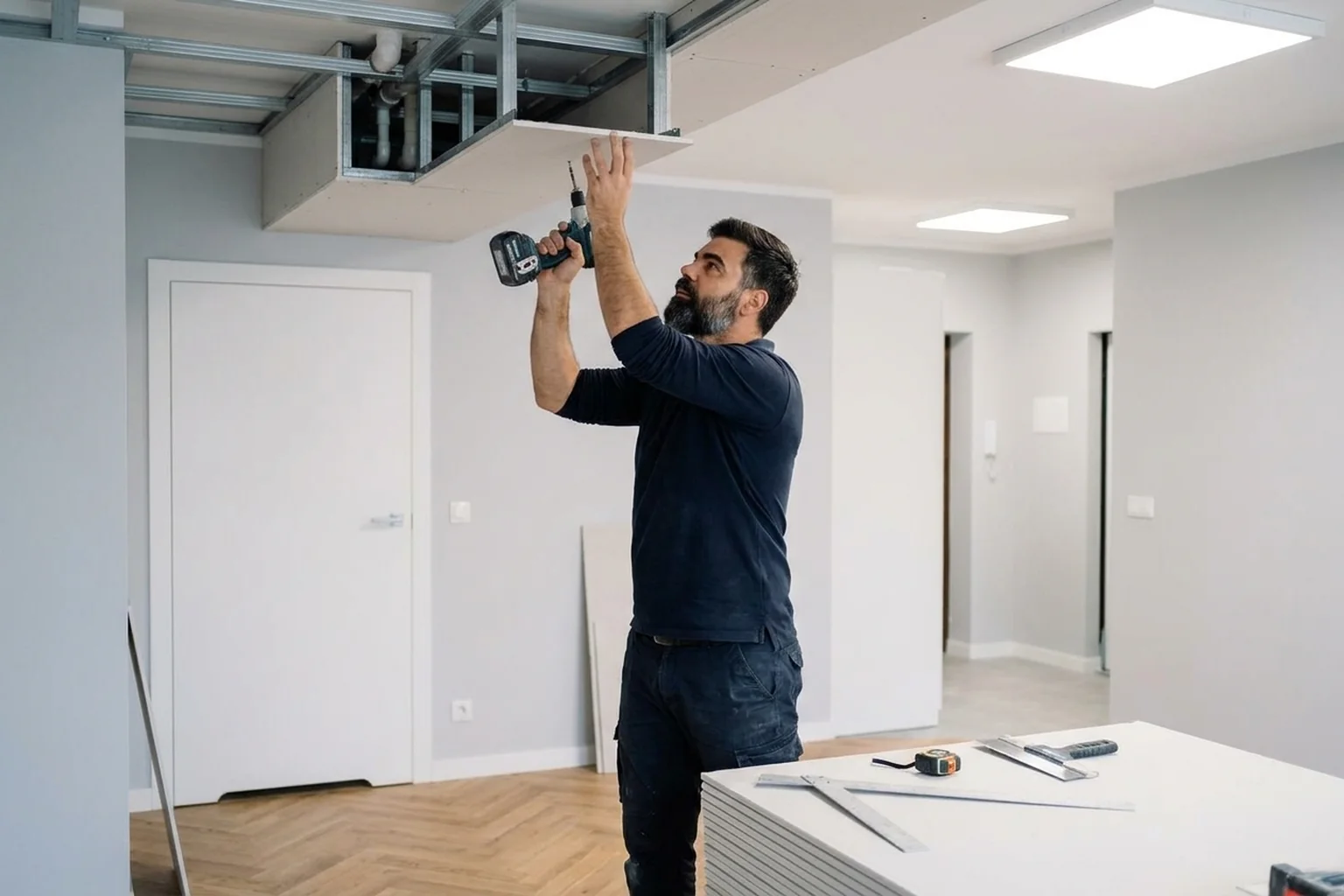

Here: what plasterboard installation costs, when boards are bonded with adhesive and when they go on a frame, which boards suit a bathroom and where cracks most often appear.
How much does plasterboard installation cost?
Fitters’ rates are in the table. Most work is priced per square metre, while boxing in a stack or WC frame is priced per item. The price depends on the method (adhesive or frame), room height, number of corners and reveals, insulation inside and whether the fitter also tapes and fills the joints.
| Service | Price |
|---|---|
| Plasterboard dot-and-dab wall levelling | 65–85 zł/m² |
| Wall cladding with drywall on frame | 90–170 zł/m² |
| Suspended drywall ceiling | 170–250 zł/m² |
| Boxing in pipes and risers with drywall | 70–180 zł/mb |
| WC frame boxing-in | 370–480 zł/szt |
| Attic plasterboard lining | 190–250 zł/m² |
| Filling and taping drywall joints | 18–45 zł/m² |
| Repairing a hole in drywall | 100–280 zł/szt |
Indicative prices. Ranges for a typical scope. Fixings included, materials separate. Minimum order 300 zł.
Screws and plugs are usually included in labour. Boards, studs, bonding adhesive, compounds, tape, insulation, an access panel, waste removal and carrying materials in are separate. Skimming the whole surface for painting is priced separately; see how gypsum skim coating works.
Plasterboard on adhesive or on a frame
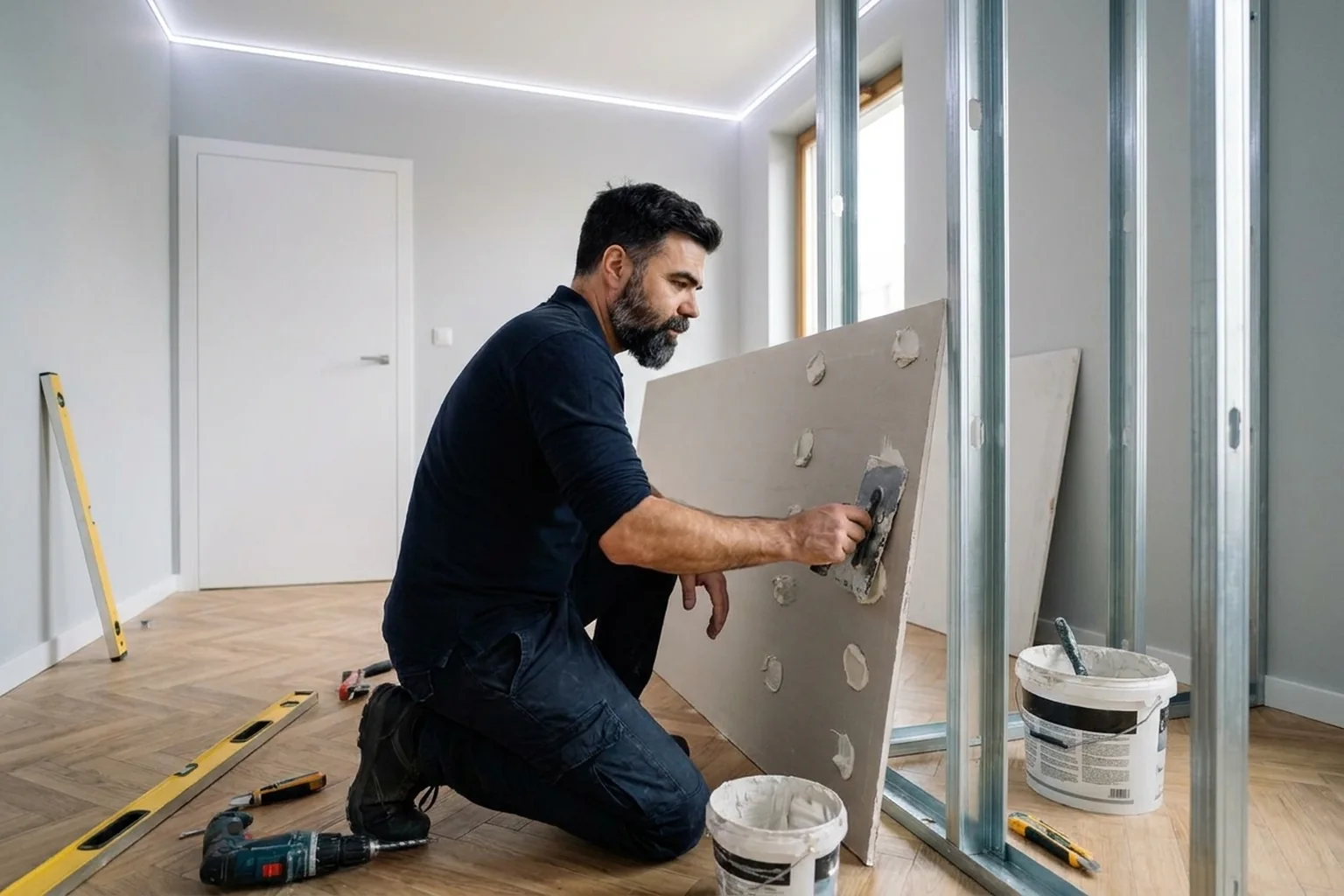
Dry lining means a board stuck to the wall on dabs of gypsum adhesive. It takes little space and goes up fast. It works when the wall is dry, sound and out of true by no more than the thickness of an adhesive dab.
A metal stud frame takes more centimetres but lets you hide cables inside and add insulation if there is a noisy neighbour behind the wall. It is the choice for badly crooked or dusty walls. A damp wall is a separate matter: fix the cause first, then think about boarding.
Window reveals and external corners are priced separately. Corners get a bead so they do not chip when furniture is moved. Say in the job how many windows there are, as that is a few hours of work.
Plasterboard does not always beat plaster. In a narrow hallway where every centimetre counts, and on a wall that takes knocks from a bike or pushchair, traditional plaster can be the better call. Many jobs end up as a mix.
Which plasterboard for a bathroom, kitchen or bedroom
The board type suits the room. Standard board is fine for living spaces, moisture-resistant board goes in bathrooms and kitchens, and fire-resistant board where the design or regulations call for it. Acoustic boards exist for walls that should let less sound through. The marking is on the board edge and the pack label.
Three systems dominate the market: Knauf, Rigips from the Saint-Gobain group and Siniat from the Etex group. Siniat is the former Nida Gips, the brand under which Lafarge boards used to be sold. Fitters prefer one system from start to finish, because boards, studs, screws and compounds from one maker are designed to work together.
Boxing in pipes, stacks and WC frames with plasterboard
A bathroom stack is boxed in with a stud frame. The key part is an access panel at the valves and rodding eye. Without one, the first leak means breaking open the new boxing together with the tiles.
Boarding a concealed WC frame means moisture-resistant board screwed rigidly to the frame. Tiles on a board that flexes crack the first time someone leans on the wall. In the shower zone, walls and corners also get tanking. More about the frame and pan itself in wall-hung toilet installation.
Suspended ceilings and loft boarding
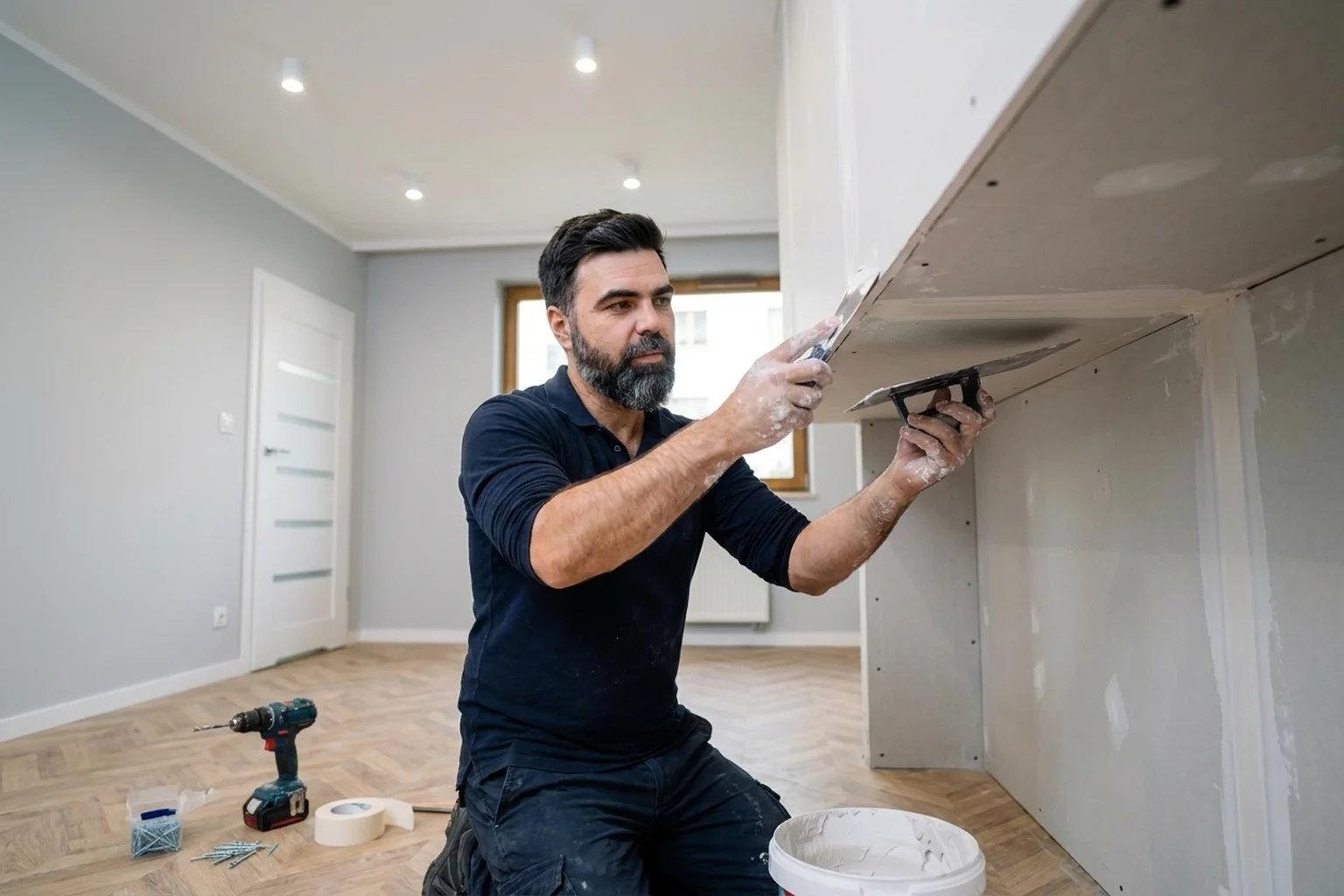
A suspended ceiling hangs on hangers and has to be levelled across the whole area. Dropping it a few centimetres hides cables for LED downlights and evens out a crooked slab. Light positions are decided before the ceiling is closed. Board joints on a ceiling should be staggered, or a single long crack will run across the room.
If the ceiling is meant to hide a water stain, find and fix the leak first: plasterboard will not stop it. When levelling and painting are enough without dropping the ceiling, see how ceiling repair is done.
In a loft the frame hangs from the rafters. Insulation must fill the space without gaps, and a vapour control layer goes on the room side with its overlaps taped. Without it, moisture condenses under the roof and a stain appears on the board even though the roof is sound. Roof window reveals are formed with a vertical bottom and horizontal top so warm air washes over the glass.
Taping and filling plasterboard joints so nothing cracks
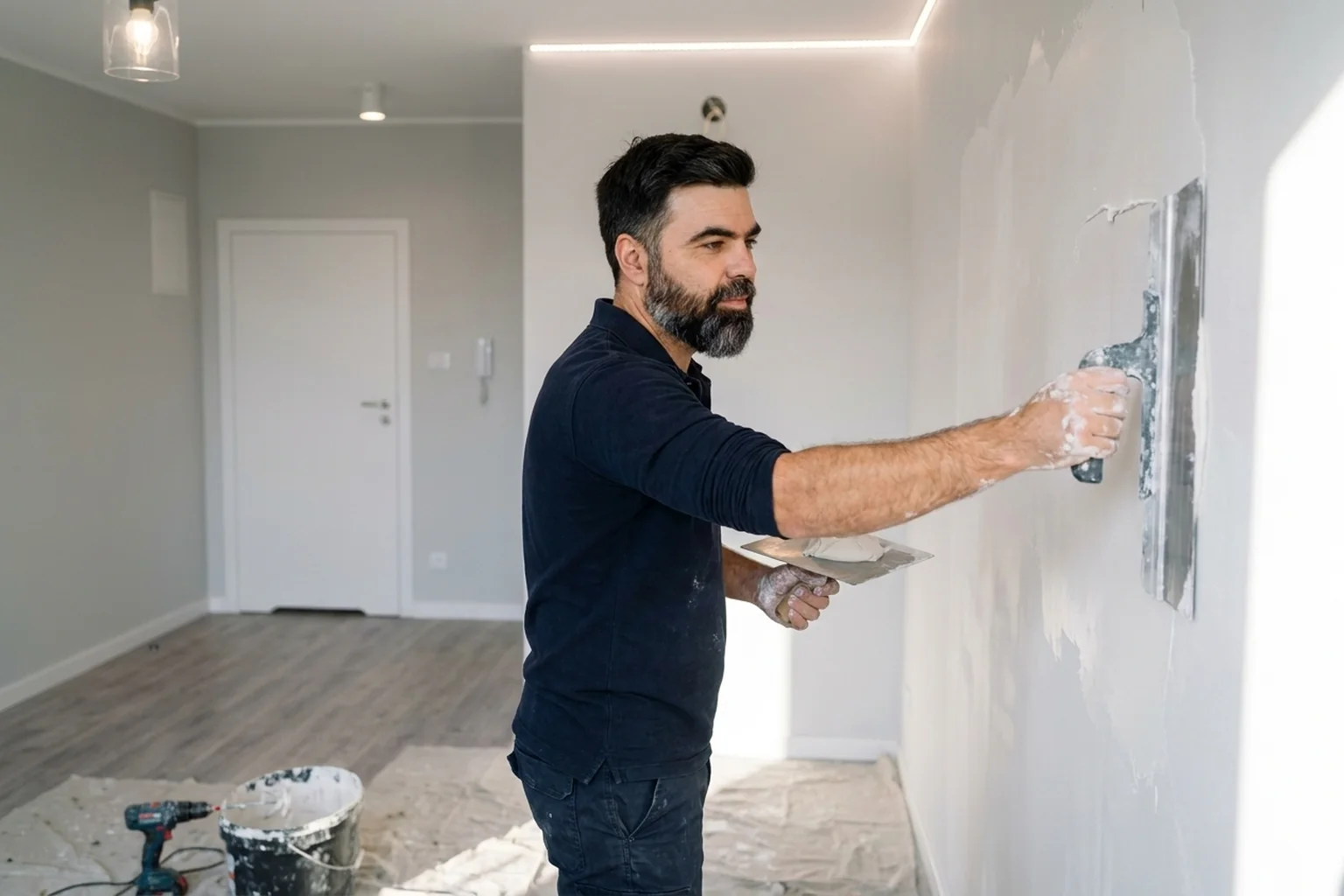
Hanging the boards is half the job. The other half is the joints: compound in the joint, reinforcing tape, another coat once dry. Compound alone cannot take the board’s movement, and after a heating season a crack appears on the joint.
A gap is left at the floor and ceiling because buildings move. In a loft, the corner between slope and wall is finished so it can move slightly instead of being filled rigid. Joints are not filled in a cold, damp flat, where compound dries unevenly and shrinks.
Common plasterboard installation mistakes
- Joints without tape. The crack comes back after the first winter.
- Ceiling board joints in one line. The crack runs across the whole room.
- Standard board in a bathroom. The paper face takes on moisture and bulges.
- Screws driven too deep. Torn paper no longer holds the board.
- Dry lining on a damp wall, or adhesive in sparse dabs. The board sounds hollow and comes away.
- Stack boxing with no access panel. A valve failure means breaking everything open.
- Ceiling hangers spaced too far apart. The board waves over time.
- No noggins where cabinets will hang. A plug in the board alone will not take the weight.
- A torn or untaped vapour control layer in a loft. Stains and wet insulation.
Preparing for the job
- Decide where sockets, lights and heavy cabinets go. Cabinets need noggins in the frame.
- Cables in walls or ceilings are run by an electrician before boarding, with the power off.
- Check the walls are dry. Fresh plaster and screed need time.
- Photograph the walls with a level or straightedge held against them; it shows at once how far out they are.
- For stack boxing, photograph the valves and where the access panel should be.
- Clear the room. Cutting and sanding gypsum spreads dust everywhere.
Want to split a room in two? A separate article explains what a plasterboard partition wall costs and what makes it quiet.
Example: an old tenement in Ochota
The bedroom wall bulges in the middle, and the ceiling after a leak from upstairs is only fit to be covered. The owner adds photos with a straightedge against the wall and notes that the neighbour’s leak has been fixed. The fitter proposes a framed wall, since the bow is bigger than an adhesive dab, and a suspended ceiling with room for downlights. A crack six months later almost always starts at the frame or the joints, so those are what gets checked at handover.
Frequently asked questions
How much does plasterboard installation cost per m²?
Current rates are in the table above. The price per metre depends on the method (adhesive or frame), height, number of corners and reveals, and whether jointing and skimming are included.
Plasterboard on adhesive or on a frame?
Adhesive when the wall is dry, sound and only moderately out of true. A frame when it is badly crooked or when cables or acoustic insulation need to go inside.
Can plasterboard be used in a bathroom?
Yes, moisture-resistant board. In the shower zone and around the bath, tanking goes under the tiles. Standard board in a bathroom soon takes on moisture.
Will plasterboard hold a cabinet or a TV?
Yes, if the frame has a noggin at that spot and the bracket is fixed with plasterboard plugs. Positions for heavy items are marked before the wall is closed.
Does boxing round a stack need an access panel?
Yes, at valves, the water meter and the rodding eye. Without one, any failure means taking the boxing apart along with the tiles.
Does plasterboard need skimming all over?
For paint, usually yes, because side light shows every joint and screw head. For tiles, taped joints and primer are enough.
How to book plasterboard installation in the app
Upload photos, dimensions and a description to the app: wall or ceiling, room or bathroom, stack boxing, WC frame or loft. You can ask about both methods, adhesive and frame, in the description. Fitters send offers with their own price and date, and you choose by price, ratings and reviews. Only the chosen fitter gets your contact details and address.
You pay the fitter directly and they issue the invoice. The fitter is responsible for their own work and fixes cracks on their own joints. Movement of an old building, damp in the masonry and leaks from neighbours are not their responsibility. For a larger renovation, see interior finishing in Warsaw.
Order in the app
Describe the job, add photos and the address. Tradespeople send their own prices and dates, and you pick one of the offers.
Open the app