
You can usually cut this story off before you even unpack the drill. If it has already happened, take it one step at a time: a calm reminder, a written demand, and court only at the very end. Below I go through each stage and where the app’s role stops.
Before you start: scope and price in writing

Arguments about money rarely start with bad faith. More often the two sides simply understood the price differently. You priced the fitting; the client assumed it included taking away the old cabinet and the sealant. A verbal agreement is still an agreement, but in a dispute it’s your word against his.
You don’t need a three-page contract. One message before the job, answered with “OK”, is enough:
- what exactly you’re doing, and what you’re not;
- the price: for the whole job, per hour or per metre;
- materials: who buys them and how you settle up;
- what is charged separately, such as rubble removal or carrying materials upstairs;
- when and how the client pays: cash, card or bank transfer, on completion or in stages.
On a bigger job with expensive materials, ask for a deposit to cover them, or let the client buy them himself. Paying out of your own pocket because “he’ll pay me back” is an easy way to lose twice: on the labour and on the materials.
Photos and sign-off: evidence you collect along the way
A “before” photo is not a formality. It shows the crooked wall, the cracked tile and the old pipe before anyone starts claiming it was your doing. The “after” photo shows the work is finished and what it looks like. Take both from the same spot, in good light, one wide and one close-up.
At the end, ask the client to look at the result while you’re still there and confirm he’s happy with it. A short message like “checked it, all working” will do. If he has complaints, better to hear them now, with your tools next to you, than in two weeks as a reason not to pay.
Found extra work on site? Don’t do it on a handshake. Write down what’s being added and for how much, and wait for a yes in writing. It takes five minutes and saves a row when you settle up.
The money hasn’t come. What to do, step by step

- Send a calm reminder a day or two after the agreed date. Give the amount you agreed, the payment method and a new date. Often the client has simply forgotten.
- If the client disputes the amount, ask what exactly he objects to. Sometimes it’s a small fix to your own work, and doing it is quicker than arguing. The part nobody disputes he can pay straight away.
- Send a written payment demand (in Polish, wezwanie do zapłaty): who owes whom, for what work, how much, how to pay, by when, and what you’ll do if the money doesn’t arrive. Send it in a way that proves delivery, for example by registered letter with acknowledgement of receipt.
- If the client is willing to talk at all, consider mediation or another out-of-court route.
- Only then go to court.
The demand matters later too. A claim filed in a Polish court has to state whether the parties tried to settle the dispute out of court, and a demand you actually sent is the simplest proof that you did.
For straightforward money claims that don’t need witnesses heard, Poland has an electronic writ-of-payment procedure (EPU). You file the claim online at e-sad.gov.pl, and the court can issue a payment order (nakaz zapłaty). The debtor can file an objection (sprzeciw), in which case the case moves to an ordinary court. Fees, deadlines and procedural details change, so check them on the e-sąd website. And don’t leave it for years: claims have a limitation period.
To be straight with you: this is a general outline, not legal advice. If the amount matters to you or the client has his own version of events, talk to a lawyer before you file anything.
Mistakes that leave a tradesperson with nothing
- “We’ll sort it out later” instead of a price before you start. Later, everyone remembers a different figure.
- Extra work without a written yes. The client pays for what he ordered and calls the rest your idea.
- No “before” photo. Suddenly the old scratch on the tile is your scratch.
- Materials bought with your own money and nothing written down about what and for how much.
- Months of waiting without a single letter. The longer it drags, the harder it gets to recover anything.
- Losing your temper: threats in messages, threatening a bad review, ripping out the work you did. That is how a creditor turns into the one who caused damage.
The last one hurts most because it comes from emotion, and being left unpaid makes anyone angry. Still, a calm, factual letter gets further than a phone call at ten at night.
How it works on HandyMan24
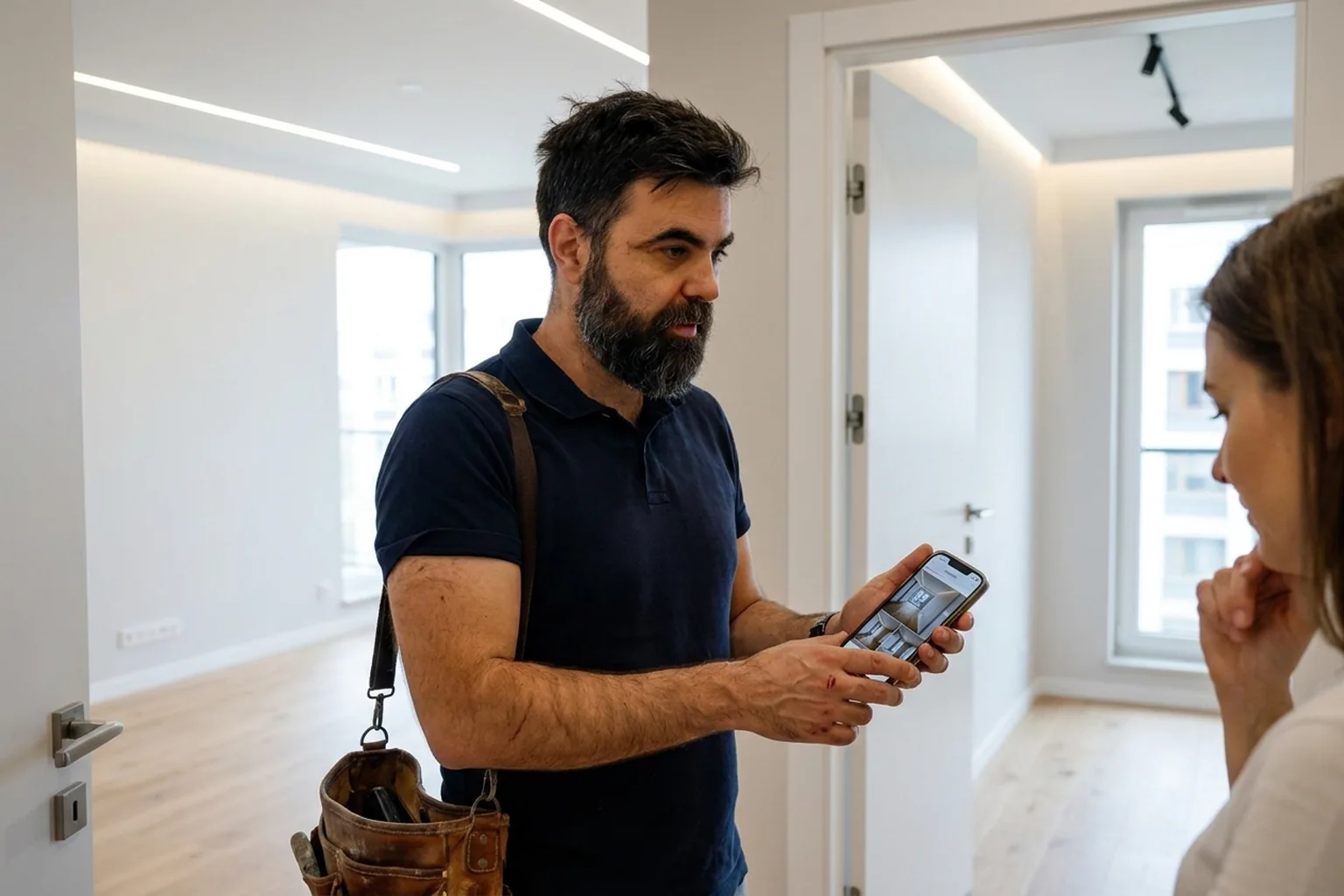
The client posts a job and you send an offer with your own price and a note on what it includes. The scope and the amount are recorded in the app before the client picks you. If there’s more work on site, you propose a change of scope in the platform. Without the client’s consent the price stays the same, so there are no verbal add-ons.
Messages in the platform can’t be edited or deleted, so they stand as evidence for both sides. You take the “before” and “after” photos in the app. At the end the client confirms the job is done and leaves a review. All of that comes in handy if you ever have to write a payment demand.
Now the part that needs saying plainly. The client pays you directly, in cash or by card, and the money for the work never passes through the platform. HandyMan24 does not collect debts and is not a party to your settlement. Either side can open a dispute, which a platform staff member reviews based on the messages and photos. That decision covers the status of the deal and your commission, not who owes whom money. If the client still won’t pay, you’re back to the route described above.
Signing up and sending offers is free; commission is only charged once a client chooses you. You can read how the whole thing works on the jobs for professionals page. You talk to clients in Polish, and the app also comes in English, Ukrainian and Russian.
Common questions
Does a verbal agreement count?
Yes, but it’s hard to prove in a dispute. That’s why it’s worth confirming scope and price with at least one message before you start.
Do I have to send a payment demand before going to court?
The claim has to say whether you tried to settle out of court. A demand sent with acknowledgement of receipt is the simplest proof of that.
What is EPU?
The electronic writ-of-payment procedure: you file a money claim online at e-sad.gov.pl. It suits straightforward payment cases. Check current fees and deadlines on that site.
Will HandyMan24 get my money back?
No. The client pays you directly and the platform doesn’t collect debts. In a dispute it decides on the deal and the commission, not on the debt.
Can I pressure the client with a bad review?
No. Making sign-off or payment depend on a review is against the platform rules. A review describes the job; it is not a lever.
Want jobs where the scope, price and photos are on record from the first message? Sign up as a tradesperson. It won’t protect you from every difficult client, but if a dispute comes up, you’re not starting from zero.